Monday, March 25, 2013

Information Whist

A bookseller once asked me an odd question. Knowing of my interest in books on the game of whist and knowing that whist had pretty much died out, he asked what was my newest book on the game. The answer is a small pamphlet called Information Whist, published in my home town of San Francisco.

Sloan, Information Whist
Levy [0156]

The work is an eight-page pamphlet with stiff covers and text printed on the inside rear cover as a ninth page. The author is W. A Sloan and the book is published at 4024 Eighteenth Street, San Francisco, Calif. More information about the author and the address appears below. I wish there were a colophon telling who printed the book.


From everything I can tell, mine is the only surviving copy of this work. It's not listed in WorldCat or any of the catalogues of California libraries. None of the whist collectors I know seem to have a copy. I purchased it more than 20 years ago at a second hand book shop. It was tucked in the back of the most common whist book of all, a late reprint of Cavendish on Whist, first published in 1862, a work I discuss in the essay "The Successors to Hoyle (part 1)". The bookseller was delighted to let me have both for five dollars.

The title page contains a rather silly verse, foreshadowing the Rhyming Rules for Whist, discussed below:
All whist players for the prize aspire
And fight for all tricks that they require.
From this little book take your advice
Then your partner's sure to treat you nice.
In the pre-Google days, I went to the San Francisco Public Library and looked through old telephone books and city directories trying to identify the author and learn when the book was written. I found that his full name is Wolsey A. Sloan, and he moved to 18th Street about 1920 with his wife Lucy P. Sloan. He was employed as a boilermaker in the early 1920s and became a rent collector for the real estate firm of Umbsen, Kerner, and Eisert. He died in 1946 and Lucy lived at the same address until 1960. So the pamphlet dates between 1920 and 1946.

With Google, and his unusual first name, it is not hard to learn more about the Sloans. The site findagrave.com gives details for both Wolsey and Lucy. Wolsey was born December 4, 1861 in Ohio and died May 20, 1947 in Alameda, just across the Bay from San Francisco. Lucy was a California girl, born in July 21, 1860. She died in San Francisco on August 8, 1960. The two are buried together in the Golden Gate National Cemetery, sharing a gravestone with his details on one side and hers on the other.

Wolsey was an army private, serving in the Indian Wars of the late 19th century. His first person account of serving with Troop H, Fourth U. S. Cavalry, appeared in the July 30, 1935 issue of Winners of the West, a periodical issued by the National Indian War Veterans Association. It was reprinted in Indian War Veterans, Memories of Army Life and Campaigns in the West, 1864-1898, edited by Jerome A. Greene (New York: Savas Beatie, 2007).

The Chicago Blue Book of 1895 shows Wolsey and Lucy living together at 607 Chestnut Street, the same address as Mrs. C. E. Sloan, presumably his mother. A 1910 census shows him living in Washington State.

4024 Eighteenth Street is in the Castro District of San Francisco, just a block and a half from the famous Castro Theatre, built in 1922 just after the Sloans moved to 18th Street. Pictures of the duplex appear below. The Sloans would no doubt be shocked to learn that the property is worth seven figures today!

4024 18th Street duplex
Detail of 4024 18th Street


The pamphlet itself consolidates useful strategies for playing whist. What is most interesting, in my opinion, is the Rhyming Rules of Whist on pages 8-9, pictured below. The rhyme begins:
If you desire the game of Whist to know
From these set rules it simple precepts flow,
Treat your hand as to your partners bound.
Both combine as one, or both confound.
Sloan's Rhyming Rules
Levy [1296]

As awkward as the rhyme is, it is not original! Rhyming rules for whist date back to the British whist expert William Pole. He published his Rhyming Rules, printed on a card, entitled Pocket Precepts in 1864. Pole's rules, pictured below, begin quite similarly:

If you the modern game of Whist would know
From this great principle its precepts flow:
Treat your own hand as to your partner's joined,
And play, not one alone, but both combined.
Pole's Rhyming Rules for Whist

Sloan's debt to Pole is obvious, but what I find interesting are the few substantive changes. For example both recommend the same honor leads. For example, Pole: "In this, with ace and king, lead king then ace." Sloan: "Holding Ace and King lead King, then Ace." The two carry on similarly for leads from KQ, AQJ, Axxxx and QJT. Otherwise, Pole says, "In other cases, you the lowest lead" while Sloan says "In other cases the fourth best lead."

The change in partnership agreement from lowest to fourth best occurred in the 1870s was recommended by Nicolas Trist of New Orleans and Henry Jones ("Cavendish") of London. The changes came to be known as American Leads in honor of Mr. Trist and were widely adopted by serious whist players. Sloan, then, did more than just plagiarize Pole, he updated Pole's rhymes to current practice.

I've devoted this long entry to a late and rather unimportant book on whist. I do so first because its rarity might be of interest to other whist collectors. More than that, perhaps a grandchild of the Sloans will find this essay through Google and get in touch so that I can learn more about how it came to be written!

Tuesday, February 19, 2013

More on Rimington-Wilson's Chess Manuscript (part 2)

My posts on the Rimington-Wilson chess manuscript have proved quite popular. Its tangled provenance and the question of whether it was penned by Oliver Goldsmith, as was once thought, make an engaging biblio-mystery.

The story of the manuscript appears in two essays: "The J. W. Rimington-Wilson Library (part 1)" and "More on Rimington-Wilson's Chess Manuscript." I have received quite a few emails, primarily from members of the EXLIBRIS listserv, adding new color and detail. Let me summarize the story so far, with a bit more precision about chronology, and then add new material suggested by EXLIBRIS readers. The summary:
  1. Bolton Corney (1784-1870), a literary critic and antiquary, owned a manuscript translation of Vida's 1527 poem Scacchia Ludus (The Game of Chess) said to be in the hand of Oliver Goldsmith. Corney  wrote and edited a number of books, the most relevant of which is Goldsmith's Poetical Works, Illustrated, with a Memoir (1846). (ODNB). Corney's book does not contain the chess poem, although it mentions a fragmentary translation of another poem by Vida.

  2. The manuscript is described by John Forster in his Life of Goldsmith (1848) based on Forster's examination of the Corney copy. I quoted the description extensively in the last blog essay, noting that the description seemed a bit strained as to authenticity. One EXLIBRIS reader suggested that Forster was not concerned with authenticity, but whether the manuscript was "an original work by Goldsmith or a work which he merely transcribed." Rereading the passage, I find myself agreeing with the reader. In any case, it seems reasonable that Bolton acquired the manuscript after the work he edited in 1846, but before Forster wrote about his copy in 1848.

  3. In 1871, after Corney's death, chess collector J. W. Rimington-Wilson purchases the manuscript from the London bookseller F. S. Ellis. Rimington-Wilson dies in 1877. The chess collection, including the Vida manuscript, stays in the Rimington-Wilson family, passing to son Reginald Henry Rimington-Wilson. (1852-1927).

  4. In 1926,  Katharine C. Balderston writes A Census of the Manuscripts of Oliver Goldsmith attributing the Vida manuscript to Oliver Goldsmith. She is unable to trace the manuscript prior to the ownership of Bolton Corney.

  5. R. H. Rimington-Wilson dies in 1927 and his nephew, Captain H. E. Rimington-Wilson, orders the sale of the library by auction at Sotheby's in February 1928. The Vida manuscript is the most important lot in the sale, with a reproduction of the first page appearing on the cover of the catalogue. Two letters from Ellis to J. W. R-W relating to the sale of the manuscript are included with the lot.

  6. The London bookseller Maggs purchases the manuscript at the R-W sale for £5600. Maggs is acting on behalf of the Philadelphia book dealer Charles Sessler. 

  7. Sessler sells the book to composer Jermone Kern for $32,998.10. 

  8. The manuscript is offered at the legendary Kern auction at Anderson Galleries in January 1929. The New York Times reports that someone named Perkins purchased the lot for $27,000, but he returns  it to Kern, claiming that it was not in the hand of Oliver Goldsmith as claimed. 

  9. Kern attempts to return the manuscript to Sessler. Sessler refuses to return the money, claiming that the manuscript is in the hand of Goldsmith. Kern brings suit in the Federal District Court of Philadelphia for return of the the sale price. 
Now for two new bits of color, both relating to the Kern sale, from two EXLIBRIS readers. 

First, Travis McDade, Curator of Law Rare Books at the University of Illinois College of Law pointed me to a brief first person account of the Kern sale by Robert Coates called “Books at a Million” in the New Yorker of January 19, 1929:
A copy of Goldsmith's "Vida's Sacchis, or Chess," starting at ten thousand dollars as we prepared to go, had reached twenty-five thousand before we found our gloves. Only the experts know why some items sell for larger amounts than others. Rosenbach's [about whom more below] interest in a book or manuscript, however, usually sends it pretty high before it is sold. Thus he had to go to seventeen thousand five hundred for a thin, faded green volume written by Elizabeth Barrett Browning when she was eleven years old, a price three times as much as was paid for a first edition of Boswell's "Johnson," with autographed letters of both Johnson and Boswell thrown in. (page 9)
Second, Stephen Tabor, Curator of Early Printed Books at the Huntington Library, pointed me to Rosenbach, A Biography, by Edwin Wolf 2nd and John F. Fleming (1936). A. W. S. Rosenbach (1876-1952) was a flamboyant Philadelphia book dealer who helped develop the collections at the Huntington and the Folger and was a bookseller to J. P. Morgan. He was a major bidder at the Kern sale where prices reached "dizzy heights." While Rosenbach apparently did not bid on the Vida manuscript, the biography notes his involvement:
Goldsmith shared in the boom. Of course excepting the so-called autograph manuscript of a translation of Vida's Scacchis, or Chess. Sessler had bought it for Kern at the Rimington Wilson sale at Sotheby's a year earlier for almost $33,000, but at $27,000 Owen Young beat out Sessler for it. After the sale and a converstaion with the Doctor [that is, with Rosenbach] he returned it to Anderson's as "wrong." Dr. Rosenbach was convinced that it was not in Goldsmith's hand, and although Miss Balderston, the greatest Goldsmith expert, had nodded in its favor before the sale, she was convinced afterward that she had not studied it carefully enough. The manuscript was returned to Kern and in the middle thirties, he was still trying to get it reinstated as genuine. (pages 310-1)
It is unclear why the New York Times reports the purchaser as Perkins, while here the purchaser is said to be Owen Young. 

The Rosenbach biography is anecdotal rather than scholarly. As Wolf notes in the preface,
Some of the stories Dr. Rosenbach told about himself are included here to give a Rosenbachian flavor to the book. Like most folk tales they have been passed down from mouth to mouth and may have been altered in the telling, but like most folk tales they are revealing of the circumstances in which they were reputed to have taken place. (pages 7-8)
With that caveat, the biography indicates the indirect involvement of Balderston and Rosenbach at the Kern sale and shows the manuscript still in Kern's possession in the mid-1930s. Oddly, Kern who sued Sessler claiming the manuscript was not in Goldsmith's hand, was claiming it to be genuine in later years.

Many questions remain:
  • Where is the manuscript now?
  • What was the resolution of the litigation between Kern and Sessler? 
  • Is the manuscript in Goldsmith's hand?
I do think it will take research in Philadelphia to extend the story and answer the nagging questions.Until then, we can trace the manuscript from Bolton Corney in the 1840s to the collection of J. W. Rimington-Wilson and on to Jerome Kern as late as the mid-1930s. Can we add to this 90 year history?

Monday, February 11, 2013

More on Rimington-Wilson's Chess Manuscript

In the essay "The J. W. Rimington-Wilson Library (part 1)," I wrote about the February 1928 Sotheby's sale of the Rimington-Wilson chess library. The most interesting lot was a manuscript said to be in the hand of Oliver Goldsmith, a translation of Vida's 1527 poem Scacchia Ludus (The Game of Chess). The London bookseller Maggs purchased the lot for the astonishing sum of  £5600. 

I wondered where the manuscript was today and was interested in learning more generally about finding aids for 18th century manuscripts. I posted a query to the EXLIBRIS listserv, and members there helped me trace the manuscript for another year. In January 1929, the manuscript was sold in the major sale of the Jerome Kern collection at Anderson Galleries. The Vida manuscript sold for $27,000 (see American Book Prices Current, VOL. XXXV, available for download).

I recently had the pleasure of meeting Anthony Tedeschi, Rare Books Librarian at the Dunedin Public Libraries in New Zealand. Anthony writes a charming and recommended blog on rare books and special collections in Australasia—Antipodean Footnotes. Anthony pointed me to a June 17, 1930 headline in the New York Times that both added detail and intrigue to the manuscript's provenance. The headline read "NEW YORK COMPOSER SUES BOOK DEALER" and the sub-head continued "Jerome Kern Seeks Return of $32,998.10 Paid Philadelphian for Translation by Goldsmith." Intrigue indeed.

The text of the article highlights the path from Rimington-Wilson to Kern and beyond:
Jerome Kern of Bronxville, N. Y., composer of "Show Boat" and other musical plays, brought suit in the Federal court here today against Charles Sessler of Merion, well-known book dealer, asking for the return of $32,998.10, the purchase price of Oliver Goldsmith's translation of Vida's "Game of Chess."
Mr. Kern declares he bought the manuscript, which is composed of 679 lines of 34 pages, from Mr. Sessler on the latter's representation that it was in Goldsmith's handwriting. On Jan. 29, 1929, he contends, he learned that the handwriting was not Goldsmith's and says that the manuscript therefore is "of no value whatever." In his complaint the composer asserts that he has demanded the return of the money on several occasions, but that Mr. Sessler has refused to refund it. 
The Philadelphia dealer in February, 1928, purchased through an agent in London the purported manuscript of the translation at a reported price of $28,000 and sold it to Mr. Kern. Early last year the composer included it with the rest of his notable private collection of rare books and manuscripts which he placed on the auction block. The collection netted him almost $1,8000,000. 
The manuscript, which was catalogued at the sale as the longest poetical manuscript by Goldsmith known to exist, went for $27,000 to a bidder whose name was given out after the sale as Mr. Perkins. The bidding had opened at $10,000. 
Mr. Sessler said that the purchase of the manuscript at the auction returned it to Mr. Kern, but the Philadelphia dealer declared he personally still believed it was in Goldsmith's own handwriting.
So, it appears that Maggs was acting on behalf of Sessler at the Rimington-Wilson sale and Sessler sold the manuscript to Kern.

With the authenticity of the manuscript called into question, I returned to the Sotheby's catalogue for the Rimington-Wilson sale for their description and provenance:
THE LONGEST POETICAL MANUSCRIPT BY OLIVER GOLDSMITH KNOWN TO EXIST. Katherine C. Balderston in her Census (New York, 1926) records only three others; two copies of The Capitivity and the rejected Epilogue to She Stoops to Conquer. The manuscript now offered is longer than all these together it was formerly in the possession of Bolton Corney, and was described by Forster in his Life of Goldsmith, 1848, but remained unpublished in its entirety until 1855, when it was included in Peter Cunningham's edition of the Works. Corney died in 1870, and the manuscript was sold by Mr. F. S. Ellis to Mr. J. W. Rimington-Wilson in the following year. Miss Balderston was unable to trace its history beyond Bolton Corney. Two letters from Mr Ellis relating to its sale are included with the lot.
AUTOGRAPH MANUSCRIPTS OF OLIVER GOLDSMITH ARE OF EXTRAORDINARY RARITY. 
We can delve a bit deeper, looking at the description by Forster in his Life of Goldsmith:
[I shall describe] Vida's Game of Chess in the English heroic metre, as it has been found transcribed in the writing of Oliver Goldsmith by my friend Mr. Bolton Corney, whose property it is and who kindly permits my use of it.
It is a small quarto manuscript of thirty-four pages, containing 679 lines, to which a fly-leaf is appended, in which Goldsmith notes the differences of nomenclature between Vida's chessmen and our own. It has occasional interlineations and corrections, but rather such as would occur in transcription than in a first or original copy. Sometimes, indeed, choice appears to have been made (as at page 29) between two words equally suitable to the sense and verse, as "to" for "toward;" but the insertions and ensures refer almost wholly to words or lines accidentally omitted and replaced. The triplet is always carefully marked and though it is seldom found in any other of Goldsmith's poems, I am disposed to regard its frequent recurrence here as even helping in some degree to explain the motive which had led him to the trial of an experiment in rhyme comparatively new to him. If we suppose him, half-consciously it may be, taking up the manner of the great master of translation, Dryden, who was at all times so much a favourite with him, he would certainly be less apt to fall short in so marked a peculiarity than to err, perhaps, a little on the side of excess—though I am far from thinking such to be the result in the present instance. The effect of the whole translation is really very pleasing, and the mock heroic effect appears to be not a little assisted by the reiterated use of the triplet and  alexandrine. As to any evidences of authorship derivable from the appearance of the manuscript, it is only necessary to add another word. The lines in the translation have been carefully counted, and the number is marked in Goldsmith's hand at the dose of his transcription. Such a fact is of course only to be taken in aid of other proof; but a man is not generally at the pains of counting,—still less, I should say, in such a case as Goldsmith's, of elaborately transcribing,—lines which are not his own.
Forster is at pains, it seems to me, perhaps due to his friendship with Corney, to describe the manuscript as authentic. His comments about such details at the marking of triplets and the counting of lines are rather strained.

I am still hopeful of locating the manuscript.I have found no online information about the litigation between Kern and Sessler, nor are there digital copies of Philadelphia newspapers available from that time. So more digging is required. Anthony had some other suggestions for further research. He notes that the Sessler papers are held by the Historical Society of Pennsylvania in Philadelphia, with a finding aid for the archive online. There is a substantial Kern archive at the Library of Congress, although that appears to relate only to his music.

Next time I'm in Philadelphia....

A page from the manuscript


In the mean time, the Sotheby's catalogue of the Rimington-Wilson catalogue included a reproduction from the Vida manuscript, which I include here with the thought that someone may be expert in identifying Goldsmith's handwriting.


Monday, January 28, 2013

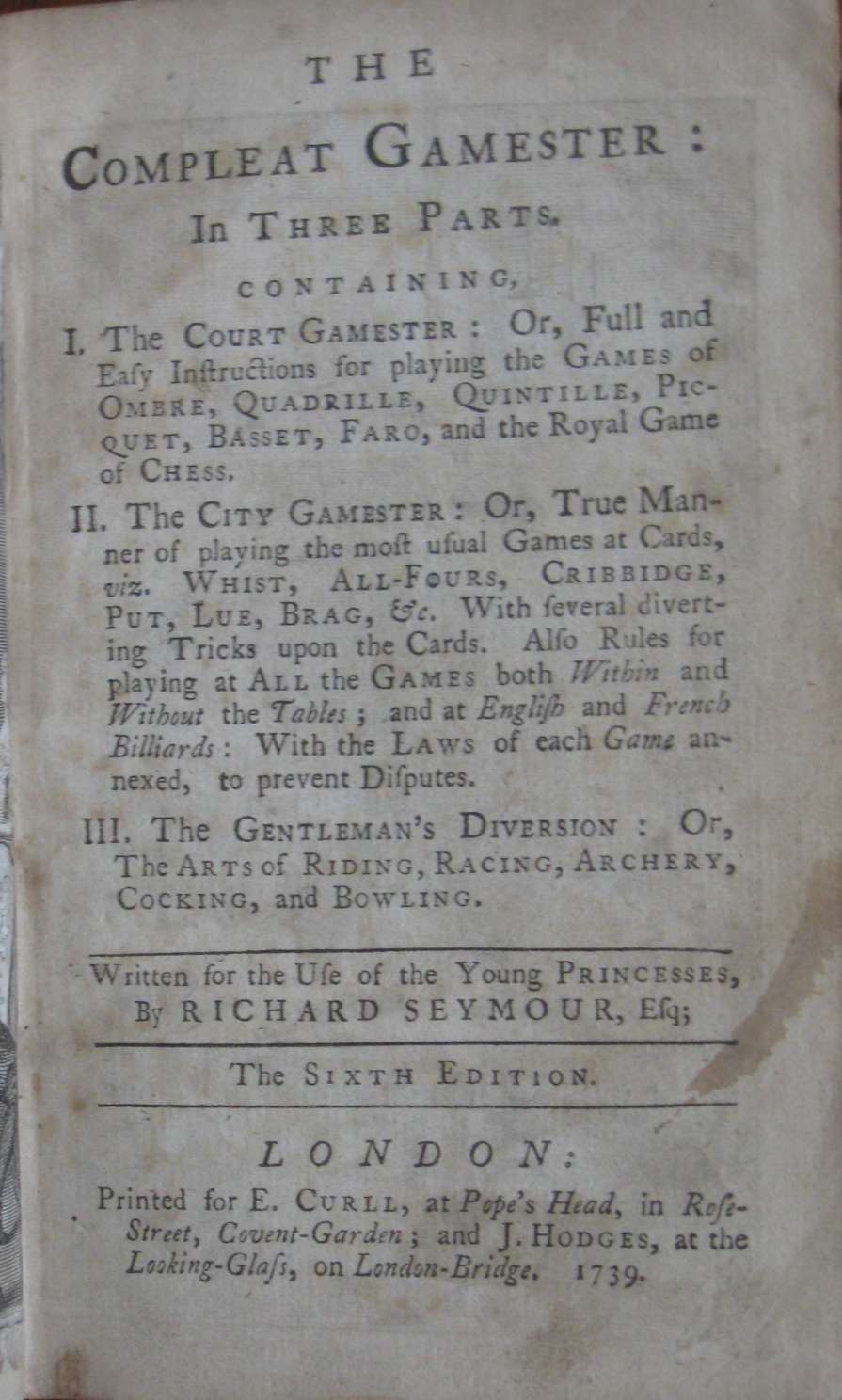
The Compleat Gamester

I have written about Charles Cotton's Compleat Gamester several times, most directly in the essay "The Predecessors of Hoyle." First published in 1674, it is valued as the first book in English devoted to gaming, and for its frontispiece showing early scenes of game-playing. One example of the frontispiece is reproduced in "Predecessors" and another appears below.

The book has received much attention from gaming bibliographers. Both Julian Marshall and Frederic Jessel discussed the work (see the essay "Where can I learn more about Hoyle's Writing?"). More recently Thomas Marston wrote a short descriptive bibliography as an introduction to a 1970 reprint of the Gamester. Despite the scholarly work, there are many errors in the bibliographical record due to changes in ownership of the copyright. The changes led to frequent reissues with a different imprint and, in two cases, with an entirely new title. This essay will attempt to provide a correct chronology and add bits and pieces about the book that I have come across in the course of my research.

The Compleat Gamester was entered in the Registry Book at Stationers Hall on October 28, 1673, showing Robt. Cutler as the proprietor.  The entry corresponds with the imprint “London: printed by A.M. for R. Cutler, and to be sold by Henry Brome at the Gun at the west-end of St. Pauls, 1674.”

1676 Henry Brome
Levy [1044]
Robert Cutler died in 1676 and later that year we see a version with the imprint “London: printed for Henry Brome at the Gun at the west-end of St. Pauls, 1676” (pictured at right), so Brome must have acquired Cutler's stock after his death. Despite the appearance of "second edition" on the title, it is in fact a first edition, second issue with a cancel title page. A close look at my copy (below left) reveals a bit of the original title page. I have indicated with red arrows some lettering which matches the original title page.

Stub of original
title page
Wrap-around stub
of new title page


In general, cancels are pasted on the stub from left from the original page. This cancel was actually sewn with the book as you can see by the wrap-around stub of the cancel title page (above right). This suggests that the this copy was unsewn in quires when the title page was cancelled. Perhaps it's my lack of experience, but I don't recall seeing that before.

Henry Brome published the true second edition in 1680, an entirely new printing. He died in 1681 and his business was carried on first by his widow Joanna Brome (d. 1684) and then by his son Charles. Charles reissued the second edition under 1687 as Instructions How to Play at Billiards, Trucks, Bowls, and Chess. He reverted to the original title in a third edition of 1709, reissuing it in 1710. He died in 1711 and the copyright was to pass on once again.

1713 Morphew
Levy [1631]
Next appears an undated edition under a new title, Games Most in Use in England, France and Spain. I am able to date the work from an advertisement in the Post Boy of December 15, 1713, which notes:
Tomorrow will be publish’d GAMES most in use in England, France, and Spain…Sold by J. Morphew near Stationers-Hall; and by the Booksellers. Price, bound in Sheep, 1s. 6d. in Calf, 2s.
Games Most In Use is thus the fourth edition and the first not to have the frontispiece. Perhaps Morphew did not acquire the plates when he acquired the copyright and was not willing to pay to have them redone.

1725 Wilford
Levy [1737]
In 1720 Morphew died and the copyright was apparently acquired by J. Wilford who spruced the book up a bit. He took Games Most In Use, added a new frontispiece and a cancel title page, reverting to the original name, The Compleat Gamester. Most interestingly, he added a new work, apparently never published separately, The Gentleman’s Diversion, in Riding, Racing, Archery, Cock-fighting, and Bowling. This fourth edition, second issue appeared in 1721. A fifth edition appeared in 1725 (pictured at right) and a sixth (perhaps a reissue of the fifth; I have not seen a copy) in 1726.

To continue to story requires a look at a second, similarly-titled book, The Court Gamester. As I noted in "The Predecessors of Hoyle," editions of The Court Gamester appeared in 1719, 1720, 1722, 1728, and 1732. They were written by Richard Seymour and published by Edmund Curll.

In 1734, with Wilford owning the rights to The Compleat Gamester and Curll owning the rights to The Court Gamester, the two joined to publish The Compleat Gamester in Three Parts, a book that combined and expanded both texts. This would be the seventh edition of The Compleat Gamester.

After the joint publication, we find some documented transactions in the copyright of The Compleat Gamester at the booksellers trade sales. On February 24, 1736, Lintot bought a one-half share in the copyright from Wilford for £2 10s and Corbett bought the other half along with another work for £1 16s. 6d. On April 24, 1739, Lintot sold his share (along with other copyrights) to James Hodges for £15 15s.

1739 Curll and Hodges
Levy [1271]
The imprint of the 1739 edition, the eighth, shows it to be printed for Curll and Hodges. The transactions, then, must only have been for Wilford's Compleat Gamester and Corbett must have sold his piece to Hodges. In 1742, Hoyle's Whist appears and from 1745, collections of Hoyle's works must have cut into the sales of the Gamester. Nonetheless, a ninth edition does appear in 1750, printed for Hodges only, as Curll died in 1747. The tenth and final edition of 1754, edited by Charles Johnson and still published by Hodges, plagiarizes substantial portions of Hoyle.

By 1756, Hodges acquired a piece of the Hoyle copyright (see "The Hoyle Copyright in Hoyle's Lifetime"). With Hodges able to participate in that much more valuable property, the Gamester was not to be published again until it was reprinted a number of times in the 20th century.

In various forms and under various titles, The Compleat Gamester was the most popular work on gaming from 1674 until Hoyle appeared. Hoyle cut into its sales and bookseller Hodges decided to invest in Hoyle rather than continue to publish the Gamester.

References

  •  Julian Marshall, "Cotton and Seymour's 'Gamesters.'"  Parts 1 and 2, Notes and Queries, 6th ser., 9 (April 26, 1884): 321-3, (May 17, 1884): 381-3. Available for download.
  • Julian Marshall, "Books on Gaming." Part 11, Notes and Queries, 7th ser., 8 (December 21, 1889): 482-3. Available for download
  • Thomas E. Marston, "Introduction" to The Compleat Gametser. Barre: Imprint Society. 1970


Saturday, January 12, 2013

A 1760 Dramatic Comedy Mentioning Hoyle

The essay "Contemporary References to Hoyle" looks at 18th century newspapers and periodicals for mentions of Hoyle. The sample findings let us appreciate the familiarity that contemporary audiences had with Hoyle and get a sense of how different readers (the clergy, society game players, etc.) received his work. In a similar vein are my two essays on the never-performed play The Humours of Whist, one focusing on it as a satire of Hoyle, the other as a satire of piracy. I have found another contemporary comedy, this one written for and performed by legendary actor David Garrick, with a substantial gaming component. And, it includes a mention of Hoyle!

As my work on the Webster piracy is proceeding slowly, I thought I'd give myself a break from research and quote extensively from the play. Written by Arthur Murphy in 1760, the play is The Way to Keep Him, A Comedy in Three Acts: As it is performed at the Theatre Royal in Drury Lane. At Garrick's request, Murphy expanded the play to five acts in 1761. The printed version of the play apparently sold quite wellsome 19 versions are recorded in ESTC. Murphy dedicates it to Garrick: "...[the author] returns his thanks to Mr. Garrick, for his admirable acting; and to all the performers concerned in the following scenes..."

Garrick plays Lovemore, who's two servants, William and another, open the first scene playing at cards:
Will. A plague on it! I've turn'd out my game. Is forty-seven good?
Serv. Equal.
Will. A plague go with it. Tearse to a queen!
Serv. Equal
Will. I've ruin'd my game, and be hang'd to me. I don't believe there's a footman in England plays with worse luck than myself. Four aces is fourteen!
Serv. That's hard; Cruel, by Jupiter!
Will. Four aces is fourteen. Fifteen (plays).
Serv. There's your equality.
Will. Very well. Sixeen (plays). Seventeen (plays).
                         Enter Muffin [waiting-woman to Mrs. Lovemore]
Muffin. There's a couple of you, indeed! You're so fond of the vices of your betters, that you're scarce out of your beds, when you must pretend to imiate them and their ways, forsooth.
Will. Prithee be quiet, woman, do. Eighteen (plays).
The game is Piquet, the third game treated by Hoyle, and William is calling and reckoning points.

Astonishingly, from this small bit of dialogue, we can determine almost all of the cards in each players' hand! Let's delve a bit into piquet. Piquet is played with a 32-card deck, four suits of ace to 7. Each player is dealt 12 cards and each is permitted to exchange some for the eight leftover cards. Before the play begins (like two-handed bridge without trump), the players try to score points by calling, first the longest and best suit, then the longest and highest sequence, and then best four of a kind or three of a kind.

William's call of 47 is an attempt to score points for a long, strong suit. The ace counts 11, the face cards 10 and the spot cards equal to their number of pips. A call of 47 can be reckoned in only three ways: (a) KQJT7; (b) HHH98; or (c) AHH97.1 Because he later called four aces, he must have (c). A tearse (more  often spelled terce) to a queen shows QJT of the one suit, and is almost2 always the best sequence in the hand, that is the longest one, with ties broken by the highest top card. The QJT cannot be in the long suit, as the long suit contains only two cards counting ten. So William has something like AHH9 AQJT A A for eleven of his twelve cards!3 We don't know the suits, but generally the opponent, looking at his hand, can determine them.

The other servant called "equal" to the calls of 47 and terce to the queen. His 47 cannot be (a) because that includes a sequence of four to the king which would have beat three to the queen. It cannot be (c) because William has all four aces, so he must have (b) with three of the four "ten" cards. Which of the four is he missing? It cannot be the king, since QJT98 is a sequence of five to the queen. It cannot be the queen, since KJT98 leaves a sequence of four to the jack.It cannot be the ten, since KQJ98 leaves him a sequence of three to the king, beating William's three to the queen. So he holds KQT98, and since he called "equal" to the terce to the queen, that must be in another suit. So we know eight of the second servants cards, though again, not the suits: KQT98 and QJT.

Piquet is a game full of such inferences and for my money, the best two-person card game.

The Hoyle reference comes late in the second act (pp31-2), where the widow Bellmour complains to Lovemore about the decline in polite conversation:
Mrs. Bell. And then from this conversation they all run to cards, "Quadrille has murdered wit."
Love. Ay, and beauty too...
...
Love. ...I have seen an uplifted eye blaspheming providence for the loss of an odd trick; and then at last, when the whole room burst out into one loud universal uproar, "My Lord, you flung away the game. No Ma'am, it was you. Sir George, why did you not ruff the diamond? Captain Hazard, why did not you lead through the honour? Ma'am, it was not the play. Pardon me, Sir, But Ma'am; But Sir, I would not play with you for straws.Don't you know what Hoyle says? If A and B are partners agains C and D, and the game nine-all, A and B have won three tricks, and C and D four tricks; C leads his suit; D puts up the King, then returns the suit, A passes, C puts up the Queen, B ruffs the next;" and so A and B, and C and D are bang'd about; and all is jargon, confusion, uproar, and wrangling, and nonsense, and noise. Ha! ha!
Mrs Bell. Ha! ha! A fine picture of a rout; but one must play sometimes we must let our friends pick our pockets sometimes, or they'll drop our acquainance. Pray my Lord, do you never play?
Love. Play, Ma'am! I must lie to the end of the chapter, (aside) play! Now and then out of necessity; otherwise, I never touch a card.
Here, despite Mrs. Bellmour's mention of Quadrille, the game is Whist and Lovemore mocks Hoyle's "cases stated, to shew what may be effectd by a very good player in critical parts of the game."

How fun it would be to travel back in time and attend one of the performancesto see Garrick perform and to gauge the crowd's reaction to the gaming scenes!

NOTES

1I use "T" to refer specifically to the ten and "H" for an honor counting ten, the K, Q, J, or T.

2There is in piquet the concept of "sinking," that is not calling the full value of your longest suit or sequence. I have ignored that rare possibility in reconstructing the two servants' hands.   

3In his long suit, the AHH97 will not be AKQ97, as that would give William a terce to the A, higher than his subsequent call.

Wednesday, January 2, 2013

The "Webster" Piracy: Collation

In this blog, I have largely refrained from repeating material covered in my article "Pirates, Autographs, and a Bankruptcy" (available for download here). That paper discusses the editions of Hoyle's A Short Treatise on the Game of Whist published from 1742 to 1744 in terms of both the physical books (descriptive bibliography) and their publication and marketing by copyright owners, pirates, and Irish reprinters.

In some of my blog essays, I have included small pieces of recent research that would have fit well into "Pirates:"
  • It is clear that the Cogan's investment in the Hoyle copyright was a financial disaster. I stated in the article that it was impossible to know to what extent that transaction contributed to Cogan's 1746 bankruptcy. (p152). Since I wrote the article, I learned that Cogan was forced to sell books and copyrights in October 1742 to satisfy debts (see "Biographical Notes on Francis Cogan, Bookseller"). Clearly, Cogan's problems predate his purchase of the Hoyle copyright.
  • I also wondered why Cogan waited two months to sue the pirates. In the same blog essay on Cogan, I noted that he was married in April 1742 and speculated that the marriage might have delayed his prosecution of the Hoyle pirates. 
  • In "Were there Cogan collections of Hoyle?" I demonstrated that Cogan published collections of the individual treatise—that would have been something worth noting in the appendix to my article. 
In the next several essays, I want to revisit the first piracy of Whist. It is a remarkable book and while I discuss it extensively in "Pirates," I find there is much more to say, both in words and pictures. This essay will correct an actual error in "Pirates," though frankly not one I am terribly embarrassed about.

The piracy is nearly a word-for-word reprinting of the November 1742 first edition—the pirate added an advertisement, a letter from a Gentleman at Bath, purporting to tell how he came to print the book. There is also a minor textual change that indirectly hints at the identity of the pirate.

Whist.P.1.1.1
Levy [1045]

The title page, at right, omits Hoyle's name and is attributed to "a Gentleman." The imprint, wholly false, is "Bath printed, and London reprinted for W. Webster near St. Paul's." The book was never printed in Bath, nor was there a bookseller named W. Webster. For the identity of the printer, the remarkable story of how he came to acquire the text (decidedly not the story told in the advertisement), and the steps that copyright owner Francis Cogan took to combat the piracy, I direct you to "Pirates."
 

I just acquired another copy of the book, pictured below, and it is a bibliographer's treasure. Do click on the pictures to enlarge them. You can see the book is remarkably in original condition, just as issued. The front leaf is the half title and the back leaf is a final blank, often absent. The book has never been bound—the original stab sewing is clearly visible on the back. The pages have never been trimmed. The spine has never been glued. Yes, there is a bit of curling to the paper, but of all the copies that have survived, this is the closest how it would have looked in the shop of one of the piratical booksellers.    

Levy [1767]

(left) half title at front of book
(right) final blank and spine

When I wrote "Pirates" I believe I had seen 8 copies of the book and digital reproductions of another five. I gave the collation as 8°: [A]4 (A4+2) B–M4. The formula means that the book was printed as an octavo (eight leaves or sixteen pages to the printed sheet) and assembled in gatherings of four leaves or eight pages. The A4+2 indicates that there are two leaves (in this case, the table of contents) inserted after leaf A4. What I could never tell was whether those were two single leaves were conjugate—that is from the same sheet of paper folded in half, or disjunct—two single leaves. Every copy I had seen had been so tightly bound that I could not determine the structure.Given my uncertainty, I thought it more conservative to record the pages as two disjunct leaves in the collation formula.

I've now seen 17 copies and had reports from the institutional or private owner about the other 21 copies I know about. Even so, it is only from my newest copy, that I can tell conclusively that the table of contents is made up of a fold and not two disjunct leaves. My collation formula was wrong, and it is properly 8°: [A]4 χ2 B–M4. The symbol "χ" is used for an unsigned gathering in the middle of the book and the superscript "2" indicates that it is two conjugate leaves. See the image below of the bottom spine of the book, with the A, χ, and B gatherings labelled in red. It is clear that the χ gathering is a fold and not two disjunct leaves.

Detail of spine showing book structure.

There will be much more to say about the Webster piracy in the next few essays, which may be a bit delayed due to the holidays and travel plans. Here, I 'fess up to an erratum that crept into my my published writing: [A]4 χ2 rather than [A]4 (A4+2). I'll get it right when I publish a full-blown bibliography of Hoyle!


Monday, December 10, 2012

Advice to the Young Whist Player

I have mentioned Advice to the Young Whist Player by Thomas Mathews a number of times. In "More Hoyle Collectibles" I shown one of the tokens with quotations from the book, one that is particularly disparaging of Hoyle. In my essay "From the Pen and Library of Henry Hucks Gibbs" I was unable to show a picture of my copy of the rare first edition of 1804 as the book was out for conservation. The book is back in my possession and I'll take the opportunity to discuss the author and his work in a bit more detail. It is the third important book on the game of whist after Edmond Hoyle's Short Treatise (1742) (much discussed in this blog) and William Payne's Maxims for Playing the Game of Whist (1773) discussed here.

In the Gibbs essay, I discussed the first edition of Mathews as follows:
Only two copies of the first edition survive. Mine bears an inscription in Gibbs's hand "Aldenham. 1901. Given me by Julian Marshall." Indeed the provenance is even better, both earlier and later. Julian Marshall bought a copy of Mathews's first, almost certainly mine, at the 1900 Sotheby's auction of books from the estate of Cavendish, whom I have anointed the successor to Hoyle. I purchased the book from the collection of Dr. Albert Ferguson, who wrote a couple of bridge books and put together an important collection of gaming books about which I shall write later. When I look at the Mathews, I see a line from Cavendish to Marshall to Gibbs to Ferguson and then to me.
 The title page and inscription by Gibbs are pictured below. 

First edition (1804)
Levy [1743]


Inscription by Henry Hucks Gibbs


Rather than naming the author, the first edition, printed in Bath by W. Meyler and Sons, purports to be written "by an amateur." I have not seen a copy of the second edition of 1806, but I believe the title page indicates that Thomas Matthews is the author; I can confirm that his name appears on the third edition of 1808. With three editions in four years, you should have the sense that the book was popular. Indeed Jessel's Bibliography of Works on Playing Cards and Gaming (1905) lists 19 Bath-printed editions through 1832 followed by an undated 20th edition. Jessel notes that after the thirteenth edition, the name is always spelled "Mathews" rather than "Matthews." Two more of the English editions are pictured below:

Sixth edition (1811)
Levy [1023]
Eleventh edition (1818)
Levy [1130]

 The book was quickly published abroad. There is an 1812 Boston edition "from the second English edition" and one from New York in 1813 "from the fourth London edition" (although the book was printed in Bath rather than London). Boston bookseller Edward Cotton issued Mathews in two works in 1814. The Whist Players Manual: Containing Hoyle's Payne's, and Matthews' Directions, Maxims, and Instructions for the Game of Whist is a small 75 page book consisting of the whist books of all three authors. The same text and same setting of type appears as the first portion of Cotton's Hoyle's Games Improved. Cotton introduces Mathews work as follows:

Mr. Mathews (London) having published "Instructions to the Young Whist player" which have been very highly approved by good Players, it has been thought expedient to add them to this work, that the student may compare the with Hoyle's and Payne's maxims, and directions, and follow such as appear most reasonable and practical.
Cambridge, MA (1847)
Levy [1456]

Another American edition ("First American from the twentieth London edition") was published by the Cambridge Whist and Chess Club in 1847. Jessel notes an English  provincial edition (Cheltenham: G. A. Williams, 1822) and an edition printed in English in India (Madras: J. R. Hogg, 1825).


Paris (1838)
Levy [1403]
 The book was printed in Paris in 1838 with parallel English and French texts (see title page at left and opening below) with a second edition in 1848.Yes, Mathews Advice to the Young Whist Player was certainly a best-selling book!


Facing English and French text (1838)

Unlike that of Hoyle, we are fortunate to know something of Mathew's life. Emanuel Green delivered three papers with biographies of prominent Bath citizens before the Bath Antiquarian Field Club in December, 1902, and January and February, 1903.

Green (1903)
Levy [1457]


The papers were collected in Thomas Linley, Richard Brinsley Sheridan, and Thomas Mathews, Their Connection with Bath (Bath: Herald Office, 1903). The title page, inscribed by Green is pictured at left.


Much of Green's paper discusses and defends Mathews who was involved in feuds and duels with the Sheridan and Linley families. Rather than dredge up old unpleasantness, I'll focus on Green's comments about Mathews and whist:

Besides his social qualifications he has left a much wider repute, more valued and remembered perhaps than all other adventures or duelling squabbles. Bath during this time was the centre or head quarters for the game of whist and in this game Mathews became the leading spirit and authority, being always referred to for many years in all the first circles at Bath on disputed points in the game. His name is well recalled by all players to-day from his having published a little book entitled--Advice to the young whist player...At the Club established in York Buildings in 1790, and in other card rooms it was always placed ready for reference. (page 77)
Green reproduces a portrait of Mathews, shown at right. We don't have a portrait of Hoyle (see "Hoyle's Scoring Method and Whist Counters"), nor am I aware of any portrait of William Payne. I don't consider General Scott, who's portrait appears as a frontispiece in his 1814 Easy Rules for Whist (see "Eighteenth Century Whist Literature") as a significant contributor to the game. So it is delightful to have a likeness of at least one of the early important whist writers.