Showing posts with label Ireland. Show all posts

Friday, December 29, 2017

2017: The Year in Collecting


2017 was another quiet year in collecting. The highlights are two London Hoyles, two translations, and a couple of books that competed with Hoyle.

First, an anecdote, and a book that is more of a curiosity than a highlight. There's an old chestnut in the rare book world: A customer calls up an English book dealer, saying "I have a book by Churchill's chauffeur. Is it worth anything?" The dealer, perhaps with eyes rolling asks, "By any chance is it autographed by the chauffeur?" The customer, excitedly, "Why yes! Yes it is!" "So sorry," replies the dealer. "Autographed copies are a glut on the market. It's the unsigned ones that are rare."

With that in mind, I acquired a "twelfth" edition of Hoyle's Games, described here. I've written about the authorized "twelfth" and its piracies, noting many differences. The most salient is that the authorized editions are signed by Hoyle and by the lead publisher Thomas Osborne; the piracies are not. Well, here is a twist--a book that is authorized, signed by Osborne, but not signed by Hoyle. The condition is terrible, but the price was commensurate, so I'm amused to have this copy and will always associate it with Churchill's (presumably fictitious) chauffeur. 

typical copy
signed by Hoyle and Osborne
Levy [1118]
oddball copy
signed by Osborne only
Levy [1825]


Back to the more serious purchases. The best single item is a substantial condition upgrade, a copy of Whist.3 (1743) in the original Dutch paper wrappers. Francis Cogan advertised his books as "done up in fine gold embossed paper" and this is what he meant. I am reliably informed that such papers were actually made in Germany and the common term "Dutch" is a corruption of "Deutsch." I like nothing better than a book in its original binding.

Whist.3 wrapper
Whist.3 Hoyle autograph and title page
Levy [1821].


 This was the second book to be autographed by Hoyle.

Epitome of Hoyle
Levy [1823]


The other Hoyle is an abridgement from the early 1780s, one I write about in the essay "An Epitome of Hoyle, a Discovery, and two Coincidences."  I'd never seen a copy for sale before and it was a treat to add this to the collection. 

1821 Italian translation
Levy [1819]
As my collection of London Hoyles grows more advanced, the biggest opportunity for me is continental translations. In 2012, I had written that I was not aware of any Italian translation of Hoyle's Whist. I have since identified an 1821 Milan edition that came bound with an almanac. I found a copy for sale and was surprised to see that it was in an original binding and did not include the almanac. The two books have different title pages, but otherwise the same setting of type. Hence they are two bibliographical issues; mine seems to be the only extant copy without the almanac.

1773 Liege imprint
Levy [1826]
As I noted in another 2012 essay, Hoyle was translated into French more often than any other language. Sometimes, Whist was published as a stand-alone text. Other times it was included in the various editions of the Académie des Jeux. The translation at left was published in Belgium in 1773. All three copies I have seen, mine included, are bound with a 1774 copy of Greco's Le Jeu des Échecs translated from Italian. The book was reissued with a cancel title in 1781 with the imprint "Paris : Les libraires associés."

Most of the card games from the Académie des Jeux were translated into English as the Academy of Play. The translation did not include Hoyle, avoiding potential copyright problems in London. In fact, the Academy of Play competed with Hoyle and was published both in London and Dublin in 1768. The Académies presented only rules for games and not strategy, as noted in the footnote at right below.

Academy of Play
Dublin (1768)
Levy [1820]


Academy of Play footnote


The note identifies the need for a manual on the game of Quadrille, dismissing Hoyle as "nothing more than instructions for the better playing of those, who have already learned the Game; for it is impossible for any one to form any idea of the game by what is there laid down." Yes, strategy is what Hoyle was about, and the footnote has an ironic sound to me. 

That brings us to The Annals of Gaming (1775). I was outbid on a copy in a 2004, but bid more aggressively this time--the book is quite rare in the trade. As I have written, Annals competed with Hoyle, but was focused more on cheating than on strategy. The essays originally appeared in the Covent Garden Magazine, a monthly periodical containing tame, but erotic engravings and essays, and a monthly article on gaming.

Levy [1822]

There were a handful of lesser acquisitions and an interesting book on the way, but that will have to wait for another time. 

Happy New Year, everyone. Let's see what 2018 brings!

Thursday, December 19, 2013

2013: The Year in Collecting

As the year draws to a close, I thought I'd take a quick break from bibliography and book history to look at my year in collecting. I'm at the point where it is difficult to find good Hoyle material that I do not already have. I recently wrote to a friend that I'm happy if I can find a dozen new items a year. This year the number was eight, and it was so high only because I have started to collect more seriously into the early 19th century for reasons I discuss in the essay "Continuities and Disruptions."

The one new eighteenth century item was a copy of the Polite Gamester printed in Dublin for Peter Wilson in 1752. I discuss the book in "A Copyright Fight in Dublin," noting that there are two issues of the book, one with 38 pages on whist and the other with 46. It is clear that the extra four leaves were added later to compete against the Ewing Polite Gamester of the same year. I now own a copy of the earlier issue, one of only two recorded.

I have written much about Hoyle's Games Improved edited by Charles Jones and records of its publication in the Longman Archive. One of the many interesting features of these books is that occasionally excerpts of them would be issued separately. For example in 1800 a section on game cocks was issued as a separate title. I'll discuss another example on horse racing below.

A number of times the chapters on card games were issued as Hoyle's Games Improved and Selected as a Companion to the Card Table. I discussed an 1803 edition in "Late Hoyles, Early Slip Case." I managed to find an 1813 edition in fine condition, still in its slip case, on eBay, of all places. Interestingly, the 1813 Companion is excerpted from the 1814 Jones Hoyle, both of which were published on December 24, 1813.

I found some lovely early 19th century translations this year. I previously wrote about the first Dutch edition of 1790. I now have the second edition of 1810, pictured below. What is striking is the folding table setting out the scoring rules for the game of quadrille in letterpress.

Whist.Nl.2.1
Levy [1775]
1810 Amsterdam
Letterpress folding plate


I noted earlier that Hoyle was first translated into Portuguese, and showed the second and third editions of 1768 and 1784. Now that I am moving into the 18th century, I found copies of the fourth and fifth editions, dated 1818 and 1827 respectively. The text appears unchanged.

Whist.Pt.5
Levy [1777]
Whist.Pt.4
Levy [1776]


Card.1
Levy [1771]


The book pictured at left is unusual and interesting. It is a small book with a text block of 10.7 x 6.7 cms. My copy has two identical engraved title pages (the second certainly an accident) with the title Hoyle's Games. The Bath Edition. The engraving includes the Ace of Spades from a deck by Hunt and Sons as illustrated here.


The letterpress title page reads Hoyle's Card Games, Complete; with an Appendix Containing his Guide to the Turf. The work is dated 1824 and is printed for E. Barret whom I believe was in Bath, and sold by three London booksellers, Bumpus, Crawford, Clark. Interestingly Bumpus was to be on the imprint for the main line of Hoyles from 1826 to 1868. Perhaps he was getting his feet wet selling this Bath edition. 

It is the Guide to the Turf which I find most interesting. The phrasing of the title is interesting, suggesting that the Guide is Hoyle's, but of course he never wrote about horse racing. Instead, some racing material was added to the 1814 edition of Hoyle's Games Improved, edited by Charles Jones. Like the Companion to the Card Table I discuss above, the racing material was separately issued as A Guide to the Turf. And it is that material that appears in the Bath edition.

The book seems rare, with other copies only at the Bodleian and UNLV. Even rarer is the 1814 Guide to the Turf. The Longman Archives show that 2000 copies were printed, but only one copy survives, at the library of a veterinary school in Hanover Germany. The 1824 Bath edition was reprinted in Glasgow in 1827 (Card.3) in an identical small format, though apparently without the engraved title. The only surviving copy is part of the Carriere Collection of Poker and Hoyle at Lousiana State University.

In the essay "Bob Short's Short Rules for Short Memories", I discuss the difficulty of identify all the many chapbook editions of Hoyle edited by Robert Withy under the pseudonym Bob Short. That essay noted a New York edition of 1828. I managed to find a copy of it this year--it seems to be the first United States printing of Bob Short.

Bartlett.Whist.1828
Levy [1773]
1828 New York (title)


I've left out the most interesting 2013 acquisition and will save it for the next essay.

Monday, August 6, 2012

An Unrecorded Dublin Hoyle?

Levy [1763]
I picked up another Hoyle at auction last month and it is quite unusual. It is a 1776 Irish reprint of Hoyle's treatise on whist together with his Artificial Memory. I disparaged the latter work in my essay "An Artificial Memory for Whist." The once elegant, now shabby binding, pictured at right is certainly not a publisher's binding—the Irish reprinters used cheap, undecorated calf or sheep. The curiousity is the text. If published as it now survives, it is a previously unrecorded issue of Hoyle.

First some background both about the individual treatises in Dublin and about The Polite Gamester, the Dublin collection of all of Hoyle's works.

In my essay on "Individual Treatises in Ireland," I commented on the difficulty of identifying all of the separately-published treatises. As compared with London publications, they survive in much smaller number and newspaper advertisements for them are less numerous and more difficult to locate. I proposed a list of editions for Whist and the Artificial Memory:
  • Whist.D.1: Dublin: the "fourth" edition, printed for George Ewing, 1743 (advertised April 2, 1743)
  • Whist.D.2: Dublin: the "fifth" edition, printed for George Ewing, 1743
  • Whist.D.3: Dublin: the "fifth" edition, printed for G. and A. Ewing, 1745
  • Whist.D.4: Dublin: the "thirteenth" edition, printed for G. and A. Ewing, 1752 (price 6d. ½ from advertisement in Quadrille.D.2, but 4d. a in newspaper advertisement)
  • Whist.D.Wilson.1.1: Dublin: the "fifth" edition, printed for Peter Wilson, 1752, apparently sold with Memory (price 4d. from newspaper advertisement)
  • Whist.D.Wilson.1.2: a second issue of the previous book.  
  • Whist.D.5: Dublin: the "fourteenth" edition, printed for G. and A. Ewing, 1762
  • Memory.D.1: Dublin: printed for George and Alexander Ewing, 1744 (price 3d. from advertisement in Quadrille.D.1)
  • Memory.D.2*: Dublin: printed for G. & A. Ewing, 1751 (price 3d. from advertisement in Quadrille.D.2, but no separate copies known)
  • Memory.D.3*: Dublin: printed for G. & A. Ewing, 1762 (likely sold only with Whist.D.5)
The treatises are most often found issued as part of a collected volume which I discuss in the essay "The Polite Gamester". It appeared to me that Gamesters through 1761 were collections, that is the individual treatises were sold separately, but could also be bought as a single volume. I felt that beginning with the 1772 edition printed for Thomas Ewing, individual treatises were no longer sold, but only the collected edition. Now I'm not so sure.

"title page"
for my new book

My new book has the title page for a 1776 edition of Memory printed for James Hoey, but contains both the text of Whist and Memory, recalling a bibliographical problem I discuss in the essay "What's in a Name?"  The new book is an excerpt of James Hoey's 1776 edition  of The Polite Gamester. It is important to note that it is the same setting of type, but contains a number of surprises that will become more understandable if we first look at the larger work.

As I wrote in the essay "Every Cancel Tells a Story, Don't It:? (part 1)" Hoey's Polite Gamester is a reissue of  an earlier edition printed for T. Ewing, 1772. When Ewing died in 1775 or 1776, Hoey must have acquired his stock of unsold copies of Polite Gamester, canceled both the overall title and the section titles, and published the book as his own.

The 1776 Polite Gamester collates 12o: π1 A4 B-C12 D12(±D6,D11) E12(±E9) F12 G12(±G3) H12(±H5,12) I-K12 (K12+1) = 114 leaves. The pagination is [10] [1] 2-58 [59-61] 62-68 [69-71] 72-88 [89-91] 92-123 [124-7] 128-151 [152-5] 156-66 [167-71] 172-217 [218] = 288 pages. The oddities were become clearer if we review the contents:

Signature
Reference
Page
Reference
Contents
π1 [2] cancel collected title page for The Polite Gamester
(verso blank)
A1-A4 [8] collected table of contents (A4v blank)
B1-D5 [1] 2-58 text of Whist
D6 59-60 cancel section title for Memory (verso blank)
D7-D10 [61] 62-68 text of Memory
D11 [69-70] cancel section title for Quadrille (verso blank)
D12-E8 [71] 72-88 text of Quadrille
E9 [89-90] cancel section title for Backgammon (verso blank)
E10-G2 [91] 92-123 [124] text of Backgammon
G3 [125-6] cancel section title for Piquet (verso blank)
G4-H4 [127] 128-151 [152] text of Piquet
H5 [153-4] cancel section title for Chess (verso blank)
H6-H11 [155] 156-166 text of Chess
H12 [167-8] cancel section title for Doctrine of Chances
I1-K12+1 [169-71] 172-217 [218] text of Doctrine of Chances

What stands out is that Whist does not have a section title at all.

With that behind us, it is time to look at my new book. The book collates 12o: π1 A1 B-C12 D12(-D6,11,12) = 35 leaves. The pagination is [4] [1] 2-58 [61] 62-68 = 70 pages. Note the three deleted leaves in gathering D and the break in pagination at pages 59-60. The contents will explain what happened:

Signature Reference Page Reference Contents
π1 [2] cancel section title for Memory (verso blank)
A1 [2] (partial) table of contents for Whist
B1-D5 [1] 2-58 text of Whist
D7-D10 [61] 62-68 text of Memory

In the absence of a section title for Whist, the section title for Memory (originally unnumbered page 59) was placed at the front of the volume. As you can see below the table of contents have been truncated to refer only to the treatise on whist.

A1v: truncated table of contents
B1r: text of Whist begins
Compare the table of contents with its appearance in the 1776 Polite Gamester, below:

A1v: Whist table of contents
A2r: Whist contents continue

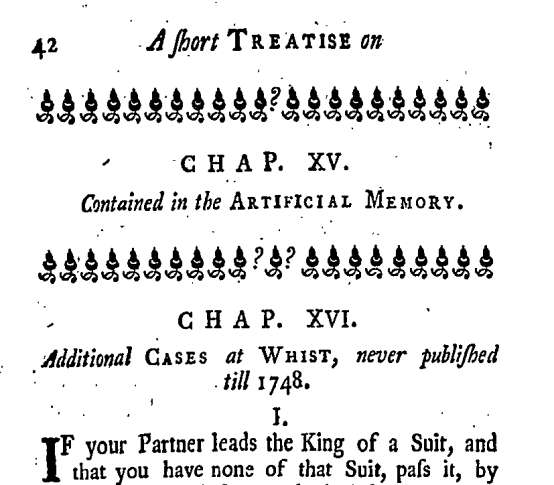
Note that the table of contents for whist continue for two lines onto A2r and then continue on to quadrille and backgammon. My volume has a slightly incomplete table of contents for Whist. Curiously there is no table of contents for Memory at all—see the top of A2r which reads "CHAP XIX. Contained in the Artificial Memory."

So the structure of my book is clear. π1 is the Hoey's cancel section title for Memory. [Aside: I was tempted to write π1 (=D6), but that is not correct—D6 as printed was Ewing's section title for Memory.] The table of contents, originally A4 was reduced to the single leaf A1 to omit references to the other treatises. As for the deleted leave, D6 and D11 were printed as Ewing section titles and D12 was the beginning of the quadrille text.

Now that the structure of my new book is clear, the question is whether it was issued by Hoey in this form. If so, we have an unrecorded work, Whist and Memory issued as a volume apart from The Polite Gamester. Perhaps Hoey broke up some copies of The Polite Gamester that he acquired from Ewing and sold the treatises individually. Perhaps Ewing issued not only The Polite Gamester in 1772, but Whist and Memory separately as well. In that case Hoey could have acquired some unsold stock and cancelled the title.

Another explanation is that a purchaser of the 1776 Polite Gamester was interested only in the game of whist and when he had the book bound, he instructed his binder to discard (or bind separately) all of the other treatises. The bibliographer's mantra says to examine as many copies as possible. Here, mine is the only copy, and unless I'm able to find some contemporary newspaper advertisements, we'll never know for sure how it was issued.

In London, Memory was merged into Whist in the "sixth" edition of 1746 as I discuss in the essay "The First Osborne Hoyles." In Dublin, the two were sold separately until the 1750s when, judging from the copies I have seen, they were always sold together. Until I acquired this book, I thought that the last time these two were sold apart from The Polite Gamester was in 1762, a combined volume of Whist.D.6 and Memory.D.4. My new book suggests the possibility that the two were sold together again in 1772 and 1776.

Perhaps this essay will help you appreciate the difficulties of doing a bibliography of Hoyle!

Monday, March 5, 2012

A copyright fight in Dublin?

updated August 30, 2013 with details about another copy of Wilson first issue identical to the Copisarow copy. 

In the past two essays, I have discussed the publication of Hoyle in Dublin—first the individual treatises and then the anthologies. The books were generally published by the Ewings, first George in 1743, then George and Alexander from 1743 to the 1760s , and lastly Thomas in the 1770s. When Thomas died, the Hoeys took over publication, first James from 1776 to 1783 and finally Peter in 1787. I have not commented on the intrusion of Peter Wilson in 1752 with his editions of Whist and Memory, and the collection The Polite Gamester.

Before discussing the Wilson works, it is time for a digression on copyright practice in Ireland. The English copyright law, the Statue of Anne, did not apply in Ireland. This is why the Irish booksellers were free to reprint Hoyle in Dublin. There was, however, a custom in Dublin that had the force of copyright:
There is a Rule among the Booksellers of Dublin, established by common Consent and Custom, that whoever shall first paste up Title-Pages, advertising their Resolutions of publish any Book, the Property then becomes theirs: And this appears to be necessary in a Country where no public Laws have been made in that Respect. [Pollard p170, citing Thomas Bacon, Dublin Mercury, 1742]
The Ewings, having published Hoyle from 1743, had the rights to publish Hoyle in Dublin. They advertised new editions in The Dublin Journal of February 22, 1752:
The Polite Gamester, containing short treatises of the games of whist, quadrille, back-gammon, piquet and chess, together with an artificial memory, or an easy method of assisting the memory of those that play at the game of whist. By Edmond Hoyle, Gent.--N. B. This thirteenth edition of the game of whist, with the above additions, not in any other edition printed in this kingdom, may be had separately, price 4d. *.* Be careful to ask for the edition printed for G. and A. Ewing.
Two things strike me about this advertisement. First, it notes new material. Dublin was finally to get all the changes to the whist treatise that appeared in London after 1743 including the thirteen new cases of 1748. Second the advertisement suggests awareness of other versions that did not contain the new material.

Indeed there was another version. Peter Wilson advertised in The Dublin Journal of February 29:
This Day is published, by Peter Wilson, opposite the old Horse-guard in Dames street, with two additional Chapters to the game of whist, (not in any former edition,) containing, a Dictionary of Whist, which resolves almost all the critical cases that may happen in the game, and 13 new cases now first published, (price a British shilling).

Wilson.A
Copisarow copy
Wilson was intruding on the customary rights of the Ewings. Indeed, he can said to be a pirate, even in the absence of a copyright law! What text was it that Wilson published? The title page, pictured at left, has several curious features. It is a word-for-word reprint of the Ewing edition of 1743, what I called Whist.D.3 in the essay on individual treatises. It is labelled a "fifth" edition, as was Whist.D.3, at a time when the Ewings were putting out a "thirteenth" edition. Hoyle's first name is given as "Edmund" rather than "Edmond," something which had been corrected in London in 1744.

The table of contents, pictured below, are also identical with Whist.D.3 of 1743 and don't indicate the presence of any of the textual changes that had since been made in London in 1745 and 1748.

Table of Contents
Copisarow copy
Table of Contents
Copisarow copy


 Note the definitions of "force" and "see-saw" in the contents of chapter 8, something that dates back to the earliest London editions. Only 14 chapters are listed; there are 20 in the contemporary London and Ewing versions. Finally, the laws of whist preceeding chapter 1 contain 25 laws, not 24 as in editions after the "third" London edition.It appears that Wilson was competing against the Ewings with a very old version of Hoyle's works.

In the Copisarow copy, the whist treatise collates π1 A2 B-D6 E1 with six unnumbered pages (π1 A1.2) followed by pages 1-38. The text is identical to Whist.D.3. In all other surviving copies, there is an extra two-leaf, four page gathering after E1, with the page numbers continuing to 46. The extra pages contain the additional cases at whist from 1748 and other appearing in the Ewing edition and promised in the Wilson advertisement. Oddly, the first leaf of the new gathering is signed 'F2' and the second 'F3'.

Since writing this essay, I have acquired a copy identical to the Copisarow copy. It seems clear that the four pages were added later to catch up to the Ewing Hoyle. Wilson issued two versions of Whist as part of The Polite Gamester—the first an out-of-date reprint of an old edition and the second containing the updates from 1748.

Wilson's entry into the Hoyle market was short-lived. The 1752 whist treatise, and the Polite Gamester anthology were his only efforts, while the Ewings kept publish Hoyle for decades thereafter. I have consistently called the Ewing editions "reprints" rather than "piracies." It is fair, however, to call the Wilson edition a piracy.

References:

  • Mary Pollard, Dublin’s trade in books, 1550-1800. Clarendon Press ; Oxford University Press, Oxford; New York. 1989.

Monday, February 27, 2012

The Polite Gamester

The last essay focused on Hoyle's individual treatises published in Dublin. This essay will focus on The Polite Gamester, the Hoyle anthology that was sold in Dublin for more than 40 years. As with the London Hoyles, early versions of the The Polite Gamester were collections, that is books issued by the publisher of works that were also available separately. In London it was possible to find the collections differently made up; the same is true in Dublin. In London, Thomas Osborne ceased publishing the individual treatises in 1748; it wasn't until 1762 that the Dublin publishers did the same. Unlike the London collections and collected editions, The Polite Gamester almost invariably had its own title page, so the cataloging problems described in my essay "What's in a Name" do not appear in Dublin. As I noted in the essay on individual treatises in Dublin, these books survive in much smaller number than do their London counterparts, so more conjecture is involved.

The separately published treatises are:
  • Whist.D.1: "fourth" edition, George Ewing, 1743
  • Whist.D.2: "fifth" edition, George Ewing, 1743
  • Whist.D.3: "fifth" edition, G. and A. Ewing, 1745
  • Whist.D.4: "thirteenth" edition, G. and A. Ewing, 1752 (likely sold only with Memory.D.2)
  • Whist.D.Wilson.1.1: "fifth" edition, Peter Wilson, 1752
  • Whist.D.Wilson.1.2: a second issue of the preceding book 
  • Whist.D.5: "fourteenth" edition, G. and A. Ewing, 1762 (likely sold only with Memory.D.4)
  • Memory.D.1: G. & A. Ewing, 1744
  • Memory.D.2.*: G. & A. Ewing, 1751 (likely sold only with Whist.D.4)
  • Memory.D.3*: G. & A. Ewing, 1762 (likely sold only with Whist.D.6)
Collections
 This is the one Irish collection that occasionally lacks an overall title page and therefore may not be separately cataloged in ESTC. Copies without a title page include one at the Bodleian (shelf mark Jessel f.541) consisting of  Whist.D.2, Memory.D.1, Backgammon.D.1, Piquet.D.1 and Quadrille.D1 and one at UNLV (shelf mark GV 1201 H83 1743) where the backgammon and piquet treatises are reversed.  

 More frequently, there is an overall title page (pictured at the bottom of this essay) and made up of Whist.D.3, Quadrille.D.1, Backgammon.D.1, Piquet.D.1, and Memory.D.1.  The title page is a single leaf bound in before the whist treatise.Inevitably, when the treatises are sold both individually and as a collection, some of the treatises go out of print before the others. Then, purchasers of the collection get a different make up. There is a copy cataloged at at DePaul University (shelf mark IY 1745) which appears to contain Memory.D.2 rather than Memory.D.1.

  • Ewing.C, Dublin: printed for G. & A. Ewing, 1752 (price a British half crown according to an advertisement in Quadrille.D.2, but 2s. 2d. in newspaper advertisement)
One version contains the same editions of Quadrille and Backgammon as Ewing.A, but new editions of Whist.D.4, Piquet.D.2, and Memory.D.2. The games appear in the order whist, memory, quadrille, backgammon, piquet. The text on whist has been updated with changes that appeared in 1748 in London. Another collection includes Quadrille.D.2 and Backgammon.D.2. Curiously, this collection is rarer, with but a single copy at the Bodleian (shelf mark Jessel f.572). One can imagine that other permutations were sold.
  • Wilson.A (and it's variants Wilson.B and Wilson.C),  Dublin: printed for Peter Wilson, 1752 (price one British shilling in newspaper advertisement)
I'll discuss this work in more detail in the next essay. It contains Whist.D.5,  the three treatises on quadrille, piquet, backgammon,apparently not sold separately, plus Memory.D.3.  Half of the six surviving copies are also bound with Brag.D.1 published by John Exshaw, suggesting a business relationship between Wilson and Exshaw.
Ewing.D
Levy [1745]
I classify this work, pictured at right, as a collection rather than a collected edition, because one copy of Whist.D.6, a "fourteenth" edition and Memory.D.4 survives at the British Library. Surprisingly, the new appearance of whist lacks changes to the text that appeared in London in 1760. The collection continues with treatises on quadrille, backgammon and piquet, with no evidence that they were issued separately. Interestingly, it concludes with the treatise on probability, Chances.D.1. In London, the Doctrine of Chances was never included with the other works; here it was both sold separately and incorporated into this and all subsequent editions of The Polite Gamester.

Collected Editions:

Polite.2
Levy [1468]
Thomas Ewing, presumably a son of George or Alexander, continued publishing The Polite Gamester after their death. For the first time in Ireland, Hoyle was available only as a single volume, as happened much earlier in London. After Thomas's death, James Hoey acquired both the rights and unsold stock which he reissued under his own title page, as described here. Peter, again presumably a son of James, published the final edition, pictured at right. It is surprising that the subsequent reprintings of Whist did not incorporate any changes to the text made after 1748, discussed in detail here.

In the next essay, we will return to 1752 and look in more detail at the competing Ewing and Wilson editions of The Polite Gamester.

Tuesday, February 21, 2012

Individual Treatises in Ireland

It's time to deal more exhaustively with the Dublin editions of Hoyle. I must say that I've been dreading it. All of the bibliographical problems we saw in London recur in Dublin: Which treatises were published individually? As in London, we will also find these separately-issued treatises reissued as collections, which in Dublin were called The Polite Gamester. Later, as in London, the publishers ceased separate publication and sold only The Polite Gamester as a collected edition.  Lastly, there were piracies. Piracies? How can there be piracies in Ireland where there was no copyright law? Just wait.

Two factors make Dublin more difficult to disentangle than London. First, the books themselves tend to survive in fewer number. Second, while the London newspapers have be digitized with full text search, Dublin newspapers have not. I have examined over 400 London advertisements for genuine editions of Hoyle; the number is much larger if you include piracies and editions published after Hoyle's death. I have seen only a half dozen advertisements for Hoyle in Dublin newspapers, and those only after many hours of painstaking search on microfilm. Fortunately some editions of the treatise on Quadrille give prices for the other works and thus confirm publication details. Nonetheless, the Dublin story will have to be a bit more speculative.

We will begin with seven separately-published treatises that appeared in Dublin: Whist, An Artificial Memory for Whist, Backgammon, Piquet (with Chess), Quadrille, Brag and The Doctrine of Chances. The next essay will explore how these were combined into various versions of The Polite Gamester.

 I have previously identified the first Dublin printings of Whist:
  • Whist.D.1: Dublin: the "fourth" edition, printed for George Ewing, 1743 (advertised April 2, 1743)
  • Whist.D.2: Dublin: the "fifth" edition, printed for George Ewing, 1743
  • Whist.D.3: Dublin: the "fifth" edition, printed for G. and A. Ewing, 1745
After these, complications begin to appear. Recall that in 1746, Thomas Osborne merged An Artificial Memory into Whist.6. As we shall see, the circumstances in Dublin are not so clear. There are three more candidates for separately-published whist treatises:
  • Whist.D.4: Dublin: the "thirteenth" edition, printed for G. and A. Ewing, 1752 (price 6d. ½ from advertisement in Quadrille.D.2, but 4d. a in newspaper advertisement)
  • Whist.D.Wilson.1.1: Dublin: the "fifth" edition, printed for Peter Wilson, 1752, apparently sold with Memory (price 4d. from newspaper advertisement), reissued as Whist.D.Wilson.1.2. 
  • Whist.D.5: Dublin: the "fourteenth" edition, printed for G. and A. Ewing, 1762
1752 Ewing Whist
(click to enlarge)
No copies survive of Whist.D.4 outside of The Polite Gamester, but I am persuaded by the advertisements that it was published separately. Its treatment of An Artificial Memory is most strange. To look only at the table of contents, Memory appears to be handled just as the London edition of 1748, with chapter 15 containing the new cases from Memory and chapter 19 the memory itself. The book itself, however, tells a different story--it redirects the reader to a separately-published work, as pictured at right. It makes for an awkward appearance and must have disappointed any purchasers who did not also buy Memory.

Wilson also published a Whist in 1752. It seems to me to be coincidental that it is styled a "fifth" edition. Only one copy is recorded at the Bodleian Library and it is bound with An Artificial Memory, which has the appearance of a separate work--a separate title page, table of contents, and page numbering. However Wilson's advertisement offers both books for 4d., so perhaps that is how they were sold, at least when not part of The Polite Gamester.

I have found no advertisements for Whist.D.5. The only surviving copy which is not included in the 1761 Polite Gamester is at the British Library, bound with Memory.D.4. Perhaps it was issued separately, perhaps not. Likely, the two books were only sold together.

Memory

I've discussed this book a number of times. One essay criticizes the text; another discusses how the London edition was merged into Whist.6.
  • Memory.D.1: Dublin: printed for George and Alexander Ewing, 1744 (price 3d. from advertisement in Quadrille.D.1)
  • Memory.D.2*: Dublin: printed for G. & A. Ewing, 1751 (price 3d. from advertisement in Quadrille.D.2, but no separate copies known)
  • Memory.D.3*: Dublin: printed for G. & A. Ewing, 1762 (likely sold only with Whist.D.5)
Backgammon
  • Backgammon.D.1: Dublin: printed for George and Alexander Ewing, 1744 (price 6d. ½ from advertisement in Quadrille.D.1)
  • Backgammon.D.2*: Dublin: printed for G. & A. Ewing, 1753 (price 6d. ½ from advertisement in Quadrille.D.2)
Piquet

Piquet.D.2* survives only in The Polite Gamester, but the advertisement in Quadrille suggests that it was available separately. Another printing of Piquet is found in the Ewing's Polite Gamester of 1762, but it was not published separately. It lacks a title page, probably because the text itself took exactly one and a half duodecimo sheets. 
  • Piquet.D.1: Dublin: printed for G. & A. Ewing 1744.  (price 6d. ½ from advertisement in Quadrille.D.1)
  • Piquet.D.2*: Dublin: the "fourth" edition, printed for G. & A. Ewing 1752 (price 6d. ½ from advertisement in Quadrille.D.2)
  • Piquet.D.3*: Dublin 1761
 
Advertisements in
Quadrille.D.2
(click to enlarge)

Quadrille 

A single copy of Quadrille.D.2 survives at the British Library. I have referred a number of times to the advertisements in these two works and show the second of them at right.

Brag

This work, discussed here,  is most often bound at the end of Peter Wilson's Polite Gamester (1752) suggesting a business relationship between Wilson and Exshaw. Some separate copies survive.

  • Brag.D.1: Dublin: printed for John Exshaw, 1751 (price 4d. newspaper advertisement)
Doctrine of Chances

Interestingly, the Ewings started to include Chances in the Polite Gamester beginning in 1761. It never appeared as part of the collected editions of Hoyle in London.
Summary

This has been a long and rather dry listing of books. It will prepare us for the more interesting discussions of the various permutations of The Polite Gamester and for the story of piracy in Ireland.

    Monday, November 14, 2011

    The Doctrine of Chances (1754)

    (updated November 17, 2011, February 21, 2013)

    In his treatises on whist, backgammon, piquet, quadrille, and brag, Hoyle had briefly discussed the mathematical aspects of each game. He provided a somewhat fuller treatment of probability in a 1754 work—An Essay towards making the Doctrine of Chances easy to those who understand Vulgar Arithmetick only. The book, a minor footnote in the histories of both gaming and mathematics, has quite an odd publishing history.

    The title recalls a much more important work on probability by Abraham De Moivre, The Doctrine of Chances: or, a Method of Calculating the Probability of Events in Play (1718) with subsequent editions in 1738 and 1756, the last of which is freely available here.

    In his landmark history of probability, Isaac Todhunter devotes nearly 70 pages to De Moivre's work and a scant two paragraphs to Hoyle's:
    Some works on Games of Chance are ascribed to Hoyle in Watt's Bibliotheca Britannica. I have seen only one of them which is entitled: An Essay towards making the Doctrine of Chances easy to those who understand Vulgar Arithmetick only: to which is added, some useful tables on annuities for lives &c. &c. &c. By Mr Hoyle... It is not dated; but the date 1754 is given in Watt's Bibliotheca Britannica.
    The work is in small octavo size, with large type. The title, preface, and dedication occupy VIII pages, and the text itself occupies 73 pages. Pages 1-62 contain rules, without demonstration, for calculating chances in certain games; and the remainder is devoted to tables of annuities, and to Halley's Breslau table of life, with a brief explanation of the latter. I have not tested the rules. (Todhunter p322)
    Where De Moivre used games to advance the mathematical theory of probably, Hoyle used probability to provide rules of thumbs for gamesters—Hoyle's Chances lacks mathematical importance.

    The publishing history of the Chances should be viewed in light of the unsuccessful publication of the treatise on Brag by John Jolliffe (1751), discussed here. Like Brag, the book was sold by subscription as is evident from a series of notices in the Public Advertiser:
    Next month will be published, By Subscription, at Half a Guinea, The Doctrine of Chances made easy to those who understand Vulgar Arithmetick only. By Mr. Hoyle. Subscriptions taken in by the Author, and Mr. Jolliffe, in St. James's street. (Public Advertiser, January 23, 1754)
    Beginning in late February and continuing into March, the same advertisement was published with the heading "Speedily will be published" and finally on June 16 it was announced as "This Day is publish'd."

    The imprint of the book is curious, particularly in comparison with Brag. In 1751, Brag appeared with the imprint "printed for and sold by J. Jolliffe, bookseller." The words "printed for" suggest that Jolliffe was the publisher and had paid Hoyle for the copyright. In contrast, Chances is "sold by J. Jolliff (sic)" suggesting that Jolliffe was only a distributor. The book was not entered into the register at Stationers Hall, so we don't have that evidence as to the owner of the copyright, but it is likely that Hoyle retained the copyright—perhaps Jolliffe was unwilling to purchase it because of the poor sales of Brag.

    Chances sold for half a guinea, and, like Brag, it did not sell well initially. From 1748 to1755 Thomas Osborne (and William Reeve) were selling various issues of Mr. Hoyle's Treatises (discussed here), followed by Osborne's "eleventh" edition in 1755 and "twelfth" in 1760. Just as Osborne began to advertise the "twelfth" edition, he began to promote two other books:
    Tuesday next will be published, Dedicated to the Right Hon. the Earl of Northumberland, Price 3s. 6d. sewed in Marble Paper, An Essay towards making the Game of Chess easily learned, by those who know the Moves only, without the Assistance of a Mater. By Mr. Hoyle, Printed for T. Osborne, in Gray's Inn; R. Baldwin, at the Rose, and S. Crowder, at the Looking-Glass, in Pater-noster Row. 
    Of whom may be had, Price 2s. 6d. sewed, Mr. Hoyle's Essay towards making the Doctrine of Chances easy to those who understand Vulgar Aritmetic only. To which are added, some useful Tables on Annuities for Lives, &c &c.
    No Copies of these Books are genuine, but those that are signed by the Author. (Public Advertiser, December 24, 1760)
    We'll save the discussion of Chess for another time, and focus on Chances. This Osborne version is not listed in ESTC and but a single copy survives at the Bodleian Library, shelf mark Jessel e.647(1). An examination of the book reveals that it is a reissue of the 1754 edition with a cancel title page. thus Chances.1.2. Again, the imprint is odd: "London: Sold by T. Osborne [and others]." It seems that Hoyle had unsold copies of the book, terminated the arrangement with Jolliffe and hired Osborne as a new distributor, selling the book at a much lower price to coincide with the new work on Chess. It is also interesting that the verso of the cancel title has an erratum, noting that "in page 57, line 2, read for doing it instead of against doing it." Chess, by the way, has the imprint "printed for Thomas Osborne [and others]" suggesting that Osborne owned the rights.

    It was only the 1760 reissue that sparked the Irish reprinters.George and Alexander Ewing reprinted the work in 1761, also incorporating it into The Polite Gamester.

    Chances.2
    Levy [1663]

    In 1764, Osborne reprinted the Doctrine of Chances, pictured at left and freely available for download here. Here the imprint suggests that Osborne and Baldwin owned the copyright: "Printed for T. Osborne, in Gray's-Inn, and R. Baldwin, at the Rose in Pater-noster Row." Note, by the way, the small piece of drab paper affixed to the title page. This is a remnant of the original paper wrapper for the book.


    The autographs, pictured below, provide further evidence that Osborne and Baldwin owned the copyright. The title page notes "No copies of this book are genuine, but those that are signed by the proprietors on the back of this title"  Hoyle did not autograph the verso in any copy of this edition I have seen—only the signatures of Osborne and Baldwin appear. Osborne and Baldwin must have been the proprietors and Hoyle's contract with Osborne to sign his early works (see my "Pirates, Autographs, and a Bankruptcy" p144) did not apply to Chances.

    (click to enlarge)

    We are left with this list of separately published editions of The Doctrine of Chances:
    • Chances.1.2: London: Sold by Osborne, Crowder, and Baldwin (1760), a reissue of Chances.1.1
    • Chances.2: London: Printed for Osborne and Baldwin (1764)
    References
    • Isaac Todhunter. A History of the Mathematical Theory of Probability from the Time of Pascal to that of Laplace. Cambridge and London: McMillan and Co. 1865. Reprinted New York: Chelsea Publishing Company. 1949.

    Thursday, November 10, 2011

    A Short Treatise on the Game of Brag (1751)

    (updated February 26, 2012 as I have located additional copies)

    In 1748, Hoyle added "thirteen new cases never before published" to the section on whist in Mr. Hoyle's Treatises. Those few pages were his first new writing since 1744. As I discussed in a recent essay, booksellers Thomas Osborne and William Reeve reissued Mr. Hoyle's Treatises under various titles a number of times from 1748 to 1755.

    Hoyle's next writing was an entirely new work, A Short Treatise on the Game of Brag, in 1751. The game of brag most resembles three-card poker, but with betting rules that look strange to a modern player. Interestingly, the treatise on brag was never incorporated into the any of the London collections of Hoyle's works. There is every reason to believe that it was an unsuccessful effort for the publisher.

    Hoyle entered A Short Treatise on the Game of Brag in the register of books at Stationers Hall on January 18, 1750/1, listing himself as the sole copyright holder. On January 22, 1750/1, an announcement appeared in the General Advertiser:
    This day is published, A Treatise on Bragg by Mr. Hoyle. To which is added the laws of the game, with some calculations. Sold by J. Jolliffe, Bookseller, next door to White's Chocolate House in St. James's Street, at the same place may be had, neatly printed to frame, The Laws on Bragg separate, Price 2s. 6d. Where subscribers may have their books on sending their receipts. The books and laws are sign'd by the author, and whoever pyrates or sells any pyratical edition will be prosecuted, they being enter'd in the Hall Books.
    There are many points of interest. First, Hoyle has found a new publisher, John Jolliffe. Recall that Hoyle originally contracted with Francis Cogan to publish all of his early works. Cogan also paid Hoyle to autograph each copy (see my Pirates, Autographs, and a Bankruptcy, p144). Cogan, nearing bankruptcy, sold the rights to Thomas Osborne in 1745. I find it striking that Hoyle chose not to work with Osborne on Brag, but found a new publisher. No evidence survives detailing the financial arrangement between Hoyle and Jolliffe. Second, as the advertisement makes clear, Jolliffe was familiar with the publishing history of whist. As Cogan and Osborne had done with Whist, Jolliffe published the laws of brag separately, secured Hoyle's signature on the books and the laws, and warned against piracy. Third, Jolliffe sold the book by subscription, with customers paying in advance for the book. There certainly must be pre-publication advertisements offering the book, although I have not found any.

    There are two reasons to believe that the subscription price was half a guinea, that is, 10s. 6d. First is an advertisement for the Irish reprint of Brag that I shall discuss below. Second, in 1754, Jolliffe sold another Hoyle treatise, An Essay on the Doctrine of Chances, by subscription for half a guinea. That work will be discussed in a subsequent essay.

    A month later, Jolliffe had a briefer advertisement offering the treatise for 2s. 6d. and the laws for 1s. (Whitehall Evening Post or London Intelligencer, February 28) If the treatise sold by subscription for half a guinea, the new price was a substantial reduction. Jolliffe dropped the price of the laws from 2s. 6d. to 1s. Likely neither sold well. No further London editions of Brag were published and few copies survive today. No copies of the laws survive—perhaps they were destroyed unsold, as were hundreds of copies of the Osborne laws of whist.

    Bookseller John Exshaw quickly reprinted Brag in Dublin. He advertised in the Dublin Courant of March 2, 1750/1 :

    Brag.D.1
    Levy [1747]


    Thursday next will be publish'd by John  Exshaw, price 4d. A Short Treatise on the Game of Brag: containing the laws of the game, also calculations, shewing the odds of winning or losing certain hands dealt.
    N. B. The price of the London edition is half a guinea. 


    It is the Exshaw advertisement that suggests that Brag sold for half a guinea by subscription, although it ignores the fact that Jolliffe lowered the price to 2s. 6d. by late February.

    Like its London counterpart, the Exshaw edition is scarce, with copies at the Dublin City Libraries and UNLV in addition to mine. A copy at the British Library was destroyed in World War Two. The UNLV copy is bound with a 1752 of The Polite Gamester printed for Peter Wilson and I suspect that an examination of more copies of the Gamester will show that they contain the brag treatise as well. Updated February 26, 2012: I have been in touch with other libraries holding a copy of the Wilson's 1752 Polite Gamester. It turns out that the Cleveland Public Library and the University of Strathclyde (Glasgow) also have copies containing the treatise on Brag.

    Neither the game of brag, nor Hoyle's book were especially popular. Indeed no other books have been published on the game, although many gaming anthologies discuss it briefly. It remains Hoyle's most obscure work.

    Thursday, September 22, 2011

    Early Dublin editions of Hoyle

    I wrote briefly about some of the Irish reprints of Hoyle here. An important point is that the Dublin printings are not piracies because the copyright law, the Statute of Anne, did not apply to Ireland.

    Having looked at a complete list of the individual treatises published by Cogan and Osborne, including the Osborne editions reissued as collections, let me now turn toward the Hoyles printed in Ireland from 1743-1745. I use the numbering scheme game.D.edition (there are no reissues, except for collections), where the D refers to Dublin. As usual, you can click on the number to get the full ESTC description.

    The list:
    • Whist.D.1: Dublin: the "fourth" edition, printed for George Ewing, 1743 (advertised April 2, 1743)
    • Whist.D.2: Dublin: the "fifth" edition, printed for George Ewing, 1743
    • Whist.D.3: Dublin: the "fifth" edition, printed for G. and A. Ewing, 1745
    • Memory.D.1: Dublin: printed for George and Alexander Ewing, 1744
    • Backgammon.D.1: Dublin: printed for George and Alexander Ewing, 1744
    • Piquet.D.1: Dublin: printed for George and Alexander Ewing, 1744
    • Quadrille.D.1: Dublin, printed for George and Alex. Ewing, 1745
    The list is short, but a number of oddities emerge. Let's begin with the publisher. George Ewing published the first two editions of Whist; all others are published by George and his brother Alexander (though the names are abbreviated differently in different books).

    Whist.D.1
    Levy [1581]
    Next, let's look at the statement of edition. The first Dublin edition is called the "fourth" while the next two are both called the "fifth". I believe the reason for the "fourth" edition (advertised April 2) is that the text was taken from the London third edition. The third London edition was advertised on March 18 and the fourth London edition on June 29. Further confirmation comes from the text—there are changes to the section on the Laws of Whist in the first four London editions. All the Dublin editions print the laws as they appear in the third London edition. So, I believe that Whist.D.1 was called a "fourth" edition for a good bibliographical reason—it was the next setting of type after the London third. This had the side benefit of making the book appear more current than the then available London edition.

    Despite many hours at microfilm readers,I have been unsuccessful in locating newspaper advertisements for any of the other books listed, so I don't have precise dates for Whist.D.2 and Whist.D.3. The text is unchanged from Whist.D.1, but each is a new setting of type. Ewing did the normal thing by incrementing the stated edition for Whist.D.2. Why Whist.D.3 is a stated "fifth" edition is a minor mystery that I'll touch on below.

    Finally note the the Ewings never published the separate Laws of Whist designed for framing. 

    We learn from the April 2 newspaper advertisement that Whist.D.1 sold for 6½d., a bit more than one quarter of the London 2s. price. Despite the lack of newspaper advertisements, there are advertisements within some of the books that tell something of the publication history. At the end of Backgammon.D.1, an advertisement notes:
    Just publish'd by George and Alexander Ewing...price 6½. A Short Treatise on the Game of Piquet...Where may be had by the same author, A Short Treatise on the Game of Whist...price 6½...Also, An Artificial Memory...price 3d.
    The implication is that Backgammon and Piquet were published at the same time, but that Whist (presumably Whist.D.1 or Whist.D.2 as Whist.D.3 was not published until 1745) and Memory had been published earlier. This sequence differs from the Cogan publications as his Backgammon preceded Memory.

    I'll use an advertisement in the preliminaries of Quadrille to introduce one last book:
    Lately published by the same author and sold by George and Alexander Ewing...A Short Treatise on the Game of Whist. Price 6½d. An Artificial Memory. Price 3d. A Short Treatise on the Game of Piquet...Price 6½d. A Short Treatise on the Game of Backgammon. Price 6½d. N. B. The above treatises may be had, together with that on Quadrille, all neatly bound together and lettered. Price a British half crown.
    The advertisement does not name the book "all neatly bound together", but it appears as The Polite Gamester, printed for G. and A. Ewing, 1745. The title recalls Cotton's The Compleat Gamester, discussed here. It seems likely that Whist.D.3 and Quadrille.D.1 were published at the same time. So, we have a collection of the Ewing pamphlets in a publisher's binding—separately advertised and with a separate title page. Bowers notwithstanding, this is a separate bibliographical entry, a separate issue of the Dublin Hoyles.

    Ewing.B
    Levy [1609]

    Recall that on October, 26, 1745 Osborne first advertised all of Hoyle's individual treatises as well as "the whole bound." I can't establish a date for The Polite Gamester, so I don't know whether the Osborne or the Ewing collection came first. Like the Osborne collections, the 1745 Ewing collection can be made up in more than one way. I have seen copies with Whist.D.2 and no collected title page, and copies such as the one above with Whist.D.3 and a collected title page. Thus, there appear to be two issues of the Dublin collection. In 1748 Osborne stopped publishing the individual treatises and therefore collections. In Dublin, there was another set of individual treatises and collections in the early 1750s, but a discussion of those will have to wait for another time.

    One final note. There is an owner's inscription, J. W. Rimington-Wilson, on the front paste down pictured above. This copy came from the wonderful Rimington-Wilson library of gaming books that was sold by the Quaritch firm in the late 1920s. In future essays, I'll discuss provenance in connection with gaming literature.