Showing posts with label Robert Withy. Show all posts

Friday, May 23, 2025

A 2025 Acquisition and Some Housekeeping

Before I get to the housekeeping, here is a rare little whist booklet that came my way. 

The Laws of Whist,
for the Pocket-Book

Levy [2230]

My use of the word "little" is deliberate as the book is 3 x 1 7/8 inches and twenty-four pages only. The introduction promises:

This little Manual, intended for reference at the Whist-table, being, from its diminutive size, portable in the smallest pocket-book, will be found useful in deciding doubtful points, and settling disputes on the spot.

The book purports to be by Jonathan Long, Esq., but that is almost certainly a play on "Bob Short", the psedonym used by Robert Withy, as discussed in a three-part series of essays (one, two, and three). The book is rare with institutional copies only at the Bodleian and British Libraries. A very pleasing acquisition!

Now the housekeeping. This blog was written as I was compiling my online Hoyle bibliography and it served as a way to record first thoughts about what is now a book in progress. A few things have become stale over time. 

First, in the course of the past fourteen (!) years of writing about Hoyle, I have learned a lot along the way. I have changed a lot of the labels I use to identify books in my bibliography. I have learned about new editions of Hoyle that I would have included in the relevant essay had I know of them at the time of writing. I have found answers to many questions I asked in the blog. I have made some, but not all of the updates I might have.

Next, the blog frequently links to the online version of ESTC, the English Short Title Catalogue. The British Library hosted ESTC until they were victims of a cyber attack in October 2023 and the links stopped working. Within the past couple of weeks, ESTC has be moved to CERL, the Consortium of European Research Libraries. I have updated the ESTC links to point to the CERL site, although I'm sure I missed some.

I also replaced the ESTC links to Hoyle books to point instead to my own bibliography. So links to the first edition of Hoyle's first book now point here rather than here. If you want to get to an ESTC page for Hoyle, you can go to my bibliography, then click on the ESTC link in the "references" section. 

Lastly, and this will only matter to me, I've added my internal ID for books in my collection. So the Laws of Whist, pictured above, refers to Levy [2239]. From that number, I can go to my catalogue and find purchase details, shelving information, etc. 

Thursday, December 7, 2023

2023: The Year in Collecting

An even dozen books came my way in 2023. I've discussed two of them in the essay "Oddly Imposed. Oddly Signed." I'll write about four more here, ignoring some 19th century books on whist that filled gaps and ignoring some 19th century books in Italian that are on lesser-known card games. 

The earliest is a French work on the game of piquet dated 1683. My experience with French and English gaming literature is that small pamphlets appeared treating a single game appeared first in the 17th century. The booksellers learned that those interested in one game were likely interested in more of them, and anthologies replaced works covering a single game. In France, early works on games such as piquet, reversis, and hoc gave way to anthologies such as La Maison Académique. In London, early works on piquet and hombre gave way to The Compleat Gamester and later, Mr. Hoyle's Games


Piquet 1683
Levy [2191]

It was a treat to find this late 17th century work, of which only one other copy is recorded. An earlier version of the book was published in 1631 and portions were translated into English in 1651 in a book I discuss in the essay "Piquet, Provenance and a Puzzle." Actually, I'm lying a bit. The first 25 pages of this 43 page pamphlet are on piquet, but it has a couple of pages each on another nine card games. Nonetheless, it is a small (12.5 x 8.7 cm) pamphlet and feels more like one of the single-game pamphlets. 


Next is a manuscript on the game of trictrac. I've shared other trictrac manuscripts here, here, and here. As noted on the title page, the scribe copied the book while he was staying in the parish of St. Jean de Brayes just outside Orleans in 1787. The printed book is quite rare with three copies known other than mine, one in Lyon, one in Grenoble, and one Châlons-en-Champagne, Marne. All these cities are several hours’ drive from Orleans, so perhaps there remains another copy closer to Orleans. I wonder if our 1787 scribe was aware of the book’s rarity when he spent hours making his copy.


Manuscript
Levy [2187]
printed book
Levy [1835]


But the year would not be complete without finding some Hoyle. It gets harder and harder for me to find something new and most of the recent acquisitions have been either cheap books or translations. I've often written about Robert Withy, the author of Hoyle Abridged, or Short Rules for Short Memories at the Game of Whist by "Bob Short". My overview article listed editions known to me in more than ten years ago.

London 1806 Harris
Levy [2188]
 

 More continue to turn up, including an auction find, pictured at left. It is an 1806 "twenty-second" edition printed in London for John Harris, described more fully here. I have seen an advertisement for a "twentieth" Harris edition of 1801, an 1806 "twenty-first" edition printed in Bath, and an 1809 "twenty-second" edition printed in London. They are all different settings of type. It is hard to make sense of the fanciful edition numbering and the fact that 1806 saw books published in London and in Bath. No other copies of this one are known, so I won't much complain about the indifferent condition.


Whist Firenze (1823)
Levy [2194]


 Recently, I have done a lot of work on my online bibliography. I have added photographs of books in my collection and have reworked the section covering Hoyle in translation. See here and scroll down to "Continental Translations." A couple of clicks away is a full description of this 1823 Italian translation of "Bob Short" on whist, one of two recorded copies. It is the first of two Italian translations of "Bob Short," followed by another Florence imprint in 1832. 


 Happy holidays and best wishes for 2024!

Wednesday, February 2, 2022

2021: The Year in Collecting (part 4)

The Hoyle I purchase at a German auction in late November has finally arrived. Before taking a close look at it, let's return to the December auction where I bought four lots, fourteen books, including the whist manuscript discussed in the last essay. There were some early books on the game of ombre, but I'll focus on the Hoyles. My collection is deep and the opportunities for me are mostly with cheap literature and with translations. 

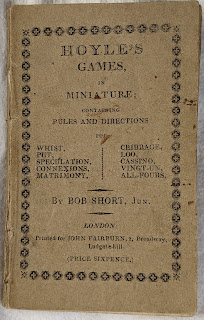
For cheap literature, it is hard to top this Hoyle's Games in Miniature, published by John Fairburn and purportedly by Bob Short, Jun.

Fairburn.Games.1825c
Levy [2160]

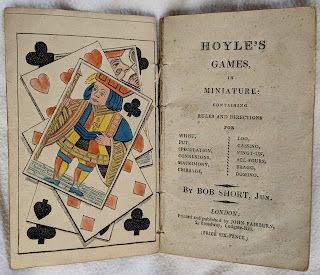
I've written about the chapbooks by "Bob Short," which I have shown is the pseudonym of Robert Withy (see "Who is 'Bob Short'?" parts one, two, and three). Like Hoyle himself, Bob Short became a brand. Withy himself wrote only about whist and quadrille in the 1780s and 1790s, but in the first half of the 19th century, you could find all sorts of chapbooks and cheap books offered under his pseudonym, sometimes, as here, with a disingenuous "Jun." appended. There is a charming and naive hand-colored frontispiece:

frontispiece and title page

This is a reissue of a book first published in 1820 or so. The original book was imposed in eights; the reissue in sixes, still the same setting of type. The reissue also adds eight pages on the games of brag and domino, which are listed on the title page, but not on the wrapper. These cheap books are quite rare. The only copy of the first issue is at the Bodleian Library and mine is one of two surviving second issues. 

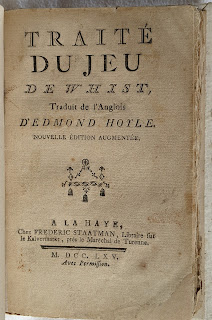
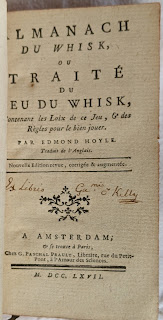
I'll show without comment two French translations of Hoyle treatise on whist, one published in the Hague by Staatman in 1765, the other in Amsterdam by Prault in 1767. 

Staatman 1765
Levy [2150]
Prault 1767
Levy [2158]


Now onto the gem. In general, editions of Hoyle are objects of commerce, not luxury. With the exception of the first edition of Hoyle's first book, pictured here, the bindings are cheap, utilitarian, and not particularly attractive. Here is a second exception, albeit a bit stained:

   
deluxe Italian? binding

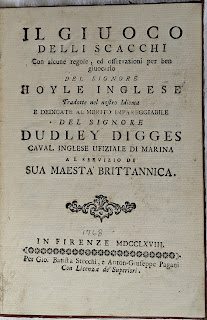
The book is an Italian translation of Hoyle on chess printed in Florence in 1768. 

Scacchi, Florence, 1768
Levy [2170]

The long title translates as The game of chess with some rules and observations to play it well, by the Englishman Mr. Hoyle translated into our language and dedicated to incomparable merit of Mr. Dudley Digges, English officer of the navy in the service of his British Majesty. We'll return to Mr. Digges in a moment. The book is quite rare with only three institutional copies in major chess collections: the White collection at Cleveland Public (pictured here), the van der Linde collection at the Koninklijke Bibliotheek (available on Google), and the Fiske collection at the National and University Library in Iceland. A label in my copy says it is a duplicate from the collection of Lothar Schmid (1928-2013), so perhaps a fifth copy remains in that collection, which I understand is still intact.

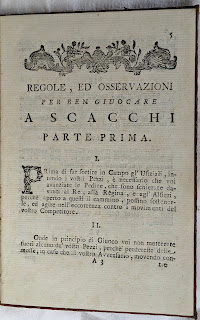
The text is not from Hoyle's 1761 work on chess, as one might expect, but rather from the second half of Hoyle's treatise on piquet, first published in 1744, and included in all editions of Hoyle's Games thereafter. To give a sense of the typography, here is the beginning of the text:

Chess, part one

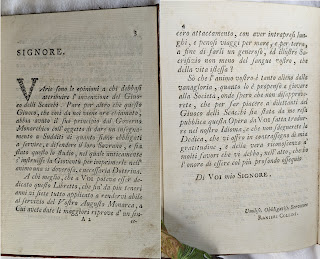
There are a few additions by the translator. The first is a two-page letter to the reader: 

Translator's preface

The translator is Ranieri Collini and the preface expresses fawning admiration of Digges. Some rough translations: 

"To whom better than you to be able to dedicate this book..."

"...having reendered yourself ably in the service of your august monarch..."

"...long undertakings, and painful voyages by land and sea..."

"I know that your soul is very alien to conceit..."

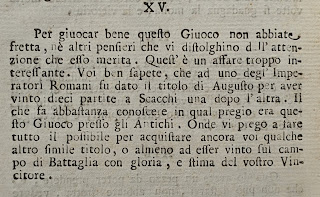
In the third and final section of the book, Hoyle had 14 numbered paragraphs and Collini adds a fifteenth: 

Part 3, paragraph XV

It connects the game of chess to antiquity, noting that the title of Augustus was given to one of the imperial Romans for having won ten games of chess in a row. I haven't seen that anecdote before!

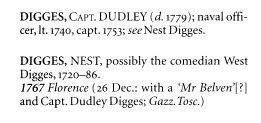
So how did Collini and Digges cross paths? A Dictionary of British and Irish Travellers in Italy, 1701-1800, Yale University Press, 1997 is based on an archive assembled by Sir Birnsley Ford and edited by John Ingamells. It is an alphabetical listing of visitors to Italy, many undertaking the grand tour. The dictionary shows Captain Dudley Digges and his brother West Digges visiting Florence in 1767, a year before the Hoyle was published:

Dictionary p301

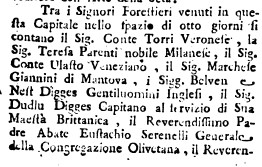
Astonishingly, the source document, Gazzetta Toscana, is available on Google books. An entry marked "Florence, December 26, 1767" reads:

Gazzetta Toscana, p215

Correcting the misspelling of the names, this translates in part:

"Among the foreign gentlemen who came to this capital in the space of eight days are...Messrs. Belven, West Digges, English gentlemen, Mr. Dudley Digges, captain in service of his British Majesty."

I have not been able to track down Belven. West Digges is a quite well-known comic actor, but if Collini had met them both, he must have been more impressed with brother Dudley. The text in the gazette almost matches the dedication on the title page. So it is possible to connect Collini and Digges in time and space. It would be fascinating to learn how they came to meet.

It took more than six weeks for this gem to travel here, but it was well worth the wait, don't you think?


Friday, December 20, 2019

2019: The Year in Collecting

updated June 4, 2020

2019 was a good year for me as a collector. Since my Hoyle collecting is far along, when I find something I don't have, it must be rare. I'll look first at the best of the new non-Hoyles, then the Hoyles, but first a story.

In the summer of 2017, I took David Pearson's class in Provenance research at the Rare Book School in Charlottesville. We learned about forms of evidence to understand book ownership: inscriptions, bookplates, bindings, heraldry, catalogues, and more. At a break, I told David that I had never marked my books in any way. As I described my collection, he said, "You have some really good books, but most of your books are interesting only because they're part of your collection. If you don't identify your books, that interest will be forever lost." His comment resonated--for example, I have a lot of whist books that are not of great value individually, but I do have 300 of them that together tell the story of the game. He convinced me that I should identify my books.

I contacted some friends who are letterpress printers and came up with the bookplate pictured below. The woodblock ornament is taken from the first edition of Hoyle's Backgammon. Add a border and my monogram (which David described as a mangled Roman numeral), and voila! My friends had a polymer plate made with many instances of the book plate in three different sizes.They printed and cut out lots of plates.
 
Levy bookplate
Polymer plate on the press


It has been a huge project attaching the plates. In addition to pasting them in the books, I've used the opportunity to make sure that my electronic and paper records are in sync with the physical books. Disclosure: they weren't! I've also added location detail so I can print a shelf list. Finally, I've also had to decide which books are part of the collection and which are not (such as modern books on contract bridge or backgammon).

I have plates in roughly 800 of the 1200 book collection so far. Work continues! I am using a rice paste that is soluble in water, so the process is reversible. If my books are important as a part of collection, they are now mostly identified.

On to the new acquisitions.
Levy [1925]

I have a weakness for books in manuscript. We tend to think that once moveable type was introduced, all books were printed. In fact manuscripts overlapped with printed books for a long, long time. For an extraordinary example with a great story, see my essay "The Left Hand of Bougy..." The manuscript on Quadrille from 1725 is, like the Bougy manuscript, copied from an edition of the Académie des Jeux, the French gaming anthology that appeared in one form or another for generations.

1732 Quadrille
Levy [1986]

Another weakness. And another book on Quadrille. I've written many times how I love books in original unsophisticated bindings. See, for example here, here, here (second from the top), and here. The book on Quadrille at left predates Hoyle; I mention it in the essay "Piquet and Quadrille Literature." I acquired the copy at left at auction this year. It is a pamphlet that has never been bound and retains the original stab sewing. Lovely!


And now the Hoyles.

Whist, Lisbon (1753)
Levy [1865]

This year brought a copy of the first Portuguese translation of Hoyle's Whist, Lisbon, 1753. When I wrote the essay "The First Translation of Hoyle," everyone thought that this was the earliest translation. Since then, a 1751 translation turned up, as I wrote in the essay "A French Discovery." So Do Jogo do Whist is the second translation of Hoyle. Mine is one of two known surviving copies.


What is remarkable about the book is that it is the first I know to illustrate the use of tokens for keeping score at whist. In the essay "Hoyle's Scoring Method and Whist Counters," I discuss whist scoring tokens. I suggest in that essay that the first mention of scoring with tokens was in the 1791 chapbook Short Rules for Short Memories at Whist by "Bob Short" (Robert Withy).  I still believe that to be the case in English, but I've since found scoring discussed in three 18c Portuguese editions (1753, 1768, 1784), and a Russian edition published in St. Petersburg (1769). The Russian edition purports to be a translation from a French edition, but the tokens are not illustrated in any French version I have seen.

Whist scoring tokens (1752)

The two new Hoyles in English are both reissues of books I have already, but with cancel titles. The first is discussed in "Reissues of Mr. Hoyle's Treatises (1748-1755). With this 1755 reissue, I have four of the five different issues.
 
Mr. Hoyle's Treatises (1755)
Levy [2050]

The final example is a Dublin reissue of the Polite Gamester from 1783. It was originally published by Thomas Ewing in 1772. Ewing died in 1775 or 1776 and James Hoey took over his stock. Hoey reissued the book with a cancel title in 1776. See the essay "Every Cancel Tells a Story, Don't It (part 1)" for pictures and more detail.

I can't say why Hoey put a new title page on the book in 1783. The imprint is the same as is his address, 19 Parliament Street. Probably, he wanted to make the book look more current with a new date.

The Polite Gamester (1783)
Levy [1924]

It's a bit beaten up, but the only other recorded copy is in the John White collection at Cleveland Public Library (discussed here), so I have no complaints. 

Best wishes for 2020!

Monday, December 31, 2018

2018: The Year in Collecting (second addendum)


Another book sneaked its way here just before year-end. It's one of the charming "Bob Short" chapbooks on whist. "Short" is the pseudonym for Robert Withy as discussed here, here, and here.

Stacy.Whist.1819
Levy [1840]
There are many editions, often with provincial imprints. In the aggregate, these booklets are quite common, but any particular one is scarce. This 1819 edition, printed by John Stacy in Norwich for Reynolds in London and Stacy is a good example. The British Library copy was lost in World War II, as is indicated by the "D-" in the shelfmark D-7913.a.70. There is a copy in private hands in the UK. This one makes three. Err...two.

There are two things I particularly like about it. First are the marbled wrappers. Original bindings are the best!


Second is the advertisement for The British Melodist, a book that may not have survived exactly as advertised--there is a single copy of an 1822 edition at the University of Aberdeen, but how would that be advertised in an 1819 book? 


Anyway, 2018 is a wrap. What will 2019 bring?

Sunday, November 19, 2017

Biographical Notes on Robert Withy (part 2)

With this essay, I am going to provide long extracts from two interesting sources on Robert Withy without added comment.

The first is a genealogical work, His Pedigree, with Memoirs old and new, Delineated by G. R. G. Pughe, of Mellor Vicarge, 1902, available for download from the Internet Archive. It  has 50 pages of rhyming couplets giving the history of Mr. Pughe, whose ancestors include our Robert Withy! The section on Robert and his son, also Robert, are on pages 17-18:
My mother's maiden name was Withy, and her family
I will accordingly distinguish as The Withy Tree.
The oldest Withy provable as her progenitor
Was Hilborne Withy, Coleman Street, an Upholsterer.
Robert, his eldest son, was long remembered as "Bob Short,"
Whose calling was stockbroking, whilst whist-playing was his forte.
His eldest son and namesake was a money scrivenir,
Or, what we designate at present, a solicitor;
He was of Buckingham Street, Strand, also of Bletchingly
In Sussex, and of Brighton. I may mention, by the bye,
That Robert, the solicitor, was no monogamist,
But, as in houses so spouses, quite a pluralist.
He married thrice. Miss Burton was the first upon his list.
One of his many daughters, Mary, lived at Cheltenham,
Also at Stapleton (it would rhyme better Stapletam).
Sarah, another of his daughters, married Mortemer
Rodney, an Honourable, I, of course, must honour her,
He was the son of George, the second Baron and the son
Of great George Brydges Rodney, who, for victory well son
Over the French when led in vain by Comte de Grasse, became
Promoted to the Peerage with a handle to his name,
And reached in seventeen eighty-three the zenith of his fame.
His Pillar on the Breidden Hill reminds my family
Of our affinity as well as as of his victory.
In eighteen fifty-six, and at the age of sixty-four,
Seven years my junior, died at Lanfanque this Mortemer.

A final source, also amusing. and also in verse is An Invocation To Edward Quin, Esq. as delivered at a society called The Eccentrics, on Saturday the 26th of Nov. 1803, by John Gale Jones (available for download from Google Books).

There are merely two lines that relate to Withy (page 37):
Did W*thy tell thee with his parting breath,
That all must share the fatal stroke of death?
It is the notes to the couplet that provide biographical interest:
 "Did W*thy tell thee," &c. The late Robert W*thy, a respectable stock-broker, and an honorary member of this society. This gentleman was author of a little tract well known among card players, intituled, "Ten Minutes Advice to those who play at Whist," signed, "Bob Short." He lately departed this life, and his death was generally believed to have been prematurely hastened by pecuniary embarrassments. Consistently with the maxim of "de mortuis nil nisi bonum." I shall merely state, that he was one of the first founders, and, by way of distinction, called "the Father of the Brilliants," a society from which, in consequence of an act of felo de se, that threw the poor landlord into a prison, and consigned his helpless wife and children to beggary and ruin, this most honourable and valuable institution, like a phoenix from the ashes of a conflagration, dates its origin and existence! Mr. W*thy was much attached to these societies; and notwithstanding his advanced age (nearly 70 years) was constant in his attendance, and assiduous in regulating its concerns. He was a facetious and pleasant companion, but, unfortunately, very irascible in his temper, and one of those who take every thing to heart! A double entendre, or a humourous allusion, afforded him great satisfaction; and he frequently indulged the company with an amorous song. When he was reproved for his levity, and reminded of his age, his reply was, that early habits are not easily eradicated; and that an old coachman always remembers with pleasure the crack of his whip!
There will perhaps be one more biographical essay to follow.

Tuesday, October 17, 2017

Biographical Notes on Robert Withy (part 1)

I wasn't able to attend this week's conference on Bibliography Among the Disciplines, but did follow a bit on Twitter under the tag #BxD17. One of the memes was "When you fall down a rabbit hole, go for it!" In that vein, my latest rabbit hole is Robert Withy.

I've written about him and his publications about whist and quadrille many times. The most important essay was a series (parts one, two, and three) establishing conclusively that it was he and not Anna Letitia Barbauld who wrote Short Rules for Short Memories at the Game of Whist under the pseudonym "Bob Short".

The rabbit hole is the Withy biography. I happened on some fascinating sources and wanted to pull them together, much as I did for bookseller Francis Cogan. The most important source is an article in Miscellanea, Genealogica et Heraldica, volume III, new series, edited by Joseph Jackson Howard, London: Hamilton, Adams, and Co., 1880. The article is called "Pedigree of Withy of Berry Norbert and Westminster" and includes information compiled by the Vicar of All Saints', Lambeth and transcribes genealogical information from the Withy family bible. It is available for download from Google Books.

I have a couple of other interesting sources that I will save for later; now here is the first part of a chronology of what I've learned about Withy:

1732-12-11 Robert Withy is born, the son of Hilborne (an upholsterer) and Elizabeth Withy of Coleman Street, London.

1747-07-07 Hilborne binds Robert as an apprentice to the bookseller John Rivington for £105. [McKenzie, Stationers' Apprentices]

1754-09-03 Withy is free of the Stationers' Company. [McKenzie]

1755 Withy begins a bookselling and print-selling career. Some of his imprints are at the sign of the Dunciad in Cornhill. See this lovely broadside advertising his business. Other imprints show Withy in partnership with John Ryall at Hogarth's Head opposite Salisbury Court, Fleet Street. A broadside from that business survives as well.

There are 107 entries in ESTC listing Withy as a publisher. I haven't gone through these in detail to find out what role he played or how many were in partnership with John Ryall. The first 101 are dated from 1755 to 1767, when, as we shall see, Withy left the trade.

1756-02-01 Withy marries, as is noted in the London Evening Post of February 3:

Sunday last Mr. Robert Withy, a bookseller in Fleet-Street, was married to Miss Amelia Hope, daughter of Roger Hope, Esq. of Windsor, an agreeable lady with a handsome fortune. 
One the one hand, this is clearly our Robert Withy. On the other, the marriage does not show up in Miscellanea, which notes two marriages, the first of which is the listed immediately below. What is the story of this ignored marriage? A mystery!

1758-03-16 Withy marries Mary, daughter of William and Elizabeth Johnson. The couple had thirteen children from 1759 to 1778, most of whom died in child birth or infancy. There were two sons name Robert who did not survive, followed by a third Robert (born 1768-06-20) who went on to become an attorney and author. [Miscellanea]

1762-03-02 Thomas Dale becomes an apprentice of Withy. [McKenzie]

1766-08-20 Withy leaves the print-selling trade, selling his remaining inventory at auction. The 19 page catalogue survives, titled:
A Catalogue of the Remaining Part of the Stock in Trade, of Mr. Robert Withy, of Cornhill, Print-Seller, who is going into another branch of business: Consisting of a great variety of prints, elegantly framed and glazed for furniture, and in portfeuilles; maps and plans upon rollers; drawing-books copper plates perspective machines, and other effects...which will be sold at auction by Samuel Paterson, at Essex-House in Essex Street, in the Strand, on Wednesday August the 20th, 1766, and the two following days, to begin each day exactly at twelve o'clock. [ESTC, ECCO]
1767-05-21 Withy sells his books and copyrights at a bookseller trade sale. [ESTC] At this point, Withy became a stock broker and auctioneer.

(updated 10/20/2017 with more complete and primary source information on the next section)

1768-02-04 An advertisement appears in the Gazetteer and New Daily Advertiser: As we shall see, it was Withy who placed the advertisement.
An estate for seven years to be sold. To prevent trouble, none need apply who cannot deposit four thousand pounds, five hundred of which to be advanced on making out the title, which is a very good one, and the remainder not to be paid till the deeds are executed. Enquire of C. D. at Baker's Coffee-House, Exchange Alley. 
Nonetheless trouble ensued, and quickly. That day, the House of Commons issued two orders as a result of that advertisement. They ordered that Charles Say, printer of the Gazetteer and the person who keeps Baker's Coffee House attend Parliament the next morning, Friday, February 5. (p580)
[Aside: My account is taken from the Journals of the House of Commons. an 1803 reprint, available for download from Google Books. The Journal reports orders, such as the two above, and who was giving testimony, but not always the substance of the testimony.]
The proceedings continue over the next week and a half:
  • On February 5, the House discussed a bill that might possibly be relevant to our story, a bill for the further and more effectual preventing bribery and corruption in the election of members to serve in Parliament. (583) The orders for Say and the keeper of Baker's House were carried over until Monday. (584) On Monday they were carried over until Tuesday. (589)
  • On February 9, Charles Say, printer of the Gazetteer testified that Robert Withy delivered handwritten copy of the advertisement to Say's clerk, Hugh Jones, on February 3. Samuel Purney, keeper of Baker's Coffee House, said that Withy asked him to delivery any letters which came in response to the advertisement to Withy's home. Purney did so.Withy was directed to appear on Thursday Februrary 11 and bring in any letters he received. Purney and Jones were also directed to attend. (596)

  • On February 11, Withy admitted placing the advertisement, but said that he had received no replies. Purney testified that Withy had frequently ordered letters directed to C. D. to be sent to him. Withy did not bring in any letters, saying that he had received none in response to the advertisement. Purney, contested that claim, informing the house that he had received letters since February 4 which he had delivered to Withy. (603)
  • Withy then opened up. He said that he had received letters from John Reynolds about the borough of Milborne-Port; and that he received instructions from Reynolds to place the advertisement and to refer replies to Reynolds. He received replies from three attorneys, Hickey, Seagrave, and Coulthurst, all whom he referred to Reynolds. Withy claimed he was present at a conversation between Reynolds and Hickey in which Reynolds said that there were some boroughs available at a reasonable price, naming Milborne Port, Reading, and Honiton. Hickey made a deposit for the borough of Redding, and Hickey identified his principal as Mr. Nightingale. (603)
This gives enough clues to sort out what is going on. Milborne Port and Honiton were "rotton boroughs", defined in the Wikipedia as Parliamentary boroughs so small that could be used by a patron to gain influence within the House of Commons. Milborne Port is mentioned specifically. A Rowlandson print from 1807 satirizes Honiton as a rotton borough. So, it seems that Parliament is investigating an effort to buy a seat in the House of Commons. Back to the proceedings.
  • Parliament ordered Reynolds, Hickey, Seagrave, and Coulthurst to attend the next day, and ordered Withy to be taken into custody to ensure his appearance. Withy was to speak with no one outside the presence of the Serjeant at Arms, and to send or receive no letters. (603).
  • On February 12, Hickey, Seagrave, and Coulthurst, and Withy appeared, but Reynolds was apparently out of town. There was much testimony, including Withy recanting some details of his earlier testimony.The attorney Hickey was not present at the meeting where Reynolds named the three boroughs; it was Reynolds and not Hickey who made the agreement about Reading; and that Nightingale was the principal of Reynolds. The proceedings were continued until Monday February 15. John Reynolds was charged with "corrupt practices relating to several boroughs", Withy was to be held in custody until Monday February 15 to be further examined. John Reynolds was ordered taken into custody to answer the charge. (606)
  • February 15, the House had a first reading of the bill for preventing bribery and corruption in the election of members to serve in Parliament. (610)
  • February 15, John Reynolds still could not be found. Parliament petitioned His Majesty, to issue a royal proclamation for apprehending John Reynolds with the promise of reward. Hickey and Withy were examined, both separately and together, although there is no report of their testimony. The House voted 83 to 37 that Joseph Hickey was guilty of a corrupt attempt to obtain a seat in the House on behalf of a client and he was taken into custody. After further testimony, it was ordered "that the said Robert Withy be discharged out of custody, without paying any fees. (610)
And so ends the story, at least as to Withy. In a 1774 treatise on election law by a "Gentleman of the Inner-Temple", the author noted it was singular to discharge a prisoner without paying any fees. (p116).

Not so for Hickey and Reynolds. On February 18, Hickey petitioned to be discharged, admitting his guilt and promising to avoid incurring censure of the house. He was order to be discharged the next day. (p617). Reynolds was not so fortunate. He was brought to the House on the 18th, and after his testimony and thought of others, including Withy, he was confined to Newgate. His Majesty was requested to direct the Attorney General to prosecute Reynolds.

1778-01-07. Wife Mary dies delivering twins.

1781-01-31 Withy advertises a card with rules for whist in the Morning Herald and Daily Advertiser:
No Puff Poz. This day is published, neatly printed on a card. The fourth edition, with additions. Price on 2d. or 1s. a dozen. A New Year's gift for grown masters and misses. Hoyle Abridged; or Twelve short standing rules for short memories, at the Game of Whist. By Bob Short. Printed for the benefit of Families to prevent Scolding, and sold by the author, at Baker's Coffee-house, Exchange-alley, where he attends daily to answer all questions relating to the game of whist. Advice to the poor gratis...N. B. Signed by the author in such a manner as to defy all counterfeits. 
There is one surviving card in the John Johnson Collection at the Bodleian Library. One side has "Twelve Short Standing Rules for short Memories at the Game of Whist" beginning with "Lead from your strong suit." and "Lead thro' on honour." The other side has an advertisement for Withy's business:
Robert Withy, Stock Broker and Auctioneer, begs leave to inform his friends and the public that he continues to buy and sell by commission, at public or private sale, estates, life annuities, mortgages, reversions, government and all other securities, also the same valued, and lives insured on the most reasonable terms.
The utmost value given for household furniture and other effects, to be remov’d or sold on the premises. All orders directed for him at Baker’s Coffee House, Change Alley, or at his house...
 This takes us to the beginning of his writing about whist. More soon...

Thursday, December 8, 2016

2016: The Year in Collecting

Earlier this year, the Book Club of California hosted the annual tour of the Fellowship of American Bibliophilic Societies. I was a panelist for a session entitled "Delights and Dilemmas of Booksellers, Librarians, and Private Collectors."  The dilemma I discussed is one familiar to the long-time collector--I don't find much to buy in my area of interest. The upside is that when I do find something, it's quite delightful. There is a video archive of the discussion on the BCC web site.

With that thought, 2016 was, like 2013, 2014, and 2015, a pretty quiet year in collecting. I've already written about the most interesting books, the Scottish miniature in a slip case and the early English book with the rules of piquet. I have four items to discuss here and will treat them in the order published.

The New Pocket Hoyle (1807)
Levy [1813]
The oldest is a third edition of The New Pocket Hoyle printed by T. Davison for Robert Scholey and others, 1807. Like the first edition, discussed in my essay "Late Hoyles, Early Slipcases", the book was sold in multiple formats, this one in a slip case covered with an engraving dated 1805. It's hard to be 100% sure, but I believe the engraving is identical to the one dated 1802 used in the first edition--the engraver appears to have changed only the date. You can judge for yourself by comparing the picture at right with that in the earlier essay. The New Pocket Hoyle is a relatively common book and was priced accordingly, but it is delightful to find it in a well-preserved case.

Early American Hoyles are much less common. I found the shabby copy of Hoyle's Games pictured below on eBay. It is printed and sold by John Bioren in Philadelphia in 1817. There is a crude tape repair to the spine, but the printed paper covered board has somehow survived. There are only three known copies of this book and I'm only a bit embarrassed to say that I have two of them. Yes, this was a duplicate; perhaps one of my copies will make it to the American Antiquarian Society at some point. They try to collect every early American imprint and tend to be active on eBay. I don't know how they missed this one.

Hoyle's Games, Philadelphia (1817)

Hoyle's Card Games, Glasgow (1826)
Levy [1816]
Astonishingly, I found another delight on eBay. This is a Glasgow imprint of Hoyle's Card Games (1826). The text is the same as the Bath edition of 1824, and I was aware of an 1827 Glasgow edition with copies at Oxford and Louisiana State (in the poker and Hoyle collection of Judge Olivier P. Carriere). The 1826 Glasgow edition was not known anywhere. Alas the book is imperfect, lacking two leaves at the end, but it seems to be the only survival, so I can't much complain.


Gazzetta.Whist.It.1832
Levy [1808]

Finally, a travel story. My family visited Italy and Spain in the Spring. Had I been alone I would have attended the international book fair in Bologna and visited a number of fine book shops in Italy and Madrid. I had different priorities with my family but was pleased to happen upon a shop in Sienna. There I found two gaming books, one of which was a delight. It consisted of four pamphlets in Italian bound together: two on chess, one on the card game of calabrasella, and the last...Hoyle's rules for whist compiled by "Bob Short".


As regular readers may recall, Bob Short is a pseudonym for Robert Withy, about whom I've written frequently. His short rules for whist date to the late 18th century and were reprinted frequently in the first half of the 19th. This Italian edition of 1832 purports to be a third edition. I've tracked down a Florence edition of 1820 which seems to be the earliest, but no sign of a second edition.

Most rare book purchases are online these days. It's a delight to walk into a shop at random and find something that fits so well into my collection. I definitely miss the days when that happened much more frequently!

Wednesday, February 4, 2015

Who is "Bob Short"? (part 3)


This is the final installment of my "Bob Short" trilogy. Parts one and two conclude that "Bob Short" is stockbroker Robert Withy and not poet Anna Latetia Barbauld. I present a last bit of evidence here, evidence that also answers a second mystery hinted at it my prequel "Bob Short's Short Rules for Short Memories". This essay also adds a final note for the Barbauld collector or scholar.

In the prequel, I note:
Eighteenth century copies of Withy's works are scarce. According to ESTC, Whist survives in but two copies of the 1791 edition, and one each of 1792, 1793, 1794, and 1795. The University of Nevada Las Vegas has a copy of a 1793 German translation. Two copies of the 1793 edition of Quadrille are extant. 
A couple of years ago, I acquired a copy of Quadrille, so now three copies are known.

In the prequel, I cited a number of newspaper advertisements that predated the 1791 edition of Whist. The earliest, from 1781, offers only "twelve short standing rules" for whist.

Morning Herald and Daily Advertiser, January 31, 1781

This advertisement is likely for Robert Withy's trade card which describes his business on one side and has twelve rules for whist on the verso. Beginning in 1782, we see advertisements for a different book:

Morning Herald and Daily Advertiser, January 26, 1782

There are two differences from the previous advertisement indicating that it is not for a mere trade card. First, the price is increased from 2d. or 1s. a dozen to 3d. or 2s. a dozen. Second, the book offers "the laws of the game as played at White's, and all public places". Is this merely an earlier edition of the 1791 Whist or is this a different book? I would have guessed the former, but...

The 1791 Whist indicates that it was "entered at Stationers' Hall", so as part of my effort to identify Bob Short, I used inter-library loan to request the microfilm of the Stationers' records. Then a couple of long, tedious days at the microfilm reader. Here is what I found:

Entry in the Stationers' Register of Books February 14, 1785

The entry, dated February 14, 1785,  indicates that Rt Withy registered the copyright for "A present for grown masters & misses, Hoyle Abridged or short standing rules for short memories at the game of whist with the laws of the game by Bob Short". Withy deposited nine copies of the book and the record was entered by stationer John Wilkie, himself an owner of a share of the main Hoyle copyright (see the essay "The Hoyle Copyright in Hoyle's lifetime").

And a second entry nearly six years later:

Entry in the Stationers' Register of Books December 14, 1790

The title is "Hoyle Abridged, or short rules for short memories, at the game of whist, with the laws of the game, &c adapted for the head or pocket, by Bob Short." Again nine copies were deposited and now stationer Robert Horsfield prepared the entry.

There are two conclusions to be reached from these records. First, that Withy wrote two different books on whist, only one of which has survived. The "present for grown masters & misses" seems to have been advertised from 1782 but entered in the registry only in 1785. I have found advertisements for it as late as 1788.

The second book on whist survives and the chronology is clear. It was entered in the Stationers' register on December 14, 1790, advertised from December 24 (see below), and printed with a date of 1791.

World, December 24, 1790

Note the new price, 6d., the warning against piracies, and the entry of the book at Stationers' Hall.

Second, the Stationers' registry proves it: Robert Withy is "Bob Short." If there were any doubters after the two previous essays, let them doubt no more!

There is, however, no entry in the registry for Withy's Quadrille, nor for Barbauld's Religion of Nature under any of its various titles. 

One last comment for fans of Anna Letitia Barbauld. In part 2, I noted many printings of her letter The Patriotic Clergyman, most of them published by J. Mitchell in Newcastle on Tyne. The first of these, a 36 page chapbook called The Charms of Literature was illustrated by Thomas Bewick. In 2011, Nigel Tattersfield wrote the monumental catalogue of Thomas Bewick, The Complete Illustrative Work. Tattersfield lists Charms as TB 2.71A (volume 2 p139) and identifies many more editions. The Barbauld collector or bibliographer should consult that entry!

Wednesday, January 28, 2015

Who is "Bob Short"? (part 2)

In part 1 of this essay, I presented a puzzle. The London Morning Post of January 3, 1794 contains an advertisement for three books by the pseudonymous "Bob Short", a strong suggestion that all three were written by one person. Yet, the books on whist and quadrille are reliably by Robert Withy, while the third, The Religion of Nature, is attributed to the dissident poetess Anna Letitia Barbauld (née Aikin). As a result the gaming books are sometimes attributed to Barbauld as well. Let us try to sort this out.

I got a digital copy of The Religion of Nature and learned that the text was first published anonymously as a letter to the editor of the Morning Chronicle of November 29, 1793:


It was reprinted with an introduction (about which more later) as The Religion of Nature, A Short Discourse, Delivered before the National Convention at Paris by Mons. le Curé of ———, still without attribution to Barbaud. This is the book that was advertised with Whist and Quadrille by Bob Short.

What is the basis for the attribution to Barbauld? I borrowed some of the many texts on Barbauld from the library and consulted a number of reference works on pseudonyms, but did not learn why Barbauld is given as the author. I then posted a query to the rare book listservs, Exlibris-L and SHARP-L and got a number of useful pointers. Professor William McCarthy pointed me to his biography Anna Letitia Barbauld, Voice of the Enlightenment, Baltimore Johns Hopkins University Press, 2008.

There I learned that the text of The Religion of Nature was reprinted under two more titles. First, it appeared as The Patriotic Clergyman in the early 19th century in a number of chapbooks and miscellanies. I checked WorldCat and Google Books and located many editions:
  • The Charms of Literature, Newcastle on Tyne: J. Mitchell, 1800. A 36 page chapbook with illustrations by Bewick containing The Patriotic Clergyman.
  • The death of Rousseau, an interesting story ... : to which is added, the patriotic clergyman. Newcastle on Tyne : Printed and sold by J. Mitchell, nd. 
  •  The Charms of Literature, Newcastle on Tyne: J. Mitchell, 1805. A 434 page miscellany available from Google.
  • The interesting story of Montford, or, the generous man: Together with the death of Rousseau; The military mendicant ... by ... C.I. Pitt ; The victim of dishonour ; and The patriotic clergyman, by Mrs. Barbauld. Newcastle on Tyne: Printed. by J. Mitchell, 1806.
  • Interesting stories : containing, The military mendicant. Female heroism. The patriotic clergyman. Edinburgh : Printed for the booksellers in town and country, 1815. 
  • The Intelligent Reader: Designed as a sequel to The Child's Guide. Springfield: Merriam, 1847. A 252 page children's reader available from Google and containing Clergyman.
Undoubtedly, many, many more reprints exist.

Some of the reprints attribute the piece to Barbauld—the section title of the first is pictured below. The text is the same letter originally published in the Morning Chronicle with a new first paragraph. It is "attributed" to Mrs. Barbauld; in the 1806 edition the title page indicates the piece to be hers. These are not, however, convincing attributions. How did the publisher identify Barbauld as the author?


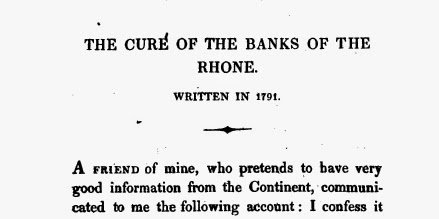
It is the two-volume set The Works of Anna Laetitia Barbauld, London: Richard Taylor, 1825 (available from Google, volumes one and two) that makes the attribution certain. It was compiled by Barbauld's niece Lucy Aikin who had access to a great deal of private material about her aunt. The letter appears in volume two, pages 260-7, under yet another title, The Curé of the Banks of the Rhone, with the notation that it was written in 1791. The text matches that of the letter to the Morning Chronicle.


With the appearance of the letter in her niece's collection of Barbauld's works, I accept the attribution and am left with the need to explain the advertisement consisting of Withy's gaming books along with Barbauld's letter.

The explanation is, I'm afraid, rather prosaic. Let us return to The Religion of Nature, the work causing all the confusion. Pictured below are the title page and introduction for the copy at the University of London Goldsmiths' Library. What I am not showing is a handwritten annotation on the front fly leaf "by Anna Letitia Barbauld", another attribution without evidence.

Religion, title page
Religion, Introduction


The title page indicates that the "short discourse" was delivered by "Mons. le Curé of ———" and it is "the short address to the jurymen of Great Britain", that is the introduction, that is by "Bob Short". The former is Barbauld and the latter must be Withy. Note the annotation "Withy" next to the name Bob Short on the title page. I am not the first to reach this conclusion, although I hope mine is better documented.

Quadrille, introduction
Levy [1757]
The introduction is signed Bob Short at Baker's Coffee-house, December 22, 1793. This is just as he signed the introduction to Quadrille, pictured at right: Baker's Coffee-house, January 1, 1793. I wish I could see a physical copy of The Religion of Nature. From the reproduction, it appears quite similar to the contemporary copies of Whist and Quadrille I have seen. All have an oblong format and the type and layout appear similar.

Indeed, Withy carried on his trade at the coffee house:
...Robert Withy...transacts as usual, all the branches of this business, and attends at Baker's Coffee-house, Change-alley, every day from one to three. (Morning Herald, October 23, 1799)
The conclusion is that Withy wrote the introduction to Religion as "Bob Short" while Barbauld wrote the text. My strong suspicion is that Withy, a former seller of books and prints, published all three pamphlets, explaining the advertisement linking all three books. We can say with certainty that Robert Withy and not Anna Letitia Barbauld was the author of Whist and Quadrille. Establishing that fact was my primary goal although I greatly enjoyed the detour provided by Barbauld. She was a remarkable woman—dissident, poet, educator and more. 

Professor McCarthy left me with some interesting questions about Withy and The Religion of Nature:
Did Barbauld know Robert Withy? Why did he reprint this piece from the [Morning Chronicle]? Did he know who wrote it, or did he reprint it because he agreed with it? Or did he reprint it because he cared about the plight of the Spitalfields silk-weavers?
I cannot answer these questions, but perhaps some readers can help?

If you're still not convinced about Withy's authorship of Whist and Quadrille, stay tuned for a brief part 3 coming shortly!