Showing posts with label quadrille. Show all posts

Friday, November 27, 2020

2020: The Year in Collecting

2020 hasn't been good for much, but it has been good for my collection. It's hard to find editions of Hoyle that I lack, but some early and interesting ones found their way here. 

The first two books are a 1744 Cogan edition of Quadrille and a 1745 Osborne edition of Piquet. I had neither, so this is pretty exciting news! There is a short and a long version to their stories. First, the short. When Osborne acquired the Hoyle copyright from Cogan, he also acquired some unsold copies of Quadrille and Piquet. As discussed in the essay "Every Cancel Tells a Story, Don't It (part 3)", Osborne reissued each of these books with cancel titles. I'd never had the original Cogan Quadrille, though I did have a copy of Osborne's reissue. It is rare with three copies at the Bodleian, one at UNLV and now one here. I had neither issue of Piquet, so one down, one to go. 

Quadrille.1.1
first edition by Francis Cogan (1744)
Levy [2112]
Piquet.1.2
reissued by Osborne (1745)
Levy [2112]


Now for the long version. These two copies were not individually published. For an example of how Cogan published the individual treatises, see here and for an Osborne example see here. Instead, these were each published as part of collections of all of Hoyle's treatises. The collections included Whist, Quadrille, Piquet, and Backgammon, and occasionally the rare sheet, Laws of Whist, but were advertised, bound, and sold as a collection. The collections can come in many permutations as I discuss in the essay "The Osborne Collections of Hoyle (1745-7)". I don't want to rehash the details here, but the main differentiators are:

  • Whist.6 or Whist.7 (the sixth or seventh edition of Whist)?
  • Piquet.1.2 or Piquet.2 (the Osborne reissue of Cogan's Piquet or the Osborne's reprint)?
  • Quadrille.1.2 or Quadrille.2 (the Osborne reissue of Cogan's Quadrille or the Osborne's reprint)?

The Piquet pictured above came with Whist.6, Quadrille.1.2, Piquet.1.2, and BG.2. There is a separately issued Piquet.1.2 at the Clark Library at UCLA and copies of this collection at the Bodleian, The Library Company of Philadelphia, and the American Contract Bridge League. Uncommon, yes, but a collection I had seen before. 

The second collection, the one containing Cogan's Quadrille.1.1, was entirely new to me. One might expect to find it in a Cogan collection (discussed here), but here it was in an Osborne collection, consisting of Whist.7, Laws.2, Piquet.2, Quadrille.1.1, and BG.2. What was a Cogan Quadrille doing in a collection of Osborne imprints? I can only assume that Osborne neglected to cancel the title page of this particular copy. This is a unique configuration.

The collection includes a copy of the Laws of Whist (see the 2012 essay "An Insomniac's Reward"). It's not quite as rare as I thought when I wrote about it in 2012. I now have two copies as does Vanderbilt. Copies at the Bodleian and UNLV bring the total to six.

Tyson Bookplate

One extra in the book is a partial, but charming bookplate. It should have been easy to identify. The initials S & M T are suggestive and the heraldic elements are simple enough that I expected to find it in the standard references, even with my limited skills. One can deduce the colors from the shading. The oval field is azure and the lozenge vert. There are three lions rampant (standing) regardant (facing backward). Nonetheless, I found nothing. 

I queried the book lists, book friends on social media, and sent out emails to experts. I finally learned from a member of The Bookplate Society that the arms belonged to the Tyson family. The only reference was an 1875 book by Frederick Cansick with drawings of monuments from Tottenham churches. The arms appeared on the grave of Edward Tyson (d. 1723), so the bookplate must belong to a descendant. Heraldry is hard!

Almanach du Whisk (1765)
Levy [2115]

Three more Hoyles. First is an almanac with a translation of Hoyle's Whist that I bought at auction. The catalogue said that book was dated 1766, but when it arrived something seemed a bit off with the final "I" in the Roman numeral for the date. It does not seem to be letterpress, but rather stamped over a letterpress period that was used to separate parts of the date. Thus, the book is really from 1765 and indeed the calendar, though undated, matches days of the week for 1765 rather than 1766. The bookseller probably had copies left over at the end of the year and was trying to disguise the date.

If someone purchased the book in 1766 for the almanac they would have been disappointed. And I might have been disappointed as well--I already had a 1765 copy, though without the almanac.  But there was a hidden bonus--the brocade endpapers are spectacular. And it is possible to identify the paper maker as Georg Reymund:


brocade endpapers by Georg Reymund

You can see another specimen of the same paper at the Bibliothèque Nationale de France. Despite the duplication, I am really pleased with the purchase. It's lovely! 

A few weeks ago, I was on a panel sponsored by the Rare Book School called "Collecting & Copyright: Three Case Studies". The video is now available on YouTube. I discussed how the end of the Hoyle copyright led to innovative books at the top of the market and cheap abridgements at the low end. Toward the end of the talk I noted: 

I must confess that I don’t understand the cheaper books as well as I do those that I have called complete. They were the product of the low-end of the trade, often outside of London. You’ve never heard of the printers. They were distributed by mercuries and hawkers rather than the retails shops. In aggregate, there are a huge number of them, but any particular edition survives in but a copy or two. The cheap bindings make them fragile. They were not collected institutionally or by private collectors. My collecting and my research are slowly turning down market.

Two new cheap Hoyles reinforce those comments. They are rare and they have led me to a lot of research. The first is the Card Games of Hoyle printed by Thomas Hughes (1825). I had seen a copy of an 1828 edition at the Bodleian Library, but the lovely colored frontispiece was dated 1825 and I suspected there was an unrecorded 1825 edition. And so there was:

The Card Games of Hoyle (1825)
Levy [2116]

The book was too small for Mary Turner's bookplate, so she folded it in half before pasting it in. It certainly has an art nouveau 1910c look to it, but I have yet to identify her.

Bookplate of Mary Turner

What is odd is that the book is 100% the same setting of type as the 1828 edition. It's hard to imagine that Hughes would have left type standing for three years, so the book is probably stereotyped. Other stereotyped Hoyles left a lot of evidence about the process. See the essay "Kicking and Screaming into the 19th Century" for an example. This book has no evidence of having been stereotyped, but it must have been.

A similar book, also acquired this year, is Hoyle's Card Games published by Richard Griffin & Co., Glasgow (1827). The book was first printed in Bath in 1824 and there are two Glasgow imprints, one dated 1826 and a reissue dated 1827 with a different title page. The new 1827 Glasgow edition is a different setting of type that the others. It is rare, with only one other copy recorded, and I snagged it on eBay for the sum of $1.00! It was in pretty rotten shape--no cover and pages that were torn and dog-eared. I learned how to do simple paper repairs when I studied bookbinding many years ago, and this was a good candidate. It's still not great, but at least it won't get any worse.

Levy [2100]
before
Levy [2100]
after
 
I said the Bath/Glasgow books were similar to the one printed in London by Thomas Hughes. How similar? The text is identical, word for word, up to a point. The last chapter of the provincial books is "A Guide to the Turf" on horse racing. Instead of that chapter, Hughes printed short chapters on the games of speculation, lottery, loto, Boston, and hazard. 
 
The similarity doesn't end there. There are some anomalies in the Hughes book (1825) that demonstrate a connection with the Bath edition (1824). Hughes has gatherings of 8 leaves and the first two leaves generally signed in each gathering. So page seventeen has a "B" at the bottom, page nineteen "B2" and so in. There are some anomalies in gathering A that make an interesting comparison with the Bath edition:
  • The Bath edition has a two leaf gathering A: the title page and verso, followed by the table of contents and blank verso. The text begins on page one (B1r , signed "B") with the game of whist.
  • The Hughes edition has the title on A1r and the table of contents on A1v. The text begins on page one (A2r) with the game of whist, but that page is signed "B". 
  • In the Bath edition, page five is correctly signed "B3". 
  • In the Hughes edition, page five is A4 and is incorrectly signed "B3".
The Hughes compositor introduced the signing anomalies because he had a copy of the Bath edition in hand! What a satisfying explanation for a signing error!

There were some other 2020 purchases that deserve their own essay.

Friday, December 29, 2017

2017: The Year in Collecting


2017 was another quiet year in collecting. The highlights are two London Hoyles, two translations, and a couple of books that competed with Hoyle.

First, an anecdote, and a book that is more of a curiosity than a highlight. There's an old chestnut in the rare book world: A customer calls up an English book dealer, saying "I have a book by Churchill's chauffeur. Is it worth anything?" The dealer, perhaps with eyes rolling asks, "By any chance is it autographed by the chauffeur?" The customer, excitedly, "Why yes! Yes it is!" "So sorry," replies the dealer. "Autographed copies are a glut on the market. It's the unsigned ones that are rare."

With that in mind, I acquired a "twelfth" edition of Hoyle's Games, described here. I've written about the authorized "twelfth" and its piracies, noting many differences. The most salient is that the authorized editions are signed by Hoyle and by the lead publisher Thomas Osborne; the piracies are not. Well, here is a twist--a book that is authorized, signed by Osborne, but not signed by Hoyle. The condition is terrible, but the price was commensurate, so I'm amused to have this copy and will always associate it with Churchill's (presumably fictitious) chauffeur. 

typical copy
signed by Hoyle and Osborne
Levy [1118]
oddball copy
signed by Osborne only
Levy [1825]


Back to the more serious purchases. The best single item is a substantial condition upgrade, a copy of Whist.3 (1743) in the original Dutch paper wrappers. Francis Cogan advertised his books as "done up in fine gold embossed paper" and this is what he meant. I am reliably informed that such papers were actually made in Germany and the common term "Dutch" is a corruption of "Deutsch." I like nothing better than a book in its original binding.

Whist.3 wrapper
Whist.3 Hoyle autograph and title page
Levy [1821].


 This was the second book to be autographed by Hoyle.

Epitome of Hoyle
Levy [1823]


The other Hoyle is an abridgement from the early 1780s, one I write about in the essay "An Epitome of Hoyle, a Discovery, and two Coincidences."  I'd never seen a copy for sale before and it was a treat to add this to the collection. 

1821 Italian translation
Levy [1819]
As my collection of London Hoyles grows more advanced, the biggest opportunity for me is continental translations. In 2012, I had written that I was not aware of any Italian translation of Hoyle's Whist. I have since identified an 1821 Milan edition that came bound with an almanac. I found a copy for sale and was surprised to see that it was in an original binding and did not include the almanac. The two books have different title pages, but otherwise the same setting of type. Hence they are two bibliographical issues; mine seems to be the only extant copy without the almanac.

1773 Liege imprint
Levy [1826]
As I noted in another 2012 essay, Hoyle was translated into French more often than any other language. Sometimes, Whist was published as a stand-alone text. Other times it was included in the various editions of the Académie des Jeux. The translation at left was published in Belgium in 1773. All three copies I have seen, mine included, are bound with a 1774 copy of Greco's Le Jeu des Échecs translated from Italian. The book was reissued with a cancel title in 1781 with the imprint "Paris : Les libraires associés."

Most of the card games from the Académie des Jeux were translated into English as the Academy of Play. The translation did not include Hoyle, avoiding potential copyright problems in London. In fact, the Academy of Play competed with Hoyle and was published both in London and Dublin in 1768. The Académies presented only rules for games and not strategy, as noted in the footnote at right below.

Academy of Play
Dublin (1768)
Levy [1820]


Academy of Play footnote


The note identifies the need for a manual on the game of Quadrille, dismissing Hoyle as "nothing more than instructions for the better playing of those, who have already learned the Game; for it is impossible for any one to form any idea of the game by what is there laid down." Yes, strategy is what Hoyle was about, and the footnote has an ironic sound to me. 

That brings us to The Annals of Gaming (1775). I was outbid on a copy in a 2004, but bid more aggressively this time--the book is quite rare in the trade. As I have written, Annals competed with Hoyle, but was focused more on cheating than on strategy. The essays originally appeared in the Covent Garden Magazine, a monthly periodical containing tame, but erotic engravings and essays, and a monthly article on gaming.

Levy [1822]

There were a handful of lesser acquisitions and an interesting book on the way, but that will have to wait for another time. 

Happy New Year, everyone. Let's see what 2018 brings!

Wednesday, February 4, 2015

Who is "Bob Short"? (part 3)


This is the final installment of my "Bob Short" trilogy. Parts one and two conclude that "Bob Short" is stockbroker Robert Withy and not poet Anna Latetia Barbauld. I present a last bit of evidence here, evidence that also answers a second mystery hinted at it my prequel "Bob Short's Short Rules for Short Memories". This essay also adds a final note for the Barbauld collector or scholar.

In the prequel, I note:
Eighteenth century copies of Withy's works are scarce. According to ESTC, Whist survives in but two copies of the 1791 edition, and one each of 1792, 1793, 1794, and 1795. The University of Nevada Las Vegas has a copy of a 1793 German translation. Two copies of the 1793 edition of Quadrille are extant. 
A couple of years ago, I acquired a copy of Quadrille, so now three copies are known.

In the prequel, I cited a number of newspaper advertisements that predated the 1791 edition of Whist. The earliest, from 1781, offers only "twelve short standing rules" for whist.

Morning Herald and Daily Advertiser, January 31, 1781

This advertisement is likely for Robert Withy's trade card which describes his business on one side and has twelve rules for whist on the verso. Beginning in 1782, we see advertisements for a different book:

Morning Herald and Daily Advertiser, January 26, 1782

There are two differences from the previous advertisement indicating that it is not for a mere trade card. First, the price is increased from 2d. or 1s. a dozen to 3d. or 2s. a dozen. Second, the book offers "the laws of the game as played at White's, and all public places". Is this merely an earlier edition of the 1791 Whist or is this a different book? I would have guessed the former, but...

The 1791 Whist indicates that it was "entered at Stationers' Hall", so as part of my effort to identify Bob Short, I used inter-library loan to request the microfilm of the Stationers' records. Then a couple of long, tedious days at the microfilm reader. Here is what I found:

Entry in the Stationers' Register of Books February 14, 1785

The entry, dated February 14, 1785,  indicates that Rt Withy registered the copyright for "A present for grown masters & misses, Hoyle Abridged or short standing rules for short memories at the game of whist with the laws of the game by Bob Short". Withy deposited nine copies of the book and the record was entered by stationer John Wilkie, himself an owner of a share of the main Hoyle copyright (see the essay "The Hoyle Copyright in Hoyle's lifetime").

And a second entry nearly six years later:

Entry in the Stationers' Register of Books December 14, 1790

The title is "Hoyle Abridged, or short rules for short memories, at the game of whist, with the laws of the game, &c adapted for the head or pocket, by Bob Short." Again nine copies were deposited and now stationer Robert Horsfield prepared the entry.

There are two conclusions to be reached from these records. First, that Withy wrote two different books on whist, only one of which has survived. The "present for grown masters & misses" seems to have been advertised from 1782 but entered in the registry only in 1785. I have found advertisements for it as late as 1788.

The second book on whist survives and the chronology is clear. It was entered in the Stationers' register on December 14, 1790, advertised from December 24 (see below), and printed with a date of 1791.

World, December 24, 1790

Note the new price, 6d., the warning against piracies, and the entry of the book at Stationers' Hall.

Second, the Stationers' registry proves it: Robert Withy is "Bob Short." If there were any doubters after the two previous essays, let them doubt no more!

There is, however, no entry in the registry for Withy's Quadrille, nor for Barbauld's Religion of Nature under any of its various titles. 

One last comment for fans of Anna Letitia Barbauld. In part 2, I noted many printings of her letter The Patriotic Clergyman, most of them published by J. Mitchell in Newcastle on Tyne. The first of these, a 36 page chapbook called The Charms of Literature was illustrated by Thomas Bewick. In 2011, Nigel Tattersfield wrote the monumental catalogue of Thomas Bewick, The Complete Illustrative Work. Tattersfield lists Charms as TB 2.71A (volume 2 p139) and identifies many more editions. The Barbauld collector or bibliographer should consult that entry!

Wednesday, January 28, 2015

Who is "Bob Short"? (part 2)

In part 1 of this essay, I presented a puzzle. The London Morning Post of January 3, 1794 contains an advertisement for three books by the pseudonymous "Bob Short", a strong suggestion that all three were written by one person. Yet, the books on whist and quadrille are reliably by Robert Withy, while the third, The Religion of Nature, is attributed to the dissident poetess Anna Letitia Barbauld (née Aikin). As a result the gaming books are sometimes attributed to Barbauld as well. Let us try to sort this out.

I got a digital copy of The Religion of Nature and learned that the text was first published anonymously as a letter to the editor of the Morning Chronicle of November 29, 1793:


It was reprinted with an introduction (about which more later) as The Religion of Nature, A Short Discourse, Delivered before the National Convention at Paris by Mons. le Curé of ———, still without attribution to Barbaud. This is the book that was advertised with Whist and Quadrille by Bob Short.

What is the basis for the attribution to Barbauld? I borrowed some of the many texts on Barbauld from the library and consulted a number of reference works on pseudonyms, but did not learn why Barbauld is given as the author. I then posted a query to the rare book listservs, Exlibris-L and SHARP-L and got a number of useful pointers. Professor William McCarthy pointed me to his biography Anna Letitia Barbauld, Voice of the Enlightenment, Baltimore Johns Hopkins University Press, 2008.

There I learned that the text of The Religion of Nature was reprinted under two more titles. First, it appeared as The Patriotic Clergyman in the early 19th century in a number of chapbooks and miscellanies. I checked WorldCat and Google Books and located many editions:
  • The Charms of Literature, Newcastle on Tyne: J. Mitchell, 1800. A 36 page chapbook with illustrations by Bewick containing The Patriotic Clergyman.
  • The death of Rousseau, an interesting story ... : to which is added, the patriotic clergyman. Newcastle on Tyne : Printed and sold by J. Mitchell, nd. 
  •  The Charms of Literature, Newcastle on Tyne: J. Mitchell, 1805. A 434 page miscellany available from Google.
  • The interesting story of Montford, or, the generous man: Together with the death of Rousseau; The military mendicant ... by ... C.I. Pitt ; The victim of dishonour ; and The patriotic clergyman, by Mrs. Barbauld. Newcastle on Tyne: Printed. by J. Mitchell, 1806.
  • Interesting stories : containing, The military mendicant. Female heroism. The patriotic clergyman. Edinburgh : Printed for the booksellers in town and country, 1815. 
  • The Intelligent Reader: Designed as a sequel to The Child's Guide. Springfield: Merriam, 1847. A 252 page children's reader available from Google and containing Clergyman.
Undoubtedly, many, many more reprints exist.

Some of the reprints attribute the piece to Barbauld—the section title of the first is pictured below. The text is the same letter originally published in the Morning Chronicle with a new first paragraph. It is "attributed" to Mrs. Barbauld; in the 1806 edition the title page indicates the piece to be hers. These are not, however, convincing attributions. How did the publisher identify Barbauld as the author?


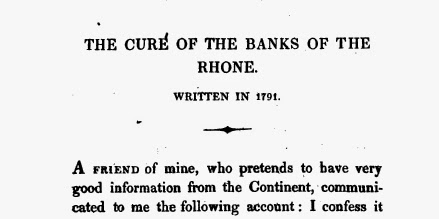
It is the two-volume set The Works of Anna Laetitia Barbauld, London: Richard Taylor, 1825 (available from Google, volumes one and two) that makes the attribution certain. It was compiled by Barbauld's niece Lucy Aikin who had access to a great deal of private material about her aunt. The letter appears in volume two, pages 260-7, under yet another title, The Curé of the Banks of the Rhone, with the notation that it was written in 1791. The text matches that of the letter to the Morning Chronicle.


With the appearance of the letter in her niece's collection of Barbauld's works, I accept the attribution and am left with the need to explain the advertisement consisting of Withy's gaming books along with Barbauld's letter.

The explanation is, I'm afraid, rather prosaic. Let us return to The Religion of Nature, the work causing all the confusion. Pictured below are the title page and introduction for the copy at the University of London Goldsmiths' Library. What I am not showing is a handwritten annotation on the front fly leaf "by Anna Letitia Barbauld", another attribution without evidence.

Religion, title page
Religion, Introduction


The title page indicates that the "short discourse" was delivered by "Mons. le Curé of ———" and it is "the short address to the jurymen of Great Britain", that is the introduction, that is by "Bob Short". The former is Barbauld and the latter must be Withy. Note the annotation "Withy" next to the name Bob Short on the title page. I am not the first to reach this conclusion, although I hope mine is better documented.

Quadrille, introduction
Levy [1757]
The introduction is signed Bob Short at Baker's Coffee-house, December 22, 1793. This is just as he signed the introduction to Quadrille, pictured at right: Baker's Coffee-house, January 1, 1793. I wish I could see a physical copy of The Religion of Nature. From the reproduction, it appears quite similar to the contemporary copies of Whist and Quadrille I have seen. All have an oblong format and the type and layout appear similar.

Indeed, Withy carried on his trade at the coffee house:
...Robert Withy...transacts as usual, all the branches of this business, and attends at Baker's Coffee-house, Change-alley, every day from one to three. (Morning Herald, October 23, 1799)
The conclusion is that Withy wrote the introduction to Religion as "Bob Short" while Barbauld wrote the text. My strong suspicion is that Withy, a former seller of books and prints, published all three pamphlets, explaining the advertisement linking all three books. We can say with certainty that Robert Withy and not Anna Letitia Barbauld was the author of Whist and Quadrille. Establishing that fact was my primary goal although I greatly enjoyed the detour provided by Barbauld. She was a remarkable woman—dissident, poet, educator and more. 

Professor McCarthy left me with some interesting questions about Withy and The Religion of Nature:
Did Barbauld know Robert Withy? Why did he reprint this piece from the [Morning Chronicle]? Did he know who wrote it, or did he reprint it because he agreed with it? Or did he reprint it because he cared about the plight of the Spitalfields silk-weavers?
I cannot answer these questions, but perhaps some readers can help?

If you're still not convinced about Withy's authorship of Whist and Quadrille, stay tuned for a brief part 3 coming shortly!

Wednesday, January 21, 2015

Who is "Bob Short"? (part 1)

In this essay, I return to Hoyle Abridged: or Short Rules for Short Memories at the Game of Whist. I find the chapbook annoying (see the discussion here) because there are so many editions and because they survive in such small numbers. The whist book and a similar title on quadrille (never reprinted) were written under the pseudonym Bob Short. The purpose of this essay is to resolve a lingering question—who is behind the pseudonym?

The whist book has been attributed to two different writers, Anna Letitia Barbauld (née Aikin) and Robert Withy. I had never investigated the case for Barbauld and thought the case for Withy convincing. Yet a recent discovery forced me to investigate further.

The earliest attirubtion to Barbauld is likely The Whist Table, A Treasury of Notes on the Royal Game, edited by "Portland" (London: James Hogg). Oh dear, another pseudonym! And an undated work! Not wishing to multiply my researches indefinitely, I am going to accept the assurance of a secondary source, Jessel (from whom more below), that "Portland" is a pseudonym for the publisher James Hogg and that the book was published in 1894. Hogg reprints most of Bob Short's rules, noting first in square brackets (suggesting an editorial voice):
It is an interesting fact, and one but little known, that these celebrated Rules were actually written by a distinguished lady—the authoress of the famous "Evenings at Home" and "early Lessons for Children," &c.
Anne (sic) Laetitia Aikin, afterwards Mrs. Barbauld, was a versatile and high-toned writer..."Bob Short" appeared about 1792, and enjoyed immediately great popularity, many editions being rapidly disposed of. The rules are substantially based upon "Hoyle": indeed, "Bob Short" only professed to be "Hoyle Abridged." (p212)
Hogg provides no evidence for the attribution. William Mill Butler repeats it, including the misspelling of Barbauld's forename, in the article "Books on Whist" in The Whist Reference Book (Philadelphia: John C. Yorston, 1899):
"Hoyle Abridged: or Short Rules for Short memories at Whist," by "Bob Short" (Anne Laetitia Aikin). Bath, 1792. Many editions. Over 7000 copies sold during the first year. (pp57-58)
The argument in favor of Robert Withy was made by William Prideaux Courtney in English Whist and English Whist Players (London: Richard Bentley and Son, 1894):
At the beginning of 1793, there came out a little tract called 'Short Rules for Whist, by Bob Short,' which was so popular among card-players that 7,000 copies were sold in twelve months. (p361)
This was likely Butler's source for the sales figure in The Whist Reference Book, but Butler did not go on to read the next page:
A satirical poem by John Gale Jones, the democratic orator, bearing the fantastic title of 'An Invocation to Edward Quin, as delivered at a Society called the Eccentrics,' and discussing the peculiarities of a social set at a tavern near Charing Cross, discloses the author's name. It was written by Robert Withy, a respectable stockbroker, and 'a facetious and pleasant companion, but very irascible,' the last years of whose life were harassed by pecuniary troubles. This statement finds corroboration in an advertisement of Robert Withy, stockbroker, which is appended to the brochure on quadrille, when his house is given as 13, George Street, York Buildings, and he is said to frequent Baker's Coffee-house. He died at West Square, Surrey, on September 19, 1803, aged seventy-two. Before trying his fortune on the Exchange, he had been for many years a book and print seller1 in Cornhill. (p362).
I would have thought this evidence dispositive. The citation from Invocation (London: printed for the author, 1803) includes two lines of verse:
Did W*thy tell the with his parting breath,
That all must share the fatal stroke of death?
with commentary below:
The late Robert W*thy, a respectable stock-broker, and an honorary member of this society. This gentleman was author of a little tract well known among card players, intituled, "Ten Minutes Advice to those who play at Whist," signed "Bob Short." (pp37-8)
Jones gives a title that does not match any surviving copies, but Hoyle Abridged is the only possible candidate. Courtney notes the advertisement of Robert Withy, stockbroker, in Hoyle Abridged, part II. Or, Short Rules for Playing the Game of Quadrille by Bob Short (pictured below). Similar advertisements appear in the 1791 and 1792 editions of Bob Short's Whist, editions not known to Courtney.
 
Withy.Quadrille.1
Levy [1757]
Withy advertisement


To this, I would add that a Robert Withy trade card survives in the John Johnson Collection of printed ephemera at the Bodleian Library and, on the back of the card, are twelve short rules for whist by "Bob Short".

Given Courtney's research, I always accepted the conclusion of Frederic Jessel in his Bibliography of Works in English on Playing Cards and Gaming (London: Longmans, Green, and Co. 1905):

Mr W. P. Courtney has proved conclusively that Robert Withy was the author of the above treatises. (page 303)
He comments elsewhere about a related later work:
These rules, evidently an imitation of the better-known 'Bob Short's' rules by Robert Withy, have been attributed to Mrs. Barbauld, apparently because she adopted the pseudonym for a tract unconnected with cards. (p265)
Jessel must be referring to Barbauld's Religion of Nature, With a Short Address to the Jurymen of Great Britain. By Bob Short. There is a note on the ESTC record that "Bob Short = Anna Letitia Barbauld".

Two recent happenings caused me to reassess the evidence. First, I read the charming new book by Julian Laderman, Bumblepuppy Days, The Evolution from Whist to Bridge (Toronto: Master Point Press 2014) which repeats the Barbauld (Aikin) attribution. Second, I began to work on the "Bob Short" items for my online bibliography of Hoyle. I reviewed all my notes on copies I have seen, copies in my collection, and contemporary newspaper advertisements. One advertisement leapt out at me:

1794-01-03 London Morning Post

Here was an advertisement for The Religion of Nature, attributed to Anna Letitia Barbauld AND for Bob Short's Short Rules for Whist and Quadrille!  Could Barbauld be the author of the gaming books all along?

I then began to find more similarities among the three titles. The imprints all show a connection to Baker's Coffee-House and involved many of the same booksellers:

  • Whist: Printed for the benefit of families, to prevent scolding: and sold by the author, at Baker’s Coffee-House, Exchange Alley; Nicol, St. Paul’s Church Yard; Ryall, Lombard Street; Bell, Strand; Fourdrinier, Charing Cross; and Debrett, Piccadilly, [1791]
  • Quadrille: Printed for, and sold by the author, at Baker’s Coffee-House, Exchange Alley ; Ryall, Lombard Street ; Newbery, St. Paul’s Church Yard ; Bell, in the Strand ; Fourdrinier, Charing Cross ; and Debrett, Piccadilly, [1793]
  • Religion of Nature: Printed for the benefit of the distressed spital-field-weavers, and sold at Baker’s Coffee-house, and by Richardson, Cornhill; Ryal, Lombard-street; Newberry, St. Paul’s Church-Yard; Bell, in the Strand; Foundrinier, Charing-Cross; and Debrett, Piccadilly, [1793]
The common language "printed for the benefit of..." is suggestive, as is the pricing "3d. or 2s. a dozen to give away". The same prices appeared in early advertisements for Whist. It felt to me that all three books might be written by the same person—would that be Robert Withy or Anna Letitia Barbaud?

My next step was to investigate the attribution of Religion to Anna Letitia Barbauld.

To be continued...

 Notes:

1Withy left the print- and book-selling trade in 1766. He auctioned off some of his stock on August 10, 1766 (see ESTC T150858, available on ECCO) and the remainder plus his copyrights at a trade sale on May 21, 1767 (see ESTC T130031).

Thursday, September 5, 2013

Contemporary Reviews of Gaming Literature

updated September 6, 2013 with some more information on Cautions. I suspect more will be forthcoming shortly. 

Patrick Spedding is, among other things, the bibliographer of the 18th century novelist Eliza Haywood. On his blog, he shared some contemporary reviews of Haywood's The Wife and The Husband (both 1756) and more. Those posts made me realize that I had a number of contemporary reviews of gaming literature, but never put them together in one place. I do so here, but first, a quick update...

The Scottish Miniature

One of my favorite Hoyles is Dundee.1, the miniature published in Dundee in 1806 that I wrote about in "The Scottish Hoyles (part 2)." I noted there that the "Canadian" copy was on its way to the National Library of Scotland. It has arrived in their catalogue here.

Reviews of Gaming Literature

There were a number of 18th century periodicals that published reviews or notices of nearly everything published in London. The two best know are The Monthly Review (1749-1844) and The Critical Review (1756-1817). They both started after Hoyle began writing, but both reviewed some books on gaming that I have discussed in this blog and one that I have not. These reviews are hugely important as they provide contemporary evidence of book publication and of book reception.
  • The Humours of Whist
The Monthly Review for February 1753 (pp143-4) notes a new edition of The Humours of Whist, a satire of Hoyle and of the piracy of his whist treatise. The notice reads:
The polite gamester; or, the humours of whist. A dramatic satire, as acted every day at White's, and other coffee-houses and assemblies. 8vo. 6d. Cooper.
This is a new edition of a pamphlet published a few years ago; it is intended as a satire upon Hoyle, author of the treatises on whist, and other games; and also upon gaming in general.
The review did not discuss Humours as a satire of piracy. Perhaps the piracy was out of mind by 1753.
  •  Calculations, Cautions and Observations, by E. Hoyle Jun.
I have never seen a copy of this book; it is not listed in ESTC. There is a copy in the British Library catalogue, shelf mark D-7913.bb.34. My experience with the British Library is that the prefix "D-" means that the book was destroyed in the Second World War. Indeed, I have confirmed that the book has been destroyed. A second copy survives, but is unfortunately not available to the public. We are left with a fair bit of information about the book--a contemporary review and the comments of a number of gaming bibliographers, Cavendish, Marshall, Jessel, and Hargrave (see my essay "Where can I learn more about Hoyle's writing?" for details on their works) who have seen and written about it.

The Critical Review for August 1761 is rather scathing:
Calculations Cautions, and Observations;  relating to the various Games played with Cards: Addressed to the Ladies. By E. Hoyle Jun. 8vo. Pr 1s Griffiths
Had not the younger Mr Hoyle made frequent unsuccessful awkward attempts to be witty and humorous we should pass over his hackney'd admonitions to the ladies, as the well meant counsel of stupidity; but affectation merits serious reprehension. We must therefore acquaint our author, that we can calculate the duration of his literary existence, with as much certainty as ever his predecessor could calculate a game of chances; and we venture to predict as a proof of our infallibility, that he may live just till he happens to be read and no longer. (p159)
Cavendish discusses the book in his article "Historical Notes on our Nation Card Game. Chapter 1" in London Society for January 1866:
A few years later another Hoyle begotten pamphlet made its appearance. It was a moral paper, dissuading from play. It is only interesting on account of its title, which is ingeniously framed so as to obtain admission for the pamphlet into card circles. It was entitled 'Calculations, Cautions, and Observations relating to various Games played with Cards. By Edmond Hoyle, jun.' The writer, under this pseudonym (which was, of course adopted to catch the eye), professed to be Hoyle's nephew. (volume 9, p65)
Similar comments were made by Julian Marshall in "Books on Gaming" in Notes and Queries for February 22, 1890:
At this point I must briefly mention a book which appeared with the following title : "Calculations, | Cautions, | and | Observations ; | Relating to | the various Games | played with | Cards: | Addressed to the Ladies. | By Edmond Hoyle, Jun.," 12mo., London, 1761, pp. 47, including subtitle and title. (B.M. and G.C.) In this there is nothing of our author's writing. It is a pamphlet in which the writer, who professes to be Hoyle's nephew, seeks to dissuade his readers from indulging in play. Of course, it is possible that Hoyle left a nephew...Much more probably "E. Hoyle, Jun." is a pseudonym, adopted with the idea that it would draw attention, as it doubtless did, to this pamphlet, which would have otherwise passed unnoticed. (7th ser. IX, p143)
The abbreviations B.M. and G.C. indicate that Marshall had seen the now-lost copy at the British Museum (now the British Library) and that in the collection of George Clulow. The United States Playing Card Company bought the Clulow collection in about 1900. Hargrave lists the Clulow copy on page 395 of her book A History of Playing Cards. Unfortunately, the UPSCC collection is not open to the public. 

Bibliographer Jessel had clearly seen a copy as he writes in his bibliography:
Probably a pseudonym. The author professes to be a nephew of Hoyles. The book contains a long extract from a Poem on Piquet, which I have been unable to trace. (p150) 
Within gaming literature, there is a sub-genre dealing with the morality of gaming. (See "The Nature of Gaming Literature (part 2)"). Hoyle never addressed the question and it is ironic that someone should exploit his name in doing so.

Although the book is unavailable, we are fortunate to have some much detail about it.
  • A New Treatise upon Real Quadrille
In my essay "Piquet and Quadrille Literature" I discuss a number of 18th century works on those card games, including the 1764 work A New Treatise upon Real Quadrille from the French of M. Martin. The Monthly Review for September 1764 gives a long excerpt and favorable notice (pp238-9):
A new Treatise upon real Quadrille, translated into English from the original French of Mons Martin...Small 8vo. 2s. 6d. sewed. Burnet.

The learned Author of this important treatise sets forth, as his motive for offering it to the public, that 'Quadrille, as it is played in England, is so little known in foreign countries, that an Englishman who goes abroad, is entirely ignorant of this game, except it be the value of the cards, their rank and order, and he cannot play it in any other country, so much has it been changed and augmented; from being tedious and languid, it has been rendered lively and amusing, by the additions and improvements it has received. Those who sit down only for amusement, will receive as much pleasure as those who play for profit and advantage.

'As the same taste cannot prevail for any length of time, it is requisite there should be as much variety in our amusements as in our dress. Quadrille fixes its reign in England; it occupies the attention of the Nobility, as well as the subordinate class of Gentry.' It is therefore to satisfy both, that I offer this treatise, which is written for those only who are acquainted with Quadrille after the English manner, who know the fort and foible of the game, and for these it will be necessary for me to enter into such disquisitions as they are unacquainted with; Beginners may have recourse to Mr. Hoyle's principles, I shall only rectify such mistakes as he has fallen into; add what he has omitted; stipulate the payments; being basted; the voles; the different changes the game at Quadrille may undergo; adding to each chapter, hands for and against; that is to say, the manner in which they should be played, either to win or lose them. It would be impossible to describe all the various turns which this game is susceptible of, a volume in folio would not be sufficient to compass such a design. I shall therefore only enter into the most material parts, and practice will render perfect such as would make themselves compleat masters.'

There is no doubt but this treatise will meet with all the encouragement which a work of so much consequence to the sons and daughters of Dissipation deserves; and the ingenious Author may, possibly, in time, become as great a man as the great Mr. Hoyle. To render it still the more fashionable, and the more universally acceptable and useful, it is printed in French and English;—perhaps too, with a particular view of introducing it, as a school-book, into the principal boarding-schools, those especially for the education of young Ladies.
The Knave of Diamonds tries his wily arts,
And wins, O shameful chance! the Queen of Hearts.
  • Whist, A Poem in Twelve Cantos
I am much less familiar with The Analytic Review published by the dissident John Johnson. In an appendix to Volume IX for 1791 (pp515-7), there is a review for Whist, A Poem in Twelve Cantos, a book which I discuss in the essay "Eighteenth Century Whist Literature:"
The author of this poem is not destitute of talents, for versifying; and truly he needs them all, when he undertakes to berhime the laws and maxims of the game of whist. The poem opens with an invocation to the spirit of Hoyle, and observations on the invention of cards, in which the writer describes, with some humour, the benefits which mankind have received from it. An agreeable tale of young Moody and his aunts, by whom the game of whist was first invented and practised, prepares the way for a full detail of the laws of whist ; and a long course of rules is laid down respecting memory, judgment, and temper. The poem, when it becomes didactic, is tedious; but it is occasionally enlivened with pleasing fiction, and with reflections, in which the writer, not unsuccessfully, indulges a vein of ironical humour. 
The review quotes some 90+ lines from the poem, then concludes:.
After the amusement this poem has afforded us, we feel ourselves not disinclined to admit the author's own judgment upon his work, when towards the close he lays,
I paused, and what was done with joy reviewed,
And thought it (if I here the truth may tell)
Hit off, upon the whole, exceeding well.
Conclusion

I wish that the reviews were in existence in the early 1740s when Hoyle was producing most of his books. It would have been interesting to see how they were received.

Tuesday, August 28, 2012

Piquet and Quadrille Literature

In "Eighteenth Century Whist Literature," I looked at early works in English on the game of whist other than those by Edmond Hoyle. In a similar vein, this essay will examine early works on quadrille and piquet. As I noted in "Bibliography of the Cogan Hoyles," Hoyle published Piquet in January 1744 and Quadrille in October 1744 and the text remained in print well into the 19th century. What literature predated Hoyle? What else was published in the 18th century?

Editions of The Compleat Gamester and The Court Gamester, discussed in "The Predecessors of Hoyle" mention both games. Unlike whist, there were also separately-published books on both games that predated Hoyle.

For piquet we have the 1651 work The royall and delightfull game of picquet. Written in French: and now rendred into English out of the last French edition. London: printed for J. Martin, and J. Ridley. The French literature on piquet goes back another two decades to Le jeu du picquet, Paris: Charles Hulpeau, 1631, the earliest book in French on any card game. It was reprinted a number of times in the 17th century and is likely what was translated into English in 1651. (See Depaulis, Les Loix du Jeux.)

The only other 18th century book on piquet is A New Treatise on Piquet; in French and English, London: printed and sold for Mess. J. Walter; and R. Davis about 1765. The author is "Mr. de Chateauneuf, captain of the Conde Regiment of Infantry. Acknowledged to be the most able player at Piquet in Europe." I date the book from an advertisement in the Gazetteer and New Daily Advertiser of December 31, 1765.

de Chateauneuf, Piquet
Levy [1741]
The book is curious. Each opening consists of French text on the left and English on the right. Interestingly, the French title page gives a cost of 18 sols, while the English title says one shilling and sixpence, suggesting that the book was sold in both countries.  It is quite rare, with ESTC recording a copy at the Huntington and two incomplete copies at the Bodleian.

One work on quadrille predates Hoyle—The Game of Quadrille; or Ombre by Four, with its establish'd Laws and Rules, As it is now Play'd at the French Court. The book was printed in London for R. Francklin and is undated, but the book was likely printed in the mid-1720s. It is advertised as "this day is republish'd" in the August 13, 1726 issue of the Daily Post. The title page indicates that it was "done from the French, just printed at Paris." It is an extract from the 1724 work Les Jeux de Quadrille et de Quintille, printed in Paris for Theodore Le Gras.

Hoyle's Quadrille was published in 1744 and two decades later the game must have surged in popularity—three new books appeared in short order. The May 1, 1764 issue of the Public Advertiser notes two of them in adjacent advertisements. The first is A Brief and Necessary Supplement to all Former Treatises on Quadrille, by No Adept, printed for T. Becket and P. A. De Hondt in London. Julian Marshall writes that the book:
...consists mainly of a criticism of Hoyle's quadrille, favourable on the whole, but particularizing the points on which the writer differs from our author. In the dedication "To the Ladies," he tells them that "After reading this little book, you will understand what Mr. Hoyle says as well as any man in England..." ("Books on Gaming" in Notes and Queries, 7th S. IX. February 22, 1890, page 144).
Interestingly, other advertisements (for example, the London Evening Post of February 12, 1765) note that  the book "will go into a fan," suggesting that the text was incorporated into a ladies fan, perhaps like the ones I describe in "The fans of Hoyle."

The second of the advertisements is for another book with parallel French and English texts:
In the press, and next week will be published, at the particular desire of several persons of distinction, in French and English, A Treatise upon Real Quadrille, A work published within these six weeks at Paris, which is totally different from that of Mr. Hoyle, and all other treatises that have hitherto appeared upon this game.
It is not clear what Parisian book the advertisement refers to—no such work appears in Depaulis, the standard bibliography of French books on card games.

Martin, Quadrille
Levy [1741]
The book was printed in 1764 in London for G. Burnet from the original French of Mons. Martin. Although the publisher is different from the one who published de Chateauneuf's Piquet, the appearance of the book is identical. French and English appear on facing pages. Unlike de Chateauneuf, both title pages give the price of 2 shillings sixpence, in English currency for a sewn binding. Like de Chateauneuf, the book is rare, with institutional copies only at the British Library and the University of Missouri.

de  Bergeron, Free Masons Quadrille
Levy [1741]

A third quadrille book appeared about the same time, The Free Masons Quadrille; with the Solitary. Printed by order of the Prince of Conti, Grand Master of the Lodges in France; and revised by Mr. De Bergeron...In French and English. London: printed for J. Walter and G. Burnet, 1765. The book is not recorded in ESTC or Depaulis; Jessel had not seen the book, but found it mentioned in a monthly list of books for 1764 (item 1404 in his bibliography). The price is listed as one shilling in both French and English.

Update April 29, 2015: In addition to my copy, there is one in the Library and Museum of Freemasonry in London, shelf mark A 750 FRE.

Note that Walter and Davis published de Chateauneuf, Burnet published Martin, while Walter and Burnet published de Bergeron. An advertisement in the Gazetteer and New Daily Advertiser of December 12, 1731, brings the three works and the three publishers together:

This day is published, A New Treatise upon Real Quadrille, printed for R. Davis..., J. Walter...; and G. Burnet...where may be had, A New Treatise on Piquette, French and English, by M. Dechateauneuf; and the Free Mason's Quadrille. 
The three rare works, each with the facing French and English text, are also brought together in my copy, in the elegant contemporary tree calf binding, pictured below.

two views of binding
The bibliographer in me wonders if this book was bound prior to retail sale, or whether a later owner combined the books into a single volume. The prices of the individual works, both in the title pages and the advertisements, suggests they were sewn rather than leather bound. Indeed the Martin title page explicitly said it was sewn. The one advertisement which mentions the three titles, does not offer the three bound as a single volume. Yet my copy shows no evidence of other sewing, as was apparent in a number of Hoyles, discussed in "Hoyle's 'sixth' edition and progressive ornament damage" here or in "The Osborne Collections of Hoyle (1745-7)" here. Having seen many copies of Cogan Hoyles bound together, I concluded in another essay that Cogan issued collections of Hoyle's separately-published works.

With the overlapping publishers of the three works, their similar appearance, and the single advertisement offering each of them, it seems possible that this is a publisher's binding, though one fancier than I am used to seeing on English gaming books. It is more typical of the bindings of contemporary French gaming books. There are so few copies of these titles, each of which was issued separately, that likely we'll never know if this is a publisher's or a bespoke binding. 

References:

The bibliographical writings of Marshall, Jessel, and Depaulis are detailed in my essay "Where can I learn more about Hoyle's writing?"