Showing posts with label backgammon. Show all posts

Tuesday, December 27, 2022

2022: The Year in Collecting

A dozen books came my way this year--some condition upgrades, some of interest only to the Hoyle completist, plus a few gems. I'll discuss five of them in the order they were published.

The earliest acquisition is a third edition (1671) of Wits Interpreter: The English Parnassus. Most collectors want first editions, but I would not have been interested in the first (1655) or second (1662). The book collects love songs, poems, and dialogues from plays in reaction against the Cromwell revolution. With Charles II restored to the throne in 1660, the third edition included material on games, as highlighted in the preface:

I took advantage from this golden season...the golden age of His Majesties happy Restauration, from which all manner of Wit and Ingenuity received as it were a new birth, to add several Games and Sports, the most A la Mode and Curious, that are now in esteem among the Gentilest...
Part 7 contains chapters on ombre, piquet, gleek, cribbage, and chess. Jessel observes that this book is the earliest that has come down to us with a treatise on card games, predating The Compleat Gamester (discussed here) by three years.

1671 Wits Interpreter
Levy [2175]

My copy is in a luscious, extensively decorated morocco binding with the bookplate of Charles Tennant of The Glen in Scotland. 

Bookplate of Charles Tennant

There are two minor bibliographical oddities about the book. First, the title page identifies the author only as J. C. and the book it has universally been attributed to John Cotgrove, including by the ESTC. Joshua McEvilla recently demonstrated conclusively the the author is John Cragge in The Library, 18:3 337-344 (2017). 

Second, there appear to be at least two versions of the third edition. Mine (like ESTC R2199) has the imprint "printed for N. Brook, at the Angel in Cornhill, and Obadiah Blagrave, at the Printing Press in Little Britain, MDCLXXI." Other copies (like ESTC R225554) omit the second line of the imprint. Moreover, at least one copy of the second issue ends on page 351, while other copies have a catchword at the bottom of 351 and the book continues through page 520. Library inquiries would be required to understand the variants I have seen in a small number of copies. 

I purchased another copy of Games.5, the "fourteenth" edition of Mr. Hoyle's Games (1767). As I wrote in an earlier essay, some copies have a cancel title page, others the uncancelled page, and a couple have both. I found a copy with both title pages, crossing a completist variant off my list. 

Also among my desiderata was the New York edition of Beaufort's Hoyle's Games Improved (1796). I found a Boston edition in 2014. When I purchased a Philadelphia edition in 2018, I wrote "Does anyone know where I can pick up the one sold in New York?" I got an email from a bookseller friend noting that another dealer had listed that book for sale and can now cross that off the list.
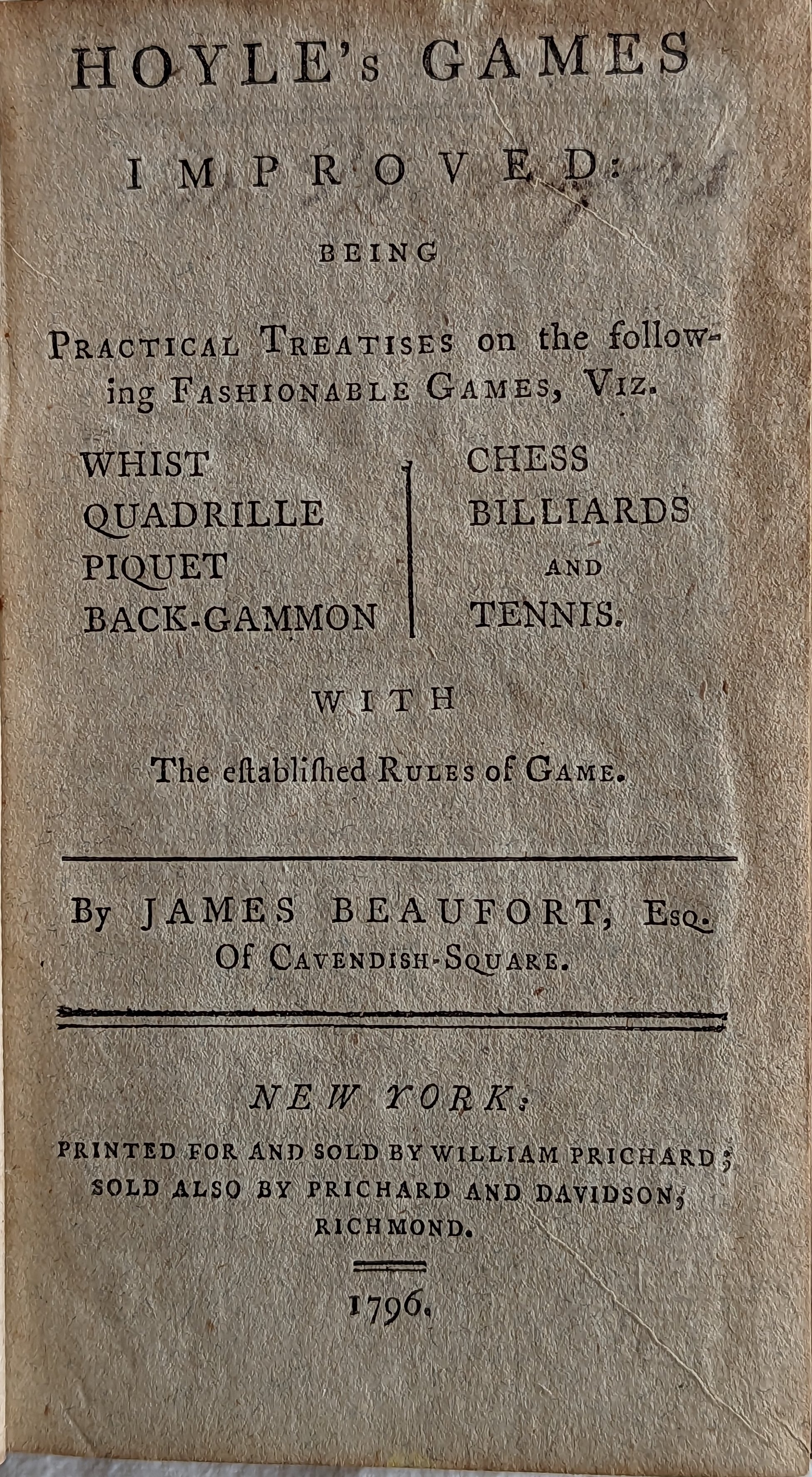
Hoyle's Games Improved
New York (1796)
Levy [2180]

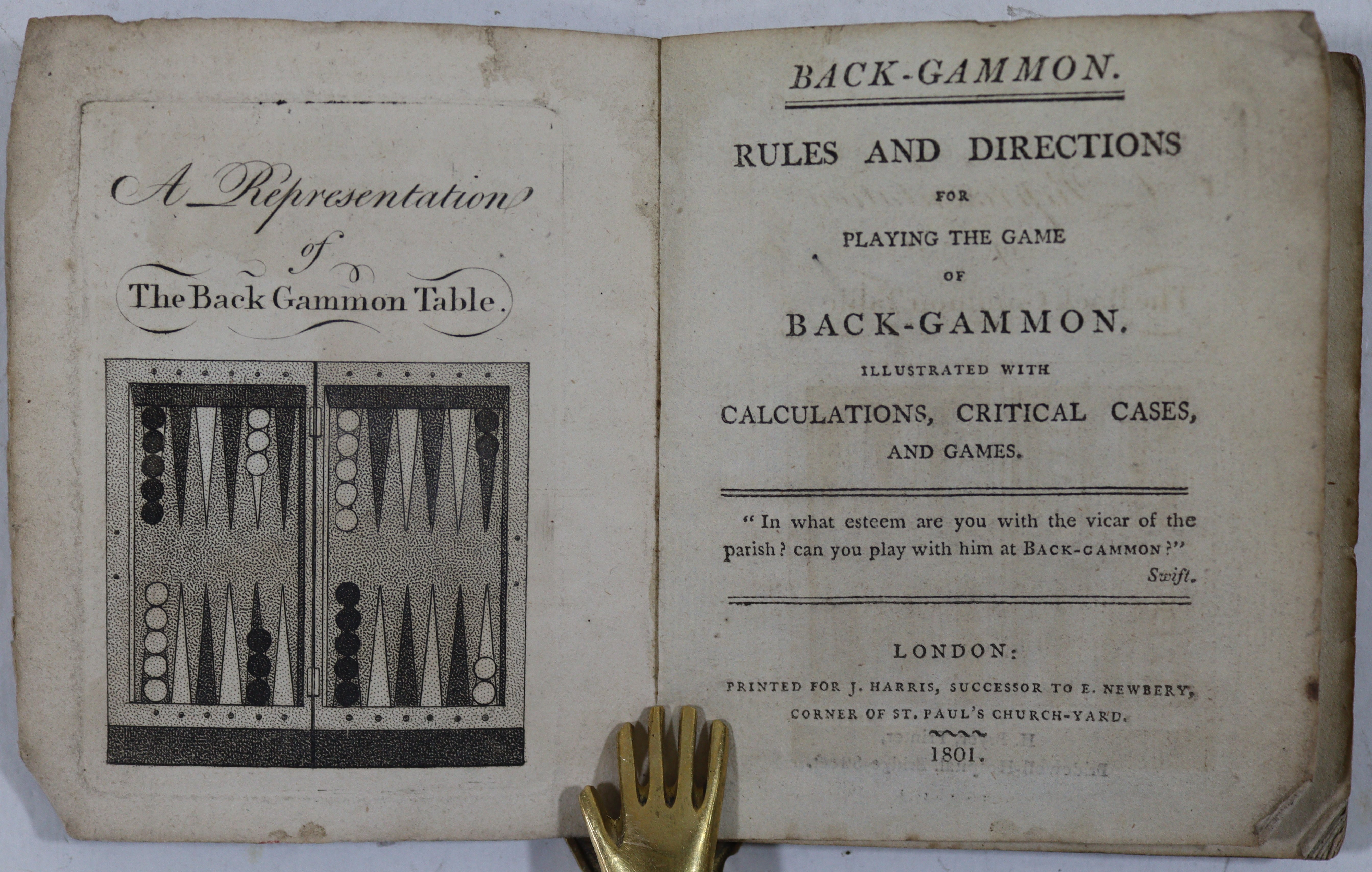
The next item is not obviously by Hoyle, although the text is almost entirely his. It was first published in 1798 by H. D. Symonds. I noted an 1817 reprint by John Harris in an essay on eighteenth century backgammon literature. I bought an earlier Harris edition (1801) at auction.

1801 Rules and Directions for Backgammon
Levy [2177]

1801 Rules and Directions for Backgammon

The last book came from an annoyingly mixed lot at auction, consisting of a Compleat Gamester worth thousands, a signed Hoyle (which I had) worth hundreds, and a later obscure Hoyle worth not very much. The obscure Hoyle is an 1820 reissue of a book first published in 1808 with a cancel title, although why it got reissued I cannot say. The book is rare, with copies recorded at Cleveland Public, Louisiana State, and Vanderbilt. Great rarity does not always mean great value. 


1820 The New Pocket Hoyle
Levy [2181]

I was not willing to bid anywhere near enough to be competitive on the lot, but I tried an approach that is usually unsuccessful. I wrote the auction house and told them of my interest in the least of the books and asked them to pass my name onto the winning bidder. They did so and I heard back from the winning buyer, a bookseller I know casually, and he was delighted to sell me the book for a modest price. A happy ending, and another to cross off my list. 

Best wishes for a happy 2023!


Monday, October 22, 2012

Eighteenth Century Backgammon Literature

As I've discussed many times, in the 1740s, Hoyle wrote short treatises on the games of whist, backgammon, piquet (with a section on chess), and quadrille. To establish context for his work, I surveyed the contemporary literature for some of the games in the essays "Eighteenth Century Whist Literature" and "Piquet and Quadrille Literature." This essay completes the survey by looking at backgammon.

Backgammon is mentioned in The Compleat Gamester (1674), a work I discuss in "The Predecessors of Hoyle," but it is really in the 18th century that we get the first works devoted to the game. Interestingly, the first two are poems.

Pax in Crumena is a series of bawdy poems written in 1713 by Thomas Rands, one of which is "A Game of Back-Gammon, Play'd by My Lord and my Lady." In it, the vocabulary of backgammon is used to create sexual metaphor, as is evident in the second verse:
Cinque Trea, the first Night,
Did yield her Delight,
And she made a Point with the same:
Size-Ace the next Throw, or she's ruined quite,
And in danger of loosing the Game:
See how bad her Case is,
For up came Two Aces,
And she is not pleased atall.
Adieu my Delight;
I'm Gammon'd Out-right;
What no more to Night
For my Merkin, my Jerkin, and my Water Firkin?
My Lord, your Two Aces are small. 
Only the very curious should seek definitions of the unfamiliar terms in the last lines (NSFW).

A more substantial effort is Back-Gammon or the Battle of the Friars by Daniel Bellamy, 1734, reprinted in his collection Miscellanies in Prose and Verse, 1741. The book is known for its charming frontispiece, pictured below. 

Bellamy, Back-Gammon, 1734.
Levy [1650]
    

 What is more remarkable is that the poem describes the moves in a game of backgammon, certainly constructed for the poem. Nonetheless, it is the first game ever recorded, played between the "dougthy friar" Fabris and his brother friar Vituleo. The description begins:

For the first Onset Fabris did prepare,
And Quator Size began the mighty War.
(This was a Service he perform'd by Rote,
And got the * Point that suited with his Coat)
          [in a footnote * = The Parson's Point]
Vituleo then, two Sixes by his Side,
Came rushing forward with a manly Stride.

Fabris as yet conceal'd his inward Pain,
Duce Ace oppos'd, but Oh! oppos'd in vain:
Homeward three Pace mov'd, he singly stood,
And stopt directly in Vituleo's Road.
This is my Pris'ner, Sir, Vituleo cries,
And if he meets me once again, he dies.
Rick Janowski has recreated the entire game, which, in modern notation, is:
     Fabris            Vituleo
1)   6-4   8/2 6/2     6-6   24/18(2) 13/7(2)
2)   2-1   13/10       2-1   18/15*
3)   6-6   ----        3-3   18/15 8/5(3)
4)   3-1   bar/21      2-1   6/4* 5/4
5)   4-4   ----        3-3   13/10(2) 6/3(2)
6)   5-4   ----        5-2
The play is quite weak by modern standards. Fabris should play 24/22 6/5 for his second move and bar/22 6/5 is somewhat better for his fourth. Vituleo's second move is a blunder (7/5 6/5 is much stronger), as is his third move, which should be 8/5(2) 6/3(2). The position, with Vituleo to play 5-2 is:

Vituleo (white) to play 5-2.
Vituleo will certainly play 13/8 10/8 completing a prime (six points in a row), leaving Fabris with three trapped checkers. Apparently Fabris resigns:
Vituleo presses on with Cinque and Duce,
And made the future Blows of little Use.
This for a Rampart he design'd to keep,
Or'e which the nimblests Warrior could not leap.

In safety now the Olive Squadrons move;
In vain the Ethiopian Pris'ners strove,
In Number Three; they could no farther go,
coop'd up within the Trenches of the Foe.
The Friar almost did his Faith remounce,
And lost a tripple Victory at once. 
All in all, a remarkable bit of backgammon history!
Levy [1537]


Hoyle's Short Treatises on the Game of Backgammon appears in 1743 and is reprinted throughout the 18th century. I have discussed the publication history throughout the blog and will not repeat it here, other than to show the title page at right. It is the first instructional book on the game of backgammon and the advice, though superficial, has stood the test of time remarkably well.


One other backgammon book appears in the 18th century: Back-Gammon. Rules and Directions for Playing the Game of Back-Gammon, London: printed for H. D. Symonds, and Lee and Hurst, 1798. Symonds was a London bookseller who published hundreds of works from the 1780s into the 19th century. A handful of those books related to games:
  • New Royal Game of Connections, 1794, apparently an original work by an unknown author.
  • Payne, Introduction to the Game of Draughts, a work first published in 1756 and incorporated into the 1779 edition of Hoyle's Games Improved (see "The Most Important Hoyle after Hoyle)".
  • Three editions of Chess Made Easy in the late 1790s, a pastiche of earlier writing on chess, much of which is taken from Hoyle. For example, in Chess Made Easy, we read "In order to begin the game, the pawns must be moved before the pieces, and afterwards the pieces must be brought out to support them." (pp28-9) Hoyle had written in 1744 "You ought to move your pawns before you stir your pieces, and afterwards to bring out your Pieces to support them." (Piquet p55). Hoyle was in the public domain at this point, so there is no suggestion of piracy.
Back-Gammon 1817 reprint

It won't be surprising then, that Symond's backgammon publication was also lifted from Hoyle. There are a couple of pages of on the origins and rules of backgammon, but the rest of the book is a slight rewording of Hoyle. The book was reprinted verbatim in 1817 for J. Harris, as pictured at left.


Reprints of Hoyle such as Chess Made Easy and Back-Gammon present quite a challenge for the Hoyle bibliographer. The works are nowhere identified as his writing, but are clearly derived from it. None of the earlier Hoyle bibliographers {see "Where Can I Learn More about Hoyle's Writing?") have included these works in the Hoyle canon, where clearly they belong. Why didn't Hoyle's name appear on the title page?