Showing posts with label bibliographer's mantra. Show all posts

Monday, April 13, 2020

The First Piracy. Part 5. Bibliographical Concerns

updated June 29, 2020
This is the fifth and final essay on the first piracy of Hoyle's Whist. I have identified lots of variants in the surviving 44 copies. Here I ask the bibliographical questions--how many editions, issues, and states do these copies represent? The bible for answering these questions is Bowers.1 Indeed the mantra in my bibliography class was WWBD--What Would Bowers Do? His prose is dense, often argumentative, sometimes infuriating. Non-bibliographers who want a flavor of Bowers will be rewarded with frequent excerpts of his writing below.

To recap, part one provided an overview of the piracy and its physical structure. The second looked at gatherings B-H and K, noting that there were two settings of type for each of them, but one setting of I, L, M, A, and χ. The printer James Mechell printed two thirds of the book and decided to increase the print run. Most gatherings were reset; others were printed in larger quantity.

Essay three focused on gathering A, noting that even though there was a single setting of type, there were variations in the half title, the title, and the Advertisement. Essay four put things together. I was able to sequence the variants in gathering A, identify four phases of printing, identified by which variant of the title page is included, and summarize them in the chart below:


variations in gathering A

Variant 1 of the title page is the most common, appearing with variants 1 of the half title and Advertisement. For phase 2, the half title was reset, unlocking the forme and causing some type movement on title page, variant 2. That spacing was in part corrected in variant 3, when some type also slipped at the lower right margin of the Advertisement. Finally, the words "second edition" were added to produce variant 4 of the title page.

From examination or reports of 44 copies (recall that one copy lacked gathering A and cannot be included in the charts), I have identified which settings of the later gatherings combine with which phase of gathering A.


Setting of later gatherings grouped by title page variant

Before I delve deeply into Bowers' Principles, I should note that I'm not sure he would approve of the chart above. In a footnote, Bowers writes:
Attempts to link a press-altered title-page with certain press-altered formes of the text in another sheet usually betray bibliographical ignorance. (51)
I am linking a press-altered title page with other sheets that are reset, rather than altered in the press. As the data show, the correlation between the printing phases of gathering A and the resetting of the rest of the book are overwhelming. I trust that I am not betraying ignorance.

One of the jobs of a bibliographer is to classify copies of books by edition, issue, and state. Bowers defines these terms in a dense 88-page Chapter 2 of Principles. He notes that:
...books exist in separate editions and issues; parts of books may exist in variant states, although in certain special circumstances a copy of an edition or of an issue may itself be said to exist in a certain state. Bibliographies customarily give separate major headings only to editions, with issues listed under subheadings. Variant states are ordinarily treated under the heading or subheading to which they apply... (37)
Bowers defines the key terms:
An EDITION is the whole number of copies of a book printed at any time or times from substantially the same setting of type. (39)
An ISSUE is the whole number of copies of a form of an edition put on sale at any time or times as a consciously planned printed unit...(40).
...STATE is synonymous with VARIANT, and can be applied to any part of a book exhibiting variation in type-setting...(41)
How do these concepts apply to the first piracy of Hoyle's Whist? How many editions? Are there any separate issues? Which of the variants constitute a separate state? It's certainly not obvious.

Bowers does allow that no definition of "edition, issue, and state will indicate the invariable line to take with a small number of abnormally complex books..." (38) Perhaps this is one of those? Indeed trying to apply the definitions to the piracy has made me a little crazy. At various times over the past decade or so, I've come to different conclusions. Let me lay out my current thinking in this essay. I welcome comment from other bibliographers.

I am going to approach the problem in a series of steps. First, I will eliminate the outliers. Looking at the chart above, it is clear that almost all the copies with a variant 1 title page have first settings of the later gatherings. Almost all the copies with variants 2-4 have second settings. The outliers were introduced not when the book was printed, but when it was bound. After printing, the sheets must be dried, cut into half sheets, folded, and brought together for sewing. It is easy to see how the odd second setting might find it way into a book composed primarily of first settings. Eliminating the outliers simplifies the problem:


Eliminate outliers

Bowers does not address outliers introduced during binding specifically. He does examine examples where different editions sheets are bound indiscriminately (110-1), but not where the edition sheets, as here, are bound nearly uniformly. Bowers warns again letting differences in binding dictate new states (43-4). I am very comfortable ignoring the outliers noting them in the bibliography as copy-specific differences rather than as separate states.

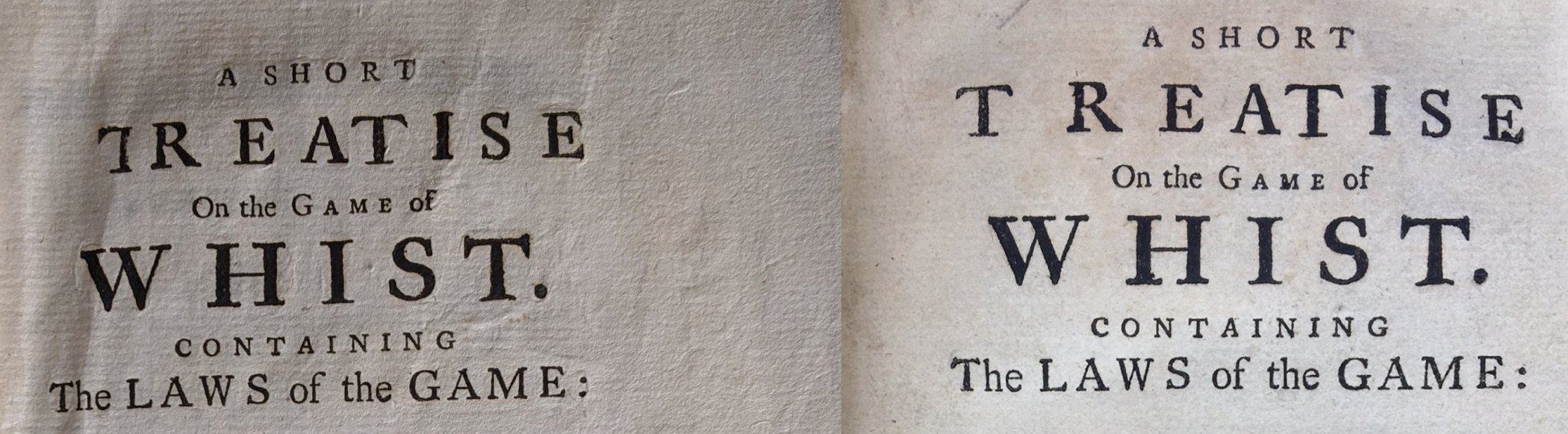
My second step is to look at the differences between variants 2 and 3 of the title page A2r, which occur with differences in the Advertisement on A3r.

A2r


A3r

Perhaps the leftward movement of the T was deliberate. In the advertisement, the semicolon after "Undertaking" popped out of the forme and the hyphen and "l" from the next two lines migrated upward. As I mentioned in part 3, I have no idea where the comma after the catchword "'vai" came from. Bowers deals precisely with this situation:
Individual types were sometimes jerked from the forme by the ink-balls. Sometimes they went unnoticed...(47)
Such a change, Bowers notes, does not affect edition or issue, but state, so we can collapse variants 2 and 3 as we think about edition and issue:

Collapse variants 2 and 3

What about variant 1 versus variants 2-4? This is when Mechell decided to expand the print run, resetting gatherings that had already been printed and distributed. Bowers address this situation in his discussion of edition, but there is a circularity is his language that bothers me:
In quite a different category are books where the type was not left standing by design from the start, or from a point early in the printing, but had been normally undistributed when a decision was made to reset and print a new edition. (109)
It is the word "edition" that bothers me. The decision is to reset and print more copies. Whether they constitute a new edition is precisely the question. Bowers continues:
This decision may have been reached towards the end of the first printing and some formes kept standing by design, but the difference is immaterial. The characteristic of these books is that the standing type is from the last sheets to be printed (including preliminaries when these were last printed) [I, L, M, A, and χ in our case] and is not scattered throughout the book in a manner clearly showing that the lack of distribution was abnormal. (109)
He gives a number of 16c and 17c examples including one2 where the "title page was used in the identical setting in the second edition" along with some standing type. As I look at surrogates of that example, I see that what Bowers and other sources call the second edition, does have a title page identical with the first. This is exactly the Whist piracy--enough of the later sheets have been reset after variant 1so that it is not substantially the same setting of type. It is a second edition, even though one would not discern that from the title page.

Now what of Phase IV when the words "second edition" were added to the title page? Books from Phase IV are substantially the same setting of type as Phases II-III, so they cannot be a third edition. Could they be a separate issue?

Generally, Bowers wants a change in title page to create an issue. I'm going to ignore his distinction between separate issue and reissue, but will give you a flavor of his language:
We must, therefore, arbitrarily assume that any alteration made in the form of a book which was not important enough to justify a new title-leaf to call attention to it or to take advantage of the opportunity to bring the book up to date is a printer's attempt belated to construct an 'ideal copy' of his original issue and is not a reissue in which sheets are given new life or chronicle change in publishing conditions by alteration of form. (67)
But is the change in title page for phase 4, adding the words "second edition" to the same setting, enough to trigger another issue? Bowers would say no, although he doesn't have an example that matches exactly. He considers stop-press alterations of an imprint or date on the title page as creating a separate state, not issue:
Alteration of an imprint, usually for a change in a printer's, bookseller's, or publisher's name, or in the date, when performed by stopping the press comes in the same category as any stop-press alteration...If we are to regard the distinction between state and issue as necessarily made on bibliographical grounds whenever possible--that is, on the printing of the book rather than on less tangible considerations--alteration of a date or of a name in the imprint by stopping the press during the impression definitely comes under state* since it was demonstrably performed during continuous printing. (50)
*In a long footnote, Bowers notes the difference between bibliography and cataloguing, saying in part "...for cataloguing purposes variation of any kind on the title-page, if observed, constitutes a different issue. The use of the term issue in two quite different senses by cataloguers and bibliographers is undoubtedly of the greatest inconvenience for scholars and confusing to the student, but it is scarcely an argument that bibliography should limit itself to elementary cataloguing standards in order to procure uniformity." (50-1)
I am confident that Bowers would treat the stop-press insertion of "second edition" as a bibliographer, not a cataloguer; as a state, rather than an issue; .

Certainly the exposition of the story is more important than the bibliographical classification. Nonetheless, I do need to organize this section of the bibliography by the usual constructs of edition, issue, and state. I conclude that copies with the first setting of gatherings B-H and K are one edition (described here). Copies containing the second setting are a second edition, with three states corresponding to phase 2, 3, and 4 of gathering A (described here).

It seems odd that only some of the copies of the second edition say "second edition" on the title page, but that is the difference between bibliography and cataloguing. 

Do you agree?

Did you enjoy your taste of Bowers?

NOTES

1Bowers, Fredson. Principles of Bibliographical Description. St. Paul's Bibliographies, 1987
2Randolph, Thomas, Aristippus (1630). 

Wednesday, April 8, 2020

The First Piracy. Part 4. Analysis

updated June 29, 2020
Part three of this series looked at gathering A of the first piracy of Hoyle's Whist. I described differences in the half-title, the title, and the advertisement. It would be useful for you to have that essay open in another window alongside this to be able to see all the photographs there. To recap:
  • The half title (A1r) is frequently not present in surviving copies. Ignoring one odd copy, almost certainly a later facsimile, two settings of type survive and initially there is no way to determine their priority. 
  • The title page (A2r) occurs in four variants, but sequencing is clear. Some type shifted between variants 1 and 2 leaving an oddly-spaced word "Treatise". Variant 3 improved the spacing in "Treatise". Variant 4 is like 3, but adds a line "second edition."
  • Some type shifted at the bottom right margin of the Advertisement on A3r. The earlier variant is is correct, while variant 2 has some inadvertent oddities. 
I have seen more than half of the surviving 44 copies and received reports on the others. There is regularity in how the four variants of the title page combine with variants of the half title and the advertisement:


Variation in gathering A

I said I have data on 44 copies and the chart shows only 43. One copy at the Bodleian Library, shelf mark Jessel e.640 lacks gathering A altogether, so one cannot say which title page it might have had.

With the title page variant 1, we always have the first variant of the half title and the first variant of the Advertisement. This includes 31 of the 44 surviving copies of which 6 no longer have a half title.

It seems that after these were printed,the half title was reset to variant 2. At the same time, there was some rightward movement of type in "Treatise" at the top of the title page, but no change in the Advertisement. I would have more confidence in the regularity if there were more than 4 copies of variant 2.

Why was the half title reset at this point in printing? One possibility is that the compositor needed the type from the half title to print some other work. The shop would have had fewer pieces of the larger letter forms that were used in the half title than those used for the text. You could imagine that the printing was interrupted, the type for the half title distributed and used elsewhere, and then the half title was reset. In the course of making this deliberate change, accidental changes were introduced on the title page while the type was unlocked. Speculation, to be sure, but it does account for the variation we see. 

The third variant of the title page moves the "T" in treatise to a more pleasing position, perhaps a deliberate change. At the same time, there is accidental type slippage in the lower right margin of the Advertisement. Only three copies survive with the variant 3 title page.

Finally, variant 4 adds the line "second edition" to the title page. There are five survivors from with two missing half titles. The motivation for this is, I think, clear. The printer/publisher James Mechell wanted to make his piracy appear to be a popular seller. Likely, he wanted to have a second edition to compete with the authorized second edition published by Francis Cogan.

To repeat, the counts vary greatly between variant 1 on the one hand (31 surviving copies) and the later variants (4, 3, and 5 survivors) on the other. That makes conclusions about the later copies more tentative than those about the earlier ones.
Note that by looking at many copies, we can determine the priority of the half titles--variant 1 always occurs with the earliest title page and variant 2 with one of the later title pages. This is a matter of how the book was printed--in gathering A the half title was in the same forme as the title page.

Similarly, we can play the same game with the variants in other other gatherings and determine priority. The rules are a bit different. Here are the counts of setting 1 and 2 for each phase of printing of gathering A:


Setting of later gatherings grouped by title page variant

In general, you can see that title page variant 1 has the setting 1 of all the gatherings, while title page variants 2-4 have setting 2. In part 2 of this series of essays, where I showed to settings of each gathering side-by-side, I conveniently put setting 1 on the left and 2 on the right.

We were able to determine the priority of gathering A (and in particular of the half title) because all the pages (the half title, title, and Advertisement) were in the forme at the same time. The priority of the title page and Advertisement were clear and we were able to infer the priority of the half title.

The story is a bit different with the other gatherings. They were not in the press at the same time as gathering A; indeed each was a distinct unit of printing. It was the binder who stitched all the gatherings together to form a book. It is logical that early versions of gathering A were sewn together with early versions of B, C, D, and so on, and that lets us infer the priority in printing the later gatherings. What I have called setting 1 was printed before setting 2.

The data is quite consistent, but there are exceptions. For example a variant 1 title page at the Newberry Library (shelf mark V 1639.42) has a second state gathering E, while another (reported to me by a bookseller) has second state gatherings B and K. There is also an odd copy from title page variant 4 at the Bodleian Library (Jessel e.641) which has the first setting of all gatherings except B.

Recall Jessel e.640 that lacked gathering A, so we couldn't identify which printing phase it belonged to. It has second states of all later gatherings.

Another observation is that for each later gathering, about 32 of the 44 copies have first settings. This suggests that Mechell decided to increase the print run by roughly a third when it was nearly done.

This was a quite detailed look at one book. With many surviving copies and many variants, we could infer a great detail about its printing history. If you enjoyed this, you may want to look at a much, much more sophisticated example: see Stephen Tabor, "James Shirley's Triumph of Peace: Analyzing Greg's Nightmare" in Studies in Bibliography 60:107-212 (2018) available online.

There is one issue I'd like to take up in the next essay. How does the printing history we have seen work with the cornerstone concepts of bibliography: edition, issue, and state?

Monday, April 6, 2020

The First Piracy. Part 3: Variants in Gathering A

updated June 29, 2020
From parts one and two, the story so far:
  • The first piracy of Hoyle's Whist is an octavo gathered in fours, and collates 8o: [A]4 χ2 B-M4.
  • The printing would have started with the B gathering and continued through to M. Gatherings A and χ would have been printed last. 
  • There are two settings of type for gatherings B-H and K. Both settings were printed at the shop of James Mechell. From the evidence presented so far there is no where to determine which might have been printed first.
  • There is one setting of type for gatherings A, χ, I, L, and M. 
Even though there is only one setting of type for gathering A, there are interesting variants to be discussed in this essay.

First a short digression that will make sense only to those who have studied physical bibliography and imposition schemes.
<biblionerd> An octavo in fours can be imposed in two way. In "work-and-turn", all pages of one gathering are set in a forme. It is printed (worked) on one side, the paper is flipped (turned), and the other side printed. You end up with two copies of the same gathering.

In "two sheets worked together" you set half of the pages in one gathering and half the pages of another in one forme. After printing one side, you distribute the type and set the other pages of each of the two gatherings. After printing the second side, you have one copy of each gathering.

The Webster piracy was printed work-and-turn1 so that a setting of type corresponded exactly to a gathering. Our story would be much more complicated if the book were printed the other way. In an early draft of this I showed the two imposition schemes and how I was able to determine that it was printed work-and-turn. I left it out of this final version because (a) it distracts from the story I'm trying to tell; and (b) only a small handful of you would care. </biblionerd>
On to gathering A.

Leaf A1r is the half-title used to identify the book before it is bound. Binders would often remove the half title before binding, in part because it is inessential and in part because binders would sell waste paper back to the paper mills.2

Of the 44 copies I know about, 12 lack a half title. The most common half title, appearing in 25 copies is this:

A1r variant 1

Notice the word game is in small caps--that is a large capital G followed by smaller, but uppercase letters: GAME. The second most common half title appears in 6 copies:

A1r variant 2

There are lots of obvious differences from the first variant, but the clearest is that "game" is in all capitals without the larger initial "G".

For those of you keeping score at home, I've accounted for 43 of 44 copies. Here's a final variant appearing in one copy only:

A1r variant 3
Vanderbilt University Special Collections
GV1277.H87 1743a c.1

The final variant looks odd. The type does not appear to be from the 18th century. The book is from the United States Playing Card Company/George Clulow collection at Vanderbilt. Clulow had many of his books rebound by fine 19c binders such as Ramage and Root & Son. This copy was bound by Root and like many Victorian bindings of the era, this copy is tightly bound. I cannot determine if the half title is conjugate to A4. My guess is that Clulow asked the binder to insert a facsimile half title to replace one that was missing. The practice of "perfecting" a book by adding missing pages was a fixture of 19c book collecting. As I said...this is a guess, but I will make no further reference to this oddball half title and treat as though it were missing.

Surprisingly, there are four variants of the title page, leaf A2r. While there is no immediate way to determine which of the two half titles was first set in type, we can sequence the four variants of the title page. Consider these two title pages, which as I will demonstrate, are the first and fourth variants.

A2r variants 1 and 4

These are the same setting of type. For example, look closely at the second paragraph beginning "Calculations, for those..." Note the large gap between "Bet" and "the" in both variants. On the line below, look at the gap in the final "the."

There are some differences. The "R E A" in Treatise on line 2 have drifted right in variant 4. Note the "A" appears directly over the "G" in "Game" in 1 but to the right in 4. More important are the added lines, a rule and "The SECOND EDITION" at the bottom of the right-hand example. The insertion has changed the vertical alignment throughout. Variant 4, the so-called "second edition", was printed after variant 1.

As a double-check that the type was the same, I photocopied variant 4 on a transparent sheet and laid in on top variant 1. With the changes in vertical spacing, I had to take many photos to get the type to align:


Let us compare variants 1 and 2:

A2r variants 1 and 2

The main difference I see is that "TREA" in "TREATISE" on line 2 have shifted to the right. There is a bit of type movement along the right margin in the final lines. The rest looks unchanged.

A2r variants 2 and 3
variant 3 from Copisarow collection, picture by Alexandra Ciucu

As we move from 3 to 4, the "T" in "TREATISE" has moved back left. The spacing looks better, though still imperfect. Perhaps the change was deliberate.

A2r variants 3 and 4
variant 3 from Copisarow collection, picture by Alexandra Ciucu

The "T" stays left, but the edition statement is added and everything is realigned vertically.

I conclude that there is one setting of type with changes in the press, some accidental and others deliberate. The movement in type and the addition of "Second Edition" lets us sequence the four variants as I have numbered them.

We can also discern sequencing in the Advertisement on A3r:

A3r variants 1 and 2

These two pages will give you a chance to read the beginning of the amusing Advertisement. They are the same setting of type, but something has happened along the right margin at the bottom of the page. In the word "Manner" at the end of the third line from the bottom, you can see the "r" has drifted up in the right-hand copy. One line down, the semicolon after "Undertaking" has disappeared and is replaced by a hyphen, which came from the "pre-" in the line below. Down another line you see that "pre-" picked up the final "l" from the catchword "vail" which has turned to "vai,". Where the comma came from, I cannot say.

The correct page, the one on the left, was printed first and the type shifted in the forme at some point, introducing the anomalies seen on the right. 

In the next essay, we analyze what we have seen.

Notes

1To learn more about the two imposition schemes and the challenges in distinguishing them, see Povey, "On the Diagnosis of Half-sheet Impositions," The Library, 5th ser. 17 (1962) 197-212, reprinted in Jones, ed., Readings in Descriptive Bibliography. Kent State University Press. 1974.

2Carter and Barker, ABC for Book Collectors. Eighth Edition. 2004.

Friday, April 3, 2020

The First Piracy. Part 2. Variants

A quick recap from the previous essay, "The First Piracy. Part 1. Overview and Structure".
  • The book was printed by the piratical James Mechell. 
  • It is an octavo gathered in fours, collating 8o: [A]4 χ2 B-M4.
  • 44 copies survive, by far the largest number of any of the early Hoyles.
  • The printing would have started with the B gathering and continued through to M. Gatherings A and χ would have been printed last. 
I also mentioned that there were variants among the copies. Let us look at the first page of text from two different copies. The text begins on page one, leaf B1r. B1 is the first leaf in the B gathering and "r" refers to recto, the right-hand page of an open book. Page two would be B1v with "v" for verso.

B1r

The text is identical, word-for-word, but there are many typographical differences:
  • The example at left lacks a page number; the right is numbered "[1]".
  • The drop-title "A Short Treatise on the Game of Whist" is completely different. Look at the line breaks, the use of capitals and the use of italics.
  • On the last line, the word "One" is capitalized in the first example but not in the second. 
I would be easy (and tedious) to find dozens of differences in spacing or particular pieces of type:
  • On the left, the "A" in "Author" on the first line of text appears above and slightly to the left of the "d" in "did" on the line below. On the right, it appears above the space betwee "tise" and "did".
  • Look at the "e" in "Attention" 4 lines from the bottom. On the left, it seems to me that there is a break in the top part of the letter suggesting some damage to the type. On the right, the "e" looks fine. For a different broken "e", look at "Payment" on the last line. 
Clearly these pages are different settings of type.

If you picked up a random copy of Hoyle's Whist, printed for W. Webster (1743), you could find either of the two variants. That is odd, even in the hand press era. Many questions come to mind. Why did this happen? Which was printed first? Were both printed in the same shop? I'll return to the "why" question at the end of this essay. The question of priority will have to wait for a later essay--it requires a lot more evidence and discussion.

We can conclude with reasonable certainty that both settings were printed in the same shop. Note the identical woodblock ornament at the top of both settings. Ornaments are lovely decorative elements from books of this period, and can be useful in identify anonymous printers. The fact that both pages share an ornament is a strong indication that both were printed in the same shop. It is theoretically possible that the ornament was loaned from one printer to another and each printed a page, but that strains credulity. Both were printed in the shop of James Mechell.

We could have as easy compared copies of page 2:

B1v

Differences include:
  • A different break between lines 2 and 3: "upon Pay-" versus "upon".
  • Different spacing between paragraphs.
  • A decorative woodblock ornament on the left, versus a line of type ornaments on the right. 
  • Below the decoration, the type is different in every way--the use of capitals and italics, line breaks, the two-line initial "I" on the right, different catchwords...
Let us see two settings of a page from gathering C:

C2r

Some of the many differences are:
  • The spacing before and after the page number.
  • The woodblock ornament at the top
  • The line break in the chapter title and the spelling of "observ'd" versus "observed".
  • The position of the signature mark C2 with respect to the text.
And D:

D4v

Some differences:
  • The spacing before and after the page number.
  • The woodblock ornament at the top.
  • Line breaks in the chapter title.
  • The capital S in "Suppose is a different piece of type in the two examples. 
I'll skip gathering E (which also has two settings), but move on to samples from F, G, and H:

F1r

You can make your own (long) list of difference by now. I let my eye run down the right margin and note differences in the line breaks beginning on the fifth line. The woodblock tail pieces differs as well. The next two examples are an exercise for the reader:

G2r

H4v

There is only one setting of type for gathering I; gathering K has two, and gatherings L and M have one only. As mentioned above, when there are two settings, we are not yet prepared to discuss which of them might have been printed first.

Gathering A with the half-title, title page, and Advertisement has only one setting of type, but there are fascinating and revelatory variations of a different sort. Please be patient until the next essay.

Why are there two settings of type of some gatherings and only one of others? Here is how I envision the workflow in Mechell's shop. The compositors--as discussed below, I suspect there were at least two--started setting the type with the text in gathering B. As each gathering was finished, the pressmen printed a fixed number of each sheet. The compositor(s) would then distribute the type and beginning setting another gathering.

When the book was about two thirds finished, Mechell decided to increase the print run, expecting more demand for the book than he originally supposed. The pressmen printed a larger number of I, L, M, A, and χ. Then, the compositors went back to reset gatherings B-H and gathering K. Enough copies of the resettings were printed off to make complete books for the larger print run of the later gatherings.

Why do I think there were two or more compositors? If there were only one, there wouldn't be the oddity that the earlier gathering I had only one setting while the later gathering K had two. I suspect that one compositor was setting gathering I and another gathering K. Gathering K was printed and the type distributed while I was still in the press. At the point Mechell decided to increase the print run; therefore I did not need to be reset, while K did. Speculation, yes, but it explains the pattern of reset gatherings.

It is amazing and interesting how much we can learn Mechell's thought process and workflow by looking at lots of copies of Whist. 

Next: Gathering A

Wednesday, April 1, 2020

The First Piracy. Part 1. Overview and Structure

(Portions of this essay appeared in a previous post.)
I've said a lot about the first piracy of Hoyle's A Short Treatise on the Game of Whist in this blog, in a published article, and in a talk I have given two or three times. There remains much to say about the physical book. There are variants among the surviving copies that reveal much about its printing history and challenge the bibliographical concepts of edition, issue, and state. It will take me several essays to discuss the variants and their implications. A theme throughout is the bibliographer's mantra: examine as many copies of a book as possible.

First some background. 

Hoyle published A Short Treatise on the Game of Whist in November 1742. He sold it privately to his whist students for the high price of one guinea. After selling out the first edition, Hoyle sold the copyright to bookseller Francis Cogan for 100 guineas on February 3, 1743. Cogan must have expected to sell the book for the same guinea that Hoyle charged and took a slightly marked-up copy of the book to printer James Mechell. Before Mechell printed the second edition for Cogan, he printed copies, lots of copies, to sell for his own profit.1

The "Webster" piracy

The piracy, pictured at left, omits Hoyle's name from the title page, attributing the book to "a Gentleman." The imprint "Bath printed, and London reprinted for W. Webster near St. Paul's" is fictitious. The book was never printed in Bath and Webster is a name invented to disguise Mechell's identity. The piracy was advertised in the General Evening Post of February 19 at a price of two shillings, less than a tenth of the one guinea that Cogan intended to charge.


It was not until the first week of March that Cogan published a second edition, matching the pirate's price of two shillings. In April, Cogan obtained an injunction against Mechell, James Watson, a second printer who pirated Whist, and seven booksellers who sold copies of the piracies.

I was not kidding when I said that Mechell printed lots of copies. No records survive indicating the size of the print run, but I know of 44 surviving copies, by far the most of any early Hoyle. With only four known copies of the first edition, the piracy is the earliest Hoyle obtainable. Other Cogan editions of Whist survive in small numbers: eight copies of the second edition, seven of the third, ten of the fourth and seven of the fifth.

Let us start by looking at the physical book. The most important element of a book description is the collation statement which describes its structure. The piracy collates 8°: [A]4 χ2 B–M4. The formula means that the book was printed as an octavo (eight leaves or sixteen pages to the printed sheet) and assembled in gatherings of four leaves or eight pages. Gathering A is unsigned (as indicated by the brackets); B through M (omitting J, as is typical for books of the period) are signed. The symbol "χ" is used for an unsigned gathering in the middle of the book and the superscript "2" indicates that there are two conjugate leaves, that is a single piece of paper folded to make two leaves or four pages.

A stab-sewn copy, never bound

When I wrote the "Pirates" article, all the copies I had seen were tightly bound and I couldn't tell whether the two leaves between gatherings A and B were conjugate. I gave the more conservative collation formula 8°: [A]4 (A4+2) B–M4 indicating that the two inserted leaves were singletons, that is separate pieces of paper. In 2012, I got the copy pictured above. It is in completely original condition, unbound with the original stab sewing. Even though the pages are a bit curled, it is a delightful survival that reveals the book's structure.

The photograph of the bottom of the spine below, makes it clear that the two leaves between the A and B gatherings are a single folded sheet rather than two single leaves.

χ2 not A4+2

One would expect the printer to begin setting the type with gathering B where the text begins, and proceed through the end of the book. Gathering A, and here χ would be printed last. The first leaf A1r is the half-title pictured above, and A2r is the title page, also picutred. χ1 and χ2 contain the table of contents, obviously printed last.
 
Leaves A3 and A4 contain a curious "Advertisement" in the form of a "Letter from a Gentleman at Bath" which purports to describe the publishing history. The author describes losing "a considerable sum of money one night at [whist]." He concluded that he was beat by superior skill and found that there was "a treatise on the game of whist lately dispersed among a few hands at a guinea price." He obtained a copy "with no small difficulty" and learned he "had heretofore been but a bungler at this game." He "applied to a stationer who offered to make [him] a present of half a hundred of them, provided [he] would allow him to print a few more for his own use."

Well, that's not quite what happened!

The next essay will begin to look at variants.


Notes

1A fuller account is in my article "Pirates, Autographs, and a Bankruptcy: A Short Treatise on the Game of Whist by Edmond Hoyle, Gentleman" in Script & Print, 34 no. 3 (2010): 133-61, available for download.

Thursday, June 22, 2017

Who Made These Marks?


Let me note quietly the sixth anniversary of this blog!

There is an odd passage on pages 35-6 of Whist.4, the fourth edition of Hoyle's Short Treatise on Whist (1743). Hoyle gives one of his "cases" in a chapter called "Particular Games, and the Manner in which they are to be played...":
Suppose you have Ace, Queen, and three small trumps; Ace, Queen, Ten, and Nine of another Suit; with two small cards of each of the other suits. Your partner leads to your Ace, Knave, Ten, and Nine; and as the game requires rather to deceive your adversaries, than to inform your partner, put up the nine, which naturally leads the adversary to play trumps, if he wins that card. As soon as trumps are played to you, return them upon your adversary, keeping the command in your own hand. If your adversary who led trumps to you, puts up a trump which your partner cannot win, if he has no good suit of his own to play, he will return your partner's lead, imaging that suit lies between his partner and yours; if this finesse of yours should succeed, you will be a great gainer by it, but scarcely possible to be a loser.
That paragraph should give you a good sense of Hoyle's prose. The oddity is that your side suit is given as AQT9, but your partner is said to lead to your AJT9--an obvious inconsistency in the text.

I have three copies of the book and in two of them, there is a hand correction in pencil, making the text consistent by changing AJT9 to AQT9:

Whist.4
Levy [1343]

Whist.4
Levy [1682]

I have a third copy which is uncorrected. Similarly, the copy in the Bodleian Library digitized in ECCO is uncorrected. But here is one more copy:

Whist.4
(Fox copy)

Interesting! Here it is the holding of AQT9 that is corrected to AJT9, in ink rather than pencil. I know of another five copies, but don't know what appears on page 35--that's probably worth some emails.

How did the error come to be?  That's actually easy to answer. Whist.4 was printed by the same printer who was responsible for the earlier third edition, Whist.3. Indeed some of the type was left standing between Whist.3 (advertised March 18, 1743) and Whist.4 (June 29). The rest is a line-for-line resetting. Let's look at the section from Whist.3:

Whist.3
Levy [1250]

You can see that the line breaks are identical to Whist.4, consistent with a line-for-line resetting. But here, the hand is AQxxx AJT9 xx xx and partner leads to your AJT9. So, there is no error in Whist.3, nor in Whist.1 or Whist.2 for that matter. Clearly this was an error made by the printer in resetting the type.

Who do you think made the various corrections? It could be either Diligent Readers or a Contrite Printer. In favor of the Diligent Reader view is that the manner of correction differs in the three copies, suggesting different people made the correction. Second, only one of the corrections matches the text from Whist.3, text that would have been available to a Contrite Printer, but likely not to readers. In favor of the Contrite Printer view is that there are other minor errors in Whist.4 that, as far as I can tell, no reader has been diligent enough to correct.

What I do know is that the error persists for a long time. Whist.5 (1744), Whist.6 (1746), and Whist.7 (1747) all contain the error. When Thomas Osborne ceased publishing individual works, including whist and other games in Mr. Hoyle's Treatises (discussed here), the error continues until 1763 in Games.4. And when it was corrected, it didn't match Hoyle's original text!

Games.4
Levy [1150]

These later editions suggest another argument for the Contrite Printer: I have never seen the error corrected in any of the later editions. In the end, I just can't say who made the corrections in Whist.4. It would be helpful, I suppose to look at more copies. This is another instance of reward from following the bibliographer's mantra, examine as many copies of a book as possible.

If someone plans to do a critical edition of Hoyle's Whist, this is one of the many little trouble spots!

Wednesday, January 2, 2013

The "Webster" Piracy: Collation

In this blog, I have largely refrained from repeating material covered in my article "Pirates, Autographs, and a Bankruptcy" (available for download here). That paper discusses the editions of Hoyle's A Short Treatise on the Game of Whist published from 1742 to 1744 in terms of both the physical books (descriptive bibliography) and their publication and marketing by copyright owners, pirates, and Irish reprinters.

In some of my blog essays, I have included small pieces of recent research that would have fit well into "Pirates:"
  • It is clear that the Cogan's investment in the Hoyle copyright was a financial disaster. I stated in the article that it was impossible to know to what extent that transaction contributed to Cogan's 1746 bankruptcy. (p152). Since I wrote the article, I learned that Cogan was forced to sell books and copyrights in October 1742 to satisfy debts (see "Biographical Notes on Francis Cogan, Bookseller"). Clearly, Cogan's problems predate his purchase of the Hoyle copyright.
  • I also wondered why Cogan waited two months to sue the pirates. In the same blog essay on Cogan, I noted that he was married in April 1742 and speculated that the marriage might have delayed his prosecution of the Hoyle pirates. 
  • In "Were there Cogan collections of Hoyle?" I demonstrated that Cogan published collections of the individual treatise—that would have been something worth noting in the appendix to my article. 
In the next several essays, I want to revisit the first piracy of Whist. It is a remarkable book and while I discuss it extensively in "Pirates," I find there is much more to say, both in words and pictures. This essay will correct an actual error in "Pirates," though frankly not one I am terribly embarrassed about.

The piracy is nearly a word-for-word reprinting of the November 1742 first edition—the pirate added an advertisement, a letter from a Gentleman at Bath, purporting to tell how he came to print the book. There is also a minor textual change that indirectly hints at the identity of the pirate.

Whist.P.1.1.1
Levy [1045]

The title page, at right, omits Hoyle's name and is attributed to "a Gentleman." The imprint, wholly false, is "Bath printed, and London reprinted for W. Webster near St. Paul's." The book was never printed in Bath, nor was there a bookseller named W. Webster. For the identity of the printer, the remarkable story of how he came to acquire the text (decidedly not the story told in the advertisement), and the steps that copyright owner Francis Cogan took to combat the piracy, I direct you to "Pirates."
 

I just acquired another copy of the book, pictured below, and it is a bibliographer's treasure. Do click on the pictures to enlarge them. You can see the book is remarkably in original condition, just as issued. The front leaf is the half title and the back leaf is a final blank, often absent. The book has never been bound—the original stab sewing is clearly visible on the back. The pages have never been trimmed. The spine has never been glued. Yes, there is a bit of curling to the paper, but of all the copies that have survived, this is the closest how it would have looked in the shop of one of the piratical booksellers.    

Levy [1767]

(left) half title at front of book
(right) final blank and spine

When I wrote "Pirates" I believe I had seen 8 copies of the book and digital reproductions of another five. I gave the collation as 8°: [A]4 (A4+2) B–M4. The formula means that the book was printed as an octavo (eight leaves or sixteen pages to the printed sheet) and assembled in gatherings of four leaves or eight pages. The A4+2 indicates that there are two leaves (in this case, the table of contents) inserted after leaf A4. What I could never tell was whether those were two single leaves were conjugate—that is from the same sheet of paper folded in half, or disjunct—two single leaves. Every copy I had seen had been so tightly bound that I could not determine the structure.Given my uncertainty, I thought it more conservative to record the pages as two disjunct leaves in the collation formula.

I've now seen 17 copies and had reports from the institutional or private owner about the other 21 copies I know about. Even so, it is only from my newest copy, that I can tell conclusively that the table of contents is made up of a fold and not two disjunct leaves. My collation formula was wrong, and it is properly 8°: [A]4 χ2 B–M4. The symbol "χ" is used for an unsigned gathering in the middle of the book and the superscript "2" indicates that it is two conjugate leaves. See the image below of the bottom spine of the book, with the A, χ, and B gatherings labelled in red. It is clear that the χ gathering is a fold and not two disjunct leaves.

Detail of spine showing book structure.

There will be much more to say about the Webster piracy in the next few essays, which may be a bit delayed due to the holidays and travel plans. Here, I 'fess up to an erratum that crept into my my published writing: [A]4 χ2 rather than [A]4 (A4+2). I'll get it right when I publish a full-blown bibliography of Hoyle!


Monday, October 1, 2012

An Insomniac's Reward

One night last week, I was having difficulty sleeping. At about 3:30am I began reading a novel on my smartphone in bed. A half hour later, as I was flicking through the virtual pages, the phone notified me of a new email. A British bookseller had just listed a book in an online database that matched one of my registered wants:
A Short Treatise on the Game of Whist, containing the Laws of the Game.[With] A Short Treatise on the Game of Quadrille. [With] A Short Treatise on the Game of Piquet, [With] A Short Treatise on the Game of Backgammon., HOYLE (Edmond) London for T. Osborne -46, 1745,  , SPORT, GAMES,, 5 parts in one vol., second to sixth editions, 12mo, contemporary sheep, sides and joints somewhat worn, with a large folding table "Laws of the Game of Whist", torn but intact, contemporary inscription on front fly-leaf, a good copy.
I'm embarrassed to say how many copies of this book I own, but what leaped out at me here was the large folding table, the exceedingly rare Laws of the Game of Whist! There was to be no more sleep that night. I jumped up, ran to the computer, and ordered the book immediately through the database site. Occasionally you get an email back from the listing dealer that the book is no longer available, so I nervously awaited confirmation that the order was processed. At 9:15 that morning, I received an email that the order was processed and the book was on its way to me from Great Britain. Anxiety ended and, indeed, the book is now in hand. 

I have written about the Laws a number of times. In "Pirates, Autographs, and a Bankruptcy" I noted the Francis Cogan first published the laws in 1743 as a way to increase revenue after pirates forced him to lower the price of Hoyle's Whist from a guinea to two shillings. (page 142). In "Chess, Hoyle, and a Bibliographer's Speculation" I wondered if Cogan were inspired to publish the laws by similar laws for chess that had been published 125 years earlier. No copies of the Cogan Laws survive.

When Thomas Osborne took over the copyright from Cogan, he reprinted all of Hoyle's treatises, including the Laws. Osborne sold the treatises and laws both individually, and as a single-volume collection. I showed some examples where the Laws, once bound with Hoyle's treatises, had been removed, presumably to be hung near the whist table. Read "The (missing) Laws of Whist Designed for Framing" and you'll get a sense of what I was expecting when the book arrived. That essay also discusses the rarity of Osborne's Laws, with copies known, until now, only at the Bodleian, UNLV, and perhaps at the United States Playing Card Company.

With that background behind us, let us turn to the book itself.

The end of Whist
Levy [1764]


The picture at right show the folded sheet bound after the treatise on whist and before the treatise on quadrille.


The beginning of Quadrille

The British bookseller noted that the sheet was "torn but intact" and the tears are plainly visible in the picture at left. I'm not too worried about them, however. They are closed tears and the verso of the sheet is blank, so mending tissue won't obscure any text. They should be quite easy to repair.


Here are the Laws unfolded to their full size:

The Laws of the Game of Whist
(Designed for Framing)
Note that the Laws are the size of six pages of text. The book was printed as a duodecimo (12 leaves to the printed sheet) in sixes (most sheets were gathered into two sections of six leaves each). The Laws are thus a half-sheet.

I have been asked if I have any plans to remove the laws and frame them in my library. As attractive as that would be, I can't imagine ruining the book as issued by Osborne. Indeed the only reason that the laws survive is that they are still part of the book, undisturbed for 266 years. The Cogan version of the laws were not bound into a book and I'm sure that's why no copies are known. Certainly, I won't consider removing them.

The "stub"
It is easy to see how the Laws were bound into the book. The Laws as printed had a large left margin which was wrapped around the first gathering of Quadrille. The stub is visible in the picture at left between the first and second gatherings, between pages 12 and 13. 

In "The Osborne Collections of Hoyle (1745-7),"  an essay that still pleases me, I sort out the permutations of the early Osborne Hoyle's. This new copy fits with the third group as it consists of Whist.6, Quadrille.2, Piquet.2 and BG.2. The treatises appear in their normal order and, like other copies from the third group, each treatise is signed by Hoyle. In all copies I have seen from the group, the Laws are either present, or clearly removed, so this copies is made up exactly as I predicted. It's comforting to have my hypothesis in that essay confirmed by another copy of the book.

In discussing the laws of whist, bibliographer Jessel writes that "Similar sheets of the Laws of Piquet and Backgammon were advertised also." (page 136, item 785). I don't think that is correct. I have seen hundreds of contemporary advertisements for Hoyle, and none mention sheets for Piquet and Backgammon. As the new treatises were introduced, the advertisements typically included the paragraph:
N. B. At the particular desire of several persons of quality, the laws of the game are printed on a fine imperial paper, proper to be framed or made screens of, that the players may have them before them to refer to, if any dispute should arise. Price 2s. 6d. [Old England or The Constitutional Journal, December 17, 1743]
Jessel was perhaps confused because the text does not mention the game who's laws are extracted, but it does appear immediately after the description of the treatise on whist and cannot reasonably be thought to refer to another game. As I discuss in "A Short Treatise on the Game of Brag (1751)," a sheet of laws was advertised for that game, though none are known to survive.

misbound table of contents
Even though I've seen many copies of this book, there are some new things to be learned from this copy. Recall the bibliographer's mantra, which says to examine as many copies as possible. Here, the two-leaf, four-page table of contents for Whist is bound out of order, appearing between pages 76 and 77, rather than at the front of the books, as is typical. What happened?

Here the collation formula for an ideal copy of Whist is helpful: 12o: π1 [A]2 B-G6 H4. Note that most gatherings are six leaves, but gathering A, the table of contents is only two, and H is only four leaves. Looking at pagination, page 76 is H2v and page 77 is H3r. Evidently, the table of contents was printed as part gathering H and the binder was expected to move it to the front of the book. In my copy, the binder failed to do so, and Whist is bound as printed, rather than as it was intended to be issued. The same thing apparently happened with a copy now at the Beinecke Library at Yale, one that I have not seen. 

Similarly, in Piquet, the table of contents appears in a two-leaf gathering at the front of the book. It collates 12o: [A]2 B-F6 G4 and one suspects that [A]2, the table of contents, was originally part of the G gathering. Indeed, my new copy was heavily inked and one can see the offset of G3r on A2v. Note in particular the signature mark G3, circled in red. The G gathering was printed and folded as a six-leaf gathering, ink transferred, and the binder moved the two leaves to the front of the book.

ink offset of G3 on A2r
(click to enlarge)
This is an acquisition exciting both for the rarity of the Laws and quirks in the physical book that reveal details of its manufacture. Never have I been so grateful for a terrible night's sleep. Had I slept through the night, it is easy to imagine that the book would have found its way to a collector in Europe who would have been been notified mid-day, rather than to this sleepless collector eight time zones to the west!