Showing posts with label Henry Hucks Gibbs. Show all posts

Monday, November 14, 2016

Piquet, Provenance, and a Puzzle

updated December 17, 2016 with details about the British Library copy of Ombre. 

updated July 20, 2018 with the puzzle solved. 

updated November 29, 2018 with the location of the puzzle solution.

In 2013, 2014, and 2015, I wrote year-end essays highlighting new acquisitions. I've made sporadic interim updates on particularly noteworthy books: a trictrac manuscript and a Scottish miniature in a lovely slip case. I expect to do a year-end piece for 2016, but just acquired a book so delightful that I couldn't wait to write about it. 
Levy [1817]

Last month in New York, Sotheby's auctioned selections from the Fox Pointe Manor Library. I bought The Royall and Delightfull Game of Picquet (1651), a book I have written about before.

Predating Hoyle by nearly a century, it is the first instructional book on a card game in English. It is instructional in that it provides rules for how to play the two-handed card game of piquet. In 1744 Hoyle wrote the first book of strategy for piquet (mentioned here). I treat the distinction between rules and strategy in parts one and two of an essay on the nature of gaming literature.

The description in the Sotheby's catalogue was sparse:

2016 Sotheby's catalogue entry

I did a great deal of research about the book before bidding. I learned that there were only two institutional copies, one at the British Library (the one digitized for EEBO) and another at the Folger.

I found the book listed in the two standard gaming bibliographies by Horr and Jessel (see my essay "Where can I learn more about Hoyle's writing?"). The entry in Horr was odd:

Horr bibliography

It's clearly the correct book, but the publisher is not Tuckett, but Martin and Ridley. Then again, Horr had not seen many of the books he described. I know that he did not consult the British Library for his 1892 bibliography—it omits many, many gaming books that were in the library at the time—and the Folger was not established until 1932. So, at least initially, it was unclear how Horr even knew of the book.

Jessel, on the other hand, a Londoner, would have visited the British Library for his 1907 bibliography, and his description is more precise:
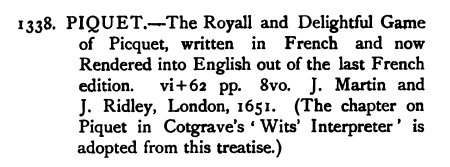
Jessel bibliography

After consulting the bibliographies, I turned next to auction records, private library catalogues, and bookseller catalogues. I found that architect Sir William Tite owned a copy that was auctioned by Sotheby's in May 1874:

Sotheby's catalogue (Google books)

The purchaser was the London bookseller Quaritch for £2 15s. Note the binding description: "tree-marbled calf extra, g. e. by Tuckett." "Extra" would mean extra decorative tooling and "g. e." would mean that the edges of the pages were gilt. And Tuckett was not the publisher, but the binder! Clearly Horr had seen this auction catalogue or the description in the 1877 Quaritch catalogue:

Quaritch catalogue (Google books)

and mangled the description. Typical Horr! Note that Quaritch had only a modest markup on the title from £2 15s. to £3 3s. Compare that to their much larger markup of gaming literature from the 1928 Rimington-Wilson sale. 

Picquet also shows up in the Aldenham Library, described here in an 1888 catalogue:

Aldenham Library catalog (Google books)

Ah, Henry Hucks Gibbs, Lord Aldenham! He has appeared a number of times in this blog, most notably in the essay "From the pen and library of Henry Hucks Gibbs." He was a superb collector of much more than gaming literature and a member of the oldest society of bibliophiles in the world, the Roxburghe Club. 

The description of the Aldenham copy is interesting because it notes that 12 pages on the game of Ombre are bound with it. That book is The Royal Game of the Ombre (1660), a rarity with only one copy known at the British Library. Sotheby's auctioned the Aldenham Library in 1937 and the Picquet/Ombre volume was sold to a bookseller named Edwards for £4. The catalogue is too recent to be available on Google books, but I was provided information from a database of auction prices realized. 

I could find records of no other copies. It seemed possible that the Fox Pointe Manor copy might be the Tite copy, although there are discrepancies in the description (a format of 16mo versus 8mo, for example). It seemed unlikely to be the Aldenham copy, as the catalogue did not mention a book on Ombre bound in. In a perfect world, I would examine the book before the sale, but geography intervened. 

Armed with my research, but no recent sales information, I was ready for the auction. I bid live online against one other active bidder and was successful within the limit I had set for myself. Then the waiting...

The book arrived a week and a half later and I first observed the binding, which is indeed lovely. It is "extra" and the edges are gilt. The "grain" effect on the leather is called tree calf or tree-marbled calf.

Picquet, front board

Looking more carefully at the front pastedown, I find a binder's stamp, "Tuckett Binder to the Queen" matching the catalogue description of the Tite copy. 

Binder's stamp

Indeed, there is a penciled inscription "Tite" on the verso of the front fly leaf, although whether by Tite himself or by, say Quaritch, I cannot say. Other notes include the fact that it was entered into a catalogue and an old sales price of, sniff, three pence.

Tite inscription

Clearly, the Fox Pointe Manor copy is the Tite copy. 

But there is more! Inside is a quite-familiar bookplate, that of the Aldenham Library—the Fox Pointe Manor copy is also the Henry Hucks Gibbs copy!

Bookplate of the Aldenham Library

His signature appears on the flyleaf "Henry H. Gibbs, St. Dunstans, 1878". I recognize the handwriting from other Gibbs books and letters.

Inscription by Henry Hucks Gibbs

The note in Gibbs hand "bought of Quaritch" completes the story. Sotheby's sold the Tite copy to Quaritch in 1874 and Gibbs bought it from Quaritch in 1878.

When I purchased the book, I suspected there might be as many as five copies: the two institutional copies at the British Library and the Folger, the Tite copy, the Aldenham Library copy, and the Fox Pointe Manor copy. I now see that the last three are all the same physical book, now in my collection.

Two things strike me. First is that Sotheby's sold this book three times, but the most recent description was perfunctory, omitting much detail about the book such as the binder, and the provenance. All of that information was more available to them than to me. I suppose they're not willing to spend a lot of time on books in this price range when they sell others for a thousand times as much, but I think the lazy description does the seller a disservice—someone interested in Tuckett bindings or books from the Aldenham Library would never be drawn to this book.

Second, my research into the provenance of this book was atypically backward. Usually one starts with the physical object and observes indicia of ownership in the book. Here, while doing pre-auction research on other copies, I knew who prior owners were, and was delighted to be able to connect them with my book.

Finally, the puzzle. What happened to the rare pamphlet on Ombre that was at one time bound in with this work?  The Tuckett binding from Tite's day is still intact and there is no evidence that I can see of the removal of any text. What happened to Ombre?

I continued my research and found one more data point, another Quaritch catalogue from March 1878:

Quaritch catalogue (Google books)

There are two differences from the earlier listing. First the price is reduced to £2 16s., barely more than Quaritch paid at the Tite auction. Second, the listing mentions Ombre, and indeed is the earliest to do so. So, to complete the chronology, the description in the 1874 Tite sale and the first Quaritch catalogue of 1877 did not include Ombre, while a second Quaritch catalogue of 1878 and all the catalogues of the Aldenham library do include it. Yet it is not present now in what is clearly the Tite/Aldenham copy.

Any solution is speculative. Perhaps the 12 page pamphlet was laid in, rather than bound in, and subsequently become separated. If so, we can only hope it turns up one day. Perhaps the second Quaritch catalogue and all the Aldenham catalogues are all in error, although that seems unlikely. Perhaps Ombre was removed from the book in a way I am unable to detect.

update December 17, 2016:
I checked with the British Library about their copy of Ombre. Perhaps they would have information about the book that would suggest that it was once part of my book. Or perhaps they could confirm that it was not, indicating a second copy of Ombre out there somewhere. They told me that they acquired it by donation in 1978, but have no record of the donor. And that it is unbound. These two data points are consistent with the thought that their copy of Ombre was once part of my book. Or not.
update July 20, 2018:
Today Skinner Auctioneers in Boston auctioned another 200 books from the Fox Pointe Manor Library. Lot 173 was the Ombre book that must have been with my Piquet. It is in a modern binding by Pat Bruno of Davis, California. So the owners of the Fox Pointe Manor copy must have removed the laid-in pamphlet on Ombre and had it rebound. The book sold for $6765.00, sadly more than I was willing to pay to reunite the two books.
update November 29, 2018:
It turns out that the Clark Library at UCLA is the new owner of Ombre, with their catalogue record here. For details of my 2013 research visit there, see my essay "Hoyles at the Clark."
There a final twist to the mystery. As I mentioned in my essay on Gibbs, he wrote a book on Ombre with three editions in 1874, 1878, and 1902, the latter of which he presented to members of the Roxburge Club that year. He made extensive references to historical Ombre literature throughout the book. For example:
Barrington says in his 'Archaelogia' that Ombre was introduced into this country by Queen Catherine of Barganca. We know that she played the game; for Waller wrote an epigram 'On a card that her Majesty tore at Ombre.' This must have been about 1680; but we have an earlier mention of the game in 'Pepys's Diary' under the date of September 1665. [Gibbs. The Game of Ombre, London: 1902, page 3]
The reference to Pepys did not appear in the 1874 or 1878 editions, but did appear in that of 1902. If Gibbs were aware of an even earlier reference in English, particularly from his own library, wouldn't he have mentioned it here?


Ombre remains a mystery, but Picquet, having graced the Tite, Aldenham, and Fox Pointe Manor libraries, has now found a new home. 

Monday, December 10, 2012

Advice to the Young Whist Player

I have mentioned Advice to the Young Whist Player by Thomas Mathews a number of times. In "More Hoyle Collectibles" I shown one of the tokens with quotations from the book, one that is particularly disparaging of Hoyle. In my essay "From the Pen and Library of Henry Hucks Gibbs" I was unable to show a picture of my copy of the rare first edition of 1804 as the book was out for conservation. The book is back in my possession and I'll take the opportunity to discuss the author and his work in a bit more detail. It is the third important book on the game of whist after Edmond Hoyle's Short Treatise (1742) (much discussed in this blog) and William Payne's Maxims for Playing the Game of Whist (1773) discussed here.

In the Gibbs essay, I discussed the first edition of Mathews as follows:
Only two copies of the first edition survive. Mine bears an inscription in Gibbs's hand "Aldenham. 1901. Given me by Julian Marshall." Indeed the provenance is even better, both earlier and later. Julian Marshall bought a copy of Mathews's first, almost certainly mine, at the 1900 Sotheby's auction of books from the estate of Cavendish, whom I have anointed the successor to Hoyle. I purchased the book from the collection of Dr. Albert Ferguson, who wrote a couple of bridge books and put together an important collection of gaming books about which I shall write later. When I look at the Mathews, I see a line from Cavendish to Marshall to Gibbs to Ferguson and then to me.
 The title page and inscription by Gibbs are pictured below. 

First edition (1804)
Levy [1743]


Inscription by Henry Hucks Gibbs


Rather than naming the author, the first edition, printed in Bath by W. Meyler and Sons, purports to be written "by an amateur." I have not seen a copy of the second edition of 1806, but I believe the title page indicates that Thomas Matthews is the author; I can confirm that his name appears on the third edition of 1808. With three editions in four years, you should have the sense that the book was popular. Indeed Jessel's Bibliography of Works on Playing Cards and Gaming (1905) lists 19 Bath-printed editions through 1832 followed by an undated 20th edition. Jessel notes that after the thirteenth edition, the name is always spelled "Mathews" rather than "Matthews." Two more of the English editions are pictured below:

Sixth edition (1811)
Levy [1023]
Eleventh edition (1818)
Levy [1130]

 The book was quickly published abroad. There is an 1812 Boston edition "from the second English edition" and one from New York in 1813 "from the fourth London edition" (although the book was printed in Bath rather than London). Boston bookseller Edward Cotton issued Mathews in two works in 1814. The Whist Players Manual: Containing Hoyle's Payne's, and Matthews' Directions, Maxims, and Instructions for the Game of Whist is a small 75 page book consisting of the whist books of all three authors. The same text and same setting of type appears as the first portion of Cotton's Hoyle's Games Improved. Cotton introduces Mathews work as follows:

Mr. Mathews (London) having published "Instructions to the Young Whist player" which have been very highly approved by good Players, it has been thought expedient to add them to this work, that the student may compare the with Hoyle's and Payne's maxims, and directions, and follow such as appear most reasonable and practical.
Cambridge, MA (1847)
Levy [1456]

Another American edition ("First American from the twentieth London edition") was published by the Cambridge Whist and Chess Club in 1847. Jessel notes an English  provincial edition (Cheltenham: G. A. Williams, 1822) and an edition printed in English in India (Madras: J. R. Hogg, 1825).


Paris (1838)
Levy [1403]
 The book was printed in Paris in 1838 with parallel English and French texts (see title page at left and opening below) with a second edition in 1848.Yes, Mathews Advice to the Young Whist Player was certainly a best-selling book!


Facing English and French text (1838)

Unlike that of Hoyle, we are fortunate to know something of Mathew's life. Emanuel Green delivered three papers with biographies of prominent Bath citizens before the Bath Antiquarian Field Club in December, 1902, and January and February, 1903.

Green (1903)
Levy [1457]


The papers were collected in Thomas Linley, Richard Brinsley Sheridan, and Thomas Mathews, Their Connection with Bath (Bath: Herald Office, 1903). The title page, inscribed by Green is pictured at left.


Much of Green's paper discusses and defends Mathews who was involved in feuds and duels with the Sheridan and Linley families. Rather than dredge up old unpleasantness, I'll focus on Green's comments about Mathews and whist:

Besides his social qualifications he has left a much wider repute, more valued and remembered perhaps than all other adventures or duelling squabbles. Bath during this time was the centre or head quarters for the game of whist and in this game Mathews became the leading spirit and authority, being always referred to for many years in all the first circles at Bath on disputed points in the game. His name is well recalled by all players to-day from his having published a little book entitled--Advice to the young whist player...At the Club established in York Buildings in 1790, and in other card rooms it was always placed ready for reference. (page 77)
Green reproduces a portrait of Mathews, shown at right. We don't have a portrait of Hoyle (see "Hoyle's Scoring Method and Whist Counters"), nor am I aware of any portrait of William Payne. I don't consider General Scott, who's portrait appears as a frontispiece in his 1814 Easy Rules for Whist (see "Eighteenth Century Whist Literature") as a significant contributor to the game. So it is delightful to have a likeness of at least one of the early important whist writers.


Monday, May 14, 2012

Eighteenth Century Whist Literature

Hoyle's 1742 Short Treatise on the Game of Whist was the first book devoted exclusively to the game. I have discussed it extensively throughout this blog, including in this essay. The text was expanded and edited by Hoyle and others well into the 19th century. The second important book on whist was Payne's Maxims, discussed here, with a specimen in fine binding from the library of Henry Hucks Gibb pictured here. In that essay, I mention the third important book, Advice to the Young Whist Player by Thomas Matthews, 1804.

Here I look at three other 18th century books on whist that do not derive quite so directly from Hoyle. The first is Hints to Whist Players by Percival Haslam. It was privately printed in Canterbury. No copies of the first edition are known to survive; below is pictured one of two known copies of the second edition. Haslam died in 1800 and the best guess for the date of publication is about 1790. It is a true miniature book, much smaller than the miniature Scottish Hoyle I have discussed previously. As you can see below, a bookworm has feasted on the adhesive under the gilding. Perhaps I should get it restored.

Haslam cover
Levy [1404]
Haslam title

In 1791, the minor Scottish poet Alexander Thomson wrote Whist, a Poem in Twelve Cantos with a second edition appearing in 1792. This is quite a common book—I suspect that as a poem it was deemed literature rather than a gaming manual, and thus more attractive to academic libraries. The first copy below bears an ownership inscription of J. W. Rimington-Wilson (for another example of a book from his collection see here) and another from A. B. Ferguson, a collector whom I mention here.

Thomson 1791
Levy [1711]

Thomson 1791 provenance

 
Levy [1712]


My copy of the second edition, pictured at right, is in a fine binding from the library of Henry Hucks Gibbs and also comes from the Ferguson collection, but lacks any evidence of Ferguson's ownership.


I'll leave it to others to assess the merits of the poem, and offer but a single quatrain:
What game indeed, of all the num'rous list,
In point of beauty, can compare to Whist?
Or which, of all where gold was ever lost,
So rich a catalogue of charms can boast?
(Canto V lines 27-30)
Okay, a bit more—I cannot resist:
Let all the games that ask but little skill,
Loo, Commerce, Comet, Basset, and Quadrille,
Like twinkling stars that dimly gild the night,
Shrink from the blaze of Whist's refulgent light:
(Canto VI lines 1-4)
The final book derives from Hoyle and from Payne's Maxims and is called The Beauties of Hoyle and Paine; or, A Compendium of Easy Rules Necessary to be Known by Every Whist-Player; with Maxims, By General Scott. London, 1792. The lovely copy below is in its original paper wrappers, and is quite similar to the early 19th century copy of Bob Short on whist, pictured here. The contrast between the fine bespoke binding on the 1792 Thomson and the paper binding of Scott is striking. I appreciate them both, but the bibliographer in me prefers the unsophisticated binding.

Scott.1
Levy [1137]
Scott.1
Levy [1137]

ESTC does not record my edition, but lists a third edition of 1792, a fourth edition of 1796 printed in Barbados of all places, and a fifth edition of 1799, showing only a single copy of each book.

Jessel notes a sixth edition of 1810 and a tenth edition of 1814. My copy of the tenth illustrates another style of binding—drab binder's boards with a printed label. The title has changed to Easy Rules of Whist... and there is a lovely hand-colored frontispiece.
 

Scott.10
Levy [1707]

Scott.10
Levy [1707]


 I believe that the success of Hoyle intimidated other would-be writers about whist. Though Hoyle was issued some 75 times in the British Isles in the 18th century, only Payne, Haslam, Thomson, and Scott managed new titles. It was not until the 1860s that Henry Jones, writing as "Cavendish" (discussed here) emerged as a true successor to Hoyle.

Monday, December 5, 2011

From the pen and library of Henry Hucks Gibbs

I am not the first to collect and studying gaming literature. It is always a special thrill for me to get a copy of a book that belonged to one of the earlier great collections. This essay will focus on one such collector, Henry Hucks Gibbs, Lord Aldenham (1819-1907). Gibbs had a stunning library, of which gaming literature was only a small part. Catalogues of the library were published in 1888 and 1914. ; Sotheby's sold books from the library at auction in 1937 and books turn up in the trade every now and then. A few of them have made their way to me.

Before looking at some gaming books from the Aldenham Library, let us discuss Gibbs as a gaming author. He wrote The Game of Ombre in 1874, with later editions in 1878 and 1902, all privately published.

1874 The Game of Ombre
Levy [1454]
Ombre is a 17th century Spanish card game for three players, which evolved into the four-player game of Quadrille, the subject of a 1744 treatise by Hoyle. About Gibbs's book, bibliographer Jessel wrote:
A full and lucid description of this excellent game. It is a misfortune that the work has never been published, for there is even to-day a constant demand for information on the details of Ombre. (p110)

uncolored proof
(click to enlarge)
As it was privately published every copy I've seen but one has been inscribed by Gibbs to the recipient—and the one without inscription is the most interesting copy of all. It is Gibbs's own copy of the first edition from the Aldenham Library, with many features that distinguish it from other copies of the first edition.  It contains two versions of each of the plates, a colored copy with text and borders such as the one pictured above, and an uncolored proof, such as is pictured at right. Gibbs's copy also contains a proof of an introduction to the second edition and of a supplementary chapter that did not appear until the second edition—an account of Belinda's game of ombre as described in Alexander Pope's Rape of the Lock.

Gibbs inscription
Levy [1178]
Gibbs letter
Levy [1347]


Two inscriptions from other copies are pictured to the left. In the top photograph, Gibbs presents a first edition to Margaret Eliza Adams, while below is a letter from Gibbs to Lady Alwyne pasted into a second edition. The letter discusses obtaining Spanish cards for playing Ombre as well as scoring counters.


Bindings from the
Aldenham Library
Levy [1491] [1701]
[1712] [1454]
Back to Gibbs as a collector—the Aldenham library must have been magnificent. Gibbs generally had the books rebound in gentlemen's Victorian bindings, some of which are pictured at right. From left to right, the books are:
I purchased the two with Morell bindings years apart and from different sources. I was struck to see that they are decorated with the same floral tool in the spine panels.

The books themselves are worthy of discussion. I described Seymour as a predecessor to Hoyle and noted that his section on Ombre (along with that on Piquet) was the earliest set of rules for a card game sufficiently detailed to teach the game. Gibbs undoubtedly consulted this copy of Seymour as he wrote his own book on Ombre. It is also the copy collated by Julian Marshall in his bibliography of the Gamesters (p382). This is certainly one of my most treasured books because of its associations with Gibbs and Marshall.

I have another book with similar provenance, though I cannot picture it here as it is off at the binder's for conservation. The book is Thomas Mathews, Advise to the Young Whist Player, 1804, the third important book on whist after Hoyle and Payne. Only two copies of the first edition survive. Mine bears an inscription in Gibbs's hand "Aldenham. 1901. Given me by Julian Marshall." Indeed the provenance is even better, both earlier and later. Julian Marshall bought a copy of Mathews's first, almost certainly mine, at the 1900 Sotheby's auction of books from the estate of Cavendish, whom I have anointed the successor to Hoyle. I purchased the book from the collection of Dr. Albert Ferguson, who wrote a couple of bridge books and put together an important collection of gaming books about which I shall write later. When I look at the Mathews, I see a line from Cavendish to Marshall to Gibbs to Ferguson and then to me.

Payne's Maxims is the first significant book on whist published after Hoyle's treatise and was incorporated into the Charles Jones edition of Hoyle's Games Improved beginning in 1779. Thomson is a minor Scottish poet, and one can get a taste for his poem from a short excerpt:
Whist, then, delightful whist, my theme shall be,
And first I'll try to trace its pedigree,
And shew what sage and comprehesive mind
Gave to the world a pleasure so refin'd:
The copies of Payne and Thomson are also ex-library Albert Ferguson.

Bookplate of Gibbs
(click to enlarge)
Books from the Aldenham Library are easy to spot as they bear an armorial bookplate with the words "Aldenham House. Herts." I hope I've succeeded in sharing the excitement good provenance adds to collecting. What is most astonishing is that none of the sellers of these books noted the provenance in their catalogues. When the books arrived, the bookplate provided a delightful surprise!

References:
  • Frederic Jessel. A Bibliography of Works in English on Playing Cards and Gaming. London: Longmans, Green, and Co. 1905. Available for download (6MB).  
  • Julian Marshall, "Cotton and Seymour's 'Gamesters.'"  Parts 1 and 2, Notes and Queries, 6th ser., 9 (April 26, 1884):321-3, (May 17, 1884): 381-3. Available for download (70MB).