Thursday, December 8, 2016

2016: The Year in Collecting

Earlier this year, the Book Club of California hosted the annual tour of the Fellowship of American Bibliophilic Societies. I was a panelist for a session entitled "Delights and Dilemmas of Booksellers, Librarians, and Private Collectors."  The dilemma I discussed is one familiar to the long-time collector--I don't find much to buy in my area of interest. The upside is that when I do find something, it's quite delightful. There is a video archive of the discussion on the BCC web site.

With that thought, 2016 was, like 2013, 2014, and 2015, a pretty quiet year in collecting. I've already written about the most interesting books, the Scottish miniature in a slip case and the early English book with the rules of piquet. I have four items to discuss here and will treat them in the order published.

The New Pocket Hoyle (1807)
Levy [1813]
The oldest is a third edition of The New Pocket Hoyle printed by T. Davison for Robert Scholey and others, 1807. Like the first edition, discussed in my essay "Late Hoyles, Early Slipcases", the book was sold in multiple formats, this one in a slip case covered with an engraving dated 1805. It's hard to be 100% sure, but I believe the engraving is identical to the one dated 1802 used in the first edition--the engraver appears to have changed only the date. You can judge for yourself by comparing the picture at right with that in the earlier essay. The New Pocket Hoyle is a relatively common book and was priced accordingly, but it is delightful to find it in a well-preserved case.

Early American Hoyles are much less common. I found the shabby copy of Hoyle's Games pictured below on eBay. It is printed and sold by John Bioren in Philadelphia in 1817. There is a crude tape repair to the spine, but the printed paper covered board has somehow survived. There are only three known copies of this book and I'm only a bit embarrassed to say that I have two of them. Yes, this was a duplicate; perhaps one of my copies will make it to the American Antiquarian Society at some point. They try to collect every early American imprint and tend to be active on eBay. I don't know how they missed this one.

Hoyle's Games, Philadelphia (1817)

Hoyle's Card Games, Glasgow (1826)
Levy [1816]
Astonishingly, I found another delight on eBay. This is a Glasgow imprint of Hoyle's Card Games (1826). The text is the same as the Bath edition of 1824, and I was aware of an 1827 Glasgow edition with copies at Oxford and Louisiana State (in the poker and Hoyle collection of Judge Olivier P. Carriere). The 1826 Glasgow edition was not known anywhere. Alas the book is imperfect, lacking two leaves at the end, but it seems to be the only survival, so I can't much complain.


Gazzetta.Whist.It.1832
Levy [1808]

Finally, a travel story. My family visited Italy and Spain in the Spring. Had I been alone I would have attended the international book fair in Bologna and visited a number of fine book shops in Italy and Madrid. I had different priorities with my family but was pleased to happen upon a shop in Sienna. There I found two gaming books, one of which was a delight. It consisted of four pamphlets in Italian bound together: two on chess, one on the card game of calabrasella, and the last...Hoyle's rules for whist compiled by "Bob Short".


As regular readers may recall, Bob Short is a pseudonym for Robert Withy, about whom I've written frequently. His short rules for whist date to the late 18th century and were reprinted frequently in the first half of the 19th. This Italian edition of 1832 purports to be a third edition. I've tracked down a Florence edition of 1820 which seems to be the earliest, but no sign of a second edition.

Most rare book purchases are online these days. It's a delight to walk into a shop at random and find something that fits so well into my collection. I definitely miss the days when that happened much more frequently!

Monday, November 14, 2016

Piquet, Provenance, and a Puzzle

updated December 17, 2016 with details about the British Library copy of Ombre

updated July 20, 2018 with the puzzle solved. 

updated November 29, 2018 with the location of the puzzle solution.

In 2013, 2014, and 2015, I wrote year-end essays highlighting new acquisitions. I've made sporadic interim updates on particularly noteworthy books: a trictrac manuscript and a Scottish miniature in a lovely slip case. I expect to do a year-end piece for 2016, but just acquired a book so delightful that I couldn't wait to write about it. 
Levy [1817]

Last month in New York, Sotheby's auctioned selections from the Fox Pointe Manor Library. I bought The Royall and Delightfull Game of Picquet (1651), a book I have written about before.

Predating Hoyle by nearly a century, it is the first instructional book on a card game in English. It is instructional in that it provides rules for how to play the two-handed card game of piquet. In 1744 Hoyle wrote the first book of strategy for piquet (mentioned here). I treat the distinction between rules and strategy in parts one and two of an essay on the nature of gaming literature.

The description in the Sotheby's catalogue was sparse:

2016 Sotheby's catalogue entry

I did a great deal of research about the book before bidding. I learned that there were only two institutional copies, one at the British Library (the one digitized for EEBO) and another at the Folger.

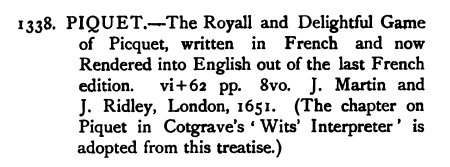
I found the book listed in the two standard gaming bibliographies by Horr and Jessel (see my essay "Where can I learn more about Hoyle's writing?"). The entry in Horr was odd:

Horr bibliography

It's clearly the correct book, but the publisher is not Tuckett, but Martin and Ridley. Then again, Horr had not seen many of the books he described. I know that he did not consult the British Library for his 1892 bibliographyit omits many, many gaming books that were in the library at the timeand the Folger was not established until 1932. So, at least initially, it was unclear how Horr even knew of the book.

Jessel, on the other hand, a Londoner, would have visited the British Library for his 1907 bibliography, and his description is more precise:

Jessel bibliography

After consulting the bibliographies, I turned next to auction records, private library catalogues, and bookseller catalogues. I found that architect Sir William Tite owned a copy that was auctioned by Sotheby's in May 1874:

Sotheby's catalogue (Google books)

The purchaser was the London bookseller Quaritch for £2 15s. Note the binding description: "tree-marbled calf extra, g. e. by Tuckett." "Extra" would mean extra decorative tooling and "g. e." would mean that the edges of the pages were gilt. And Tuckett was not the publisher, but the binder! Clearly Horr had seen this auction catalogue or the description in the 1877 Quaritch catalogue:

Quaritch catalogue (Google books)

and mangled the description. Typical Horr! Note that Quaritch had only a modest markup on the title from £2 15s. to £3 3s. Compare that to their much larger markup of gaming literature from the 1928 Rimington-Wilson sale

Picquet also shows up in the Aldenham Library, described here in an 1888 catalogue:

Aldenham Library catalog (Google books)

Ah, Henry Hucks Gibbs, Lord Aldenham! He has appeared a number of times in this blog, most notably in the essay "From the pen and library of Henry Hucks Gibbs." He was a superb collector of much more than gaming literature and a member of the oldest society of bibliophiles in the world, the Roxburghe Club. 

The description of the Aldenham copy is interesting because it notes that 12 pages on the game of Ombre are bound with it. That book is The Royal Game of the Ombre (1660), a rarity with only one copy known at the British Library. Sotheby's auctioned the Aldenham Library in 1937 and the Picquet/Ombre volume was sold to a bookseller named Edwards for £4. The catalogue is too recent to be available on Google books, but I was provided information from a database of auction prices realized. 

I could find records of no other copies. It seemed possible that the Fox Pointe Manor copy might be the Tite copy, although there are discrepancies in the description (a format of 16mo versus 8mo, for example). It seemed unlikely to be the Aldenham copy, as the catalogue did not mention a book on Ombre bound in. In a perfect world, I would examine the book before the sale, but geography intervened. 

Armed with my research, but no recent sales information, I was ready for the auction. I bid live online against one other active bidder and was successful within the limit I had set for myself. Then the waiting...

The book arrived a week and a half later and I first observed the binding, which is indeed lovely. It is "extra" and the edges are gilt. The "grain" effect on the leather is called tree calf or tree-marbled calf.

Picquet, front board

Looking more carefully at the front pastedown, I find a binder's stamp, "Tuckett Binder to the Queen" matching the catalogue description of the Tite copy. 

Binder's stamp

Indeed, there is a penciled inscription "Tite" on the verso of the front fly leaf, although whether by Tite himself or by, say Quaritch, I cannot say. Other notes include the fact that it was entered into a catalogue and an old sales price of, sniff, three pence.

Tite inscription

Clearly, the Fox Pointe Manor copy is the Tite copy. 

But there is more! Inside is a quite-familiar bookplate, that of the Aldenham Librarythe Fox Pointe Manor copy is also the Henry Hucks Gibbs copy!

Bookplate of the Aldenham Library

His signature appears on the flyleaf "Henry H. Gibbs, St. Dunstans, 1878". I recognize the handwriting from other Gibbs books and letters.

Inscription by Henry Hucks Gibbs

The note in Gibbs hand "bought of Quaritch" completes the story. Sotheby's sold the Tite copy to Quaritch in 1874 and Gibbs bought it from Quaritch in 1878.

When I purchased the book, I suspected there might be as many as five copies: the two institutional copies at the British Library and the Folger, the Tite copy, the Aldenham Library copy, and the Fox Pointe Manor copy. I now see that the last three are all the same physical book, now in my collection.

Two things strike me. First is that Sotheby's sold this book three times, but the most recent description was perfunctory, omitting much detail about the book such as the binder, and the provenance. All of that information was more available to them than to me. I suppose they're not willing to spend a lot of time on books in this price range when they sell others for a thousand times as much, but I think the lazy description does the seller a disservice—someone interested in Tuckett bindings or books from the Aldenham Library would never be drawn to this book.

Second, my research into the provenance of this book was atypically backward. Usually one starts with the physical object and observes indicia of ownership in the book. Here, while doing pre-auction research on other copies, I knew who prior owners were, and was delighted to be able to connect them with my book.

Finally, the puzzle. What happened to the rare pamphlet on Ombre that was at one time bound in with this work?  The Tuckett binding from Tite's day is still intact and there is no evidence that I can see of the removal of any text. What happened to Ombre?

I continued my research and found one more data point, another Quaritch catalogue from March 1878:

Quaritch catalogue (Google books)

There are two differences from the earlier listing. First the price is reduced to £2 16s., barely more than Quaritch paid at the Tite auction. Second, the listing mentions Ombre, and indeed is the earliest to do so. So, to complete the chronology, the description in the 1874 Tite sale and the first Quaritch catalogue of 1877 did not include Ombre, while a second Quaritch catalogue of 1878 and all the catalogues of the Aldenham library do include it. Yet it is not present now in what is clearly the Tite/Aldenham copy.

Any solution is speculative. Perhaps the 12 page pamphlet was laid in, rather than bound in, and subsequently become separated. If so, we can only hope it turns up one day. Perhaps the second Quaritch catalogue and all the Aldenham catalogues are all in error, although that seems unlikely. Perhaps Ombre was removed from the book in a way I am unable to detect.

update December 17, 2016:
I checked with the British Library about their copy of Ombre. Perhaps they would have information about the book that would suggest that it was once part of my book. Or perhaps they could confirm that it was not, indicating a second copy of Ombre out there somewhere. They told me that they acquired it by donation in 1978, but have no record of the donor. And that it is unbound. These two data points are consistent with the thought that their copy of Ombre was once part of my book. Or not.
update July 20, 2018:
Today Skinner Auctioneers in Boston auctioned another 200 books from the Fox Pointe Manor Library. Lot 173 was the Ombre book that must have been with my Piquet. It is in a modern binding by Pat Bruno of Davis, California. So the owners of the Fox Pointe Manor copy must have removed the laid-in pamphlet on Ombre and had it rebound. The book sold for $6765.00, sadly more than I was willing to pay to reunite the two books.
update November 29, 2018:
It turns out that the Clark Library at UCLA is the new owner of Ombre, with their catalogue record here. For details of my 2013 research visit there, see my essay "Hoyles at the Clark."
There a final twist to the mystery. As I mentioned in my essay on Gibbs, he wrote a book on Ombre with three editions in 1874, 1878, and 1902, the latter of which he presented to members of the Roxburge Club that year. He made extensive references to historical Ombre literature throughout the book. For example:
Barrington says in his 'Archaelogia' that Ombre was introduced into this country by Queen Catherine of Barganca. We know that she played the game; for Waller wrote an epigram 'On a card that her Majesty tore at Ombre.' This must have been about 1680; but we have an earlier mention of the game in 'Pepys's Diary' under the date of September 1665. [Gibbs. The Game of Ombre, London: 1902, page 3]
The reference to Pepys did not appear in the 1874 or 1878 editions, but did appear in that of 1902. If Gibbs were aware of an even earlier reference in English, particularly from his own library, wouldn't he have mentioned it here?


Ombre remains a mystery, but Picquet, having graced the Tite, Aldenham, and Fox Pointe Manor libraries, has now found a new home. 

Wednesday, June 22, 2016

Fifth Anniversary: The half-year in collecting

Today marks the fifth anniversary of this blog. Most of my energy is devoted to the descriptive bibliography of Hoyle, substantial portions of which are now online. But I don't want to neglect the blog entirely.

Dundee.1
Levy [1809]


So let me share a recent purchase, a condition upgrade to a book I wrote about in the essay "The Scottish Hoyles (part 2)". It is Hoyle's Game of Whist printed in Dundee Scotland by W. Chambers for booksellers in London, Edinburgh, and Perth. It is the only miniature Hoyle with a text block that is 3 1/8" tall. While my copy was in satisfactory condition, it had been rebound.


The new copy is in near mint condition with the original binding of goldenrod papers and a red leather spine. Interestingly, the binding is different from that of the copy at the National Library of Scotland (pictured in the previous essay), also original. Perhaps each of the three booksellers issued the book in different bindings. Note the crescent of discoloration to the top of the book. Can you identify the cause? 

The discoloration is from the thumb-hole of a slipcase. Yes, this charming miniature was issued in a slipcase! See the pictures below of couples dancing at a ball and a foursome playing at whist. Rather charming, don't you think?


I've written about Hoyles in slipcases a couple of times. First in "Late Hoyles, Early Slipcases" I discuss two examples, one from 1802 and another from 1803. And in "An Epitome of Hoyle, a Discovery, and two Coincidences" I discuss a very early slipcase from the early 1780s.

It is an interesting question why publishers decided to go to the expense of making the slipcases. A comment from the 1803 work suggests that the goal may be to appeal to women:
The proprietors of Hoyle's Games Improved, ambitious of retaining that patronage which those who endeavour to serve or amuse the public generally acquire, have had the whole work carefully revised and enlarged with, as they hope, material corrections throughout; and supposing that the same might with propriety be divided into nearly two equal portions, one calculated for the card table, and most suitable for ladies, the other appropriate to the male sex, as containing games that require stronger exertion or more intense application; the proprietors consequently now first publish, in a convenient size and elegant manner, that part which they trust will prove most acceptable to their fair country-women, intending soon to print the rest in a similar form, so as to give a complete edition of a book containing the most fashionable games, both of skill and chance.
My copy of the Dundee Hoyle made six known copies and it was the only one in the slipcase. However, shortly after I purchased it, another copy came to auction as part of a shelf lot of 19th century bindings. So now there are seven, two of which are in slipcases. Perhaps the seventh copy will appear in the trade before much longer!

Sunday, January 3, 2016

2015: The Year in Collecting

As I did in 2013 and 2014, let me share new acquisition highlights for the past year. The count is five 18th century editions of Hoyle, two from the 19th, and a bevy of other gaming works.

I have already written about two of the non-Hoyles in the essays "The Left Hand of Bougy: A Trictrac Manuscript" and "Le Grand Trictrac". A third book is the 1754 and final edition of The Compleat Gamester, one that I noted plagiarizes substantial portions of Hoyle. I do like the frontispiece by Parr which first appeared in the seventh edition of 1750.

1754 Compleat Gamester
Levy [1806]
1752 Polite Gamester
Levy [1791]


But let's move onto the Hoyles where there are four juicy finds (the fifth was a condition upgrade). I wrote about the Peter Wilson editions of The Polite Gamester in "A Copyright Fight in Dublin". The new acquisition is the second issue, now sitting next to my copy of the rarer first issue. These two are described in my online bibliography here


What distinguishes the first issue from the second? It is the addition of pages 39-46 which were printed after the rest of the book. Note the "finis" at the bottom page of 38 and the continuation on page 39 with "additional cases at whist, never published till 1748."

1752 Polite Gamester pages 38-39

Pigott.1.3 (1796)
Levy [1805]


"The Pigott Hoyles" edited by Charles Pigott were published posthumously and the early editions are quite scarce. The first edition survives in a single copy at the Bodleian. That book was reissued with an addenda and until 2015 I knew only of a copy at the Bodleian. How I came to acquire a second copy is one of those charming collector's stories.


I spent three weeks in Ireland this summer, two with Bibliotours and one doing research at Trinity College, the National Library of Ireland, and Dublin City Libraries (see my essay "Schools for Whist" to learn about their unique Hoyle-related item). During the trip I visited a handful of rare book shops, but found nothing to bring home. A few days after I returned home I got an email from a friend who saw the Pigott Hoyle listed in the catalogue of a Dublin book dealer. Well, the dealer was actually a bit outside of Dublin and did not keep an open shop, so perhaps I can be forgiven for not finding the book on my own. In any case, I do think of the book as a souvenir from my travels.

Pigott.2.1 (1797)
Levy [1796]


I found the next Pigott Hoyle on eBay this year. It is styled a "fourth" edition, but seems to be a second edition which seems to have been published in 1797. Still rare, there are copies at the British Library, Standford, the John White collection at the Cleveland Public Library, and the one pictured at right.


Knapen.Whist.Fr.1770
Levy [1788]


Lastly, a French translation of Hoyle. It is published by Knapen and dated 1770 and appears at the end of a 1763 Académie Universelle des Jeux purportedly printed in Amsterdam without a publisher. That is suspicious--18th century books in French with an Amsterdam imprint were often printed in Paris. The false imprint was intended to evade licensing laws.


There are an uncountable number of mysteries about this French translation. It seems never to have been issued separately from the Académie. A friend also has a copy with a 1763 Académie and it seems to turn up with a 1770 version as well, though this time with a Knapen imprint. But even stranger is that my copy with a 1763 Académie is at least in part different type from that of my friend. Really, one needs to compare all these books side-by-side to figure out what is going on.


Best wishes for 2016!

Wednesday, September 30, 2015

Hoyle Bibliography: technology update (part 3)

For background to this short post, please see part 1 and part 2 of the technology update. I've pretty much finished the work of producing MS Word from my XML files, but my approach is quite different from the one I expected.

I thought the model would be XML->HTML for the web and XML->MS Word for the print version. It turns out to be easier, much easier, to go XML->HTML->MS Word!

To look at the sample file, the HTML version of Whist.3 is here. Below is the translation to MS Word:

(click to enlarge)

Now you'll notice there isn't much in the way of formatting: no borders on the table, no nice margins or spacing, no bold table headers, etc. That's deliberate. One can always add styling later and it can be quite hard to remove if there's too much. What I have done is get all the text rendered correctly: smallcaps, italics, superscripts, etc. And the crazy table with the rows and columns that span cells. 

Other than spanning rows, the hardest thing was managing whitespace. There is a whole section in my XSLT/XPath book on whitespace including a subsection "Solving Whitespace Problems" with subsections "Too Much Whitespace" and "Too Little Whitespace". I had problems with both. It was necessary:

  • to have the XML->HTML transformation use stricter <xsl:output method ="xml"> rather than "=html"
  • to have the HTML->MS Word transformation use <xsl:strip-space elements="*"/>
  • to write a function to "normalize" all text data--that is, collapse consecutive white space into a single space, but allow an initial leading and trailing space.
 Okay, TMI, I know. But I wanted to write it all down so I wouldn't lose it.

There may well be better ways to do this. I found myself frequently at the boundaries of my knowledge. But with a lot of Googling and reading, I've found that many others have been down this path and come up with similar solutions.

OK, enough technology. Back to bibliography!

Sunday, September 27, 2015

Hoyle Bibliography: technology update (part 2)

Another techie update...

In my last essay, I gave an overview of the technology I am using for the Hoyle bibliography. One of the claims I made is that storing the descriptions in a highly-structured format would allow me to render them both on the web and in a word processing document. If truth be told, until quite recently, I had never tested that claim, except on the most trivial data. But now I'm ready to declare success!

To review the acronyms briefly, I am storing each bibliographical description in an XML file. I use another language, XSLT (Extensible Stylesheet Language Transformations) to translate the data into HTML for display on the web. I've always assumed that I could modify the XSLT to translate the data into a MS Word file, but had tested that only for unformatted text. It remained to deal with the annoyances of superscripts, subscripts, italics, tables, etc.

Well, I'm quite relieved to be able to report that everything works! In the last essay, I showed the XML for the collation formula for Whist.3, which is displayed as:

12o: A–D12 E4 [$½ (-A2,B2) signed; missigning B4 as B5]; 52 leaves, pp. [8] [1] 2–96

You can see the full bibliographical description on my website here, rendered as HTML. I wrote a new XSLT program reads the same XML and plops the collation formula into a file that MS Word can read. More on that program in a moment. Here is the output, readable by MS Word:

<?xml version="1.0" encoding="utf-8"?><?mso-application progid="Word.Document"?>
<w:wordDocument xmlns:w="http://schemas.microsoft.com/office/word/2003/wordml">
   <w:body>
      <w:p>
         <w:r>
            <w:t>
               <w:rPr>
                  <w:i w:val="on"/>
               </w:rPr>A Short Treatise on the Game of Whist<w:rPr>
                  <w:i w:val="off"/>
               </w:rPr>, printed for F. Cogan, third London edition, 1743.<w:p/>
               <w:p/>
               <w:t>Collation: 12<w:rPr>
                     <w:vertAlign w:val="superscript"/>
                  </w:rPr>o<w:rPr>
                     <w:vertAlign w:val="baseline"/>
                  </w:rPr>: A–D<w:rPr>
                     <w:vertAlign w:val="superscript"/>
                  </w:rPr>12<w:rPr>
                     <w:vertAlign w:val="baseline"/>
                  </w:rPr> E<w:rPr>
                     <w:vertAlign w:val="superscript"/>
                  </w:rPr>4<w:rPr>
                     <w:vertAlign w:val="baseline"/>
                  </w:rPr> [$½ (-A2,B2) signed; missigning B4 as B5]; 52 leaves, pp. [<w:rPr>
                     <w:i w:val="on"/>
                  </w:rPr>8<w:rPr>
                     <w:i w:val="off"/>
                  </w:rPr>] [1] 2–96 </w:t>
            </w:t>
         </w:r>
      </w:p>
   </w:body>
</w:wordDocument>


All those impenetrable tags beginning <w:....> are the incantations that MS Word needs for formatting.

For the ambitious, you can copy that text into a file and save it as Whist3.xml or some such. Note that the file extension must be .xml. Then launch MS Word and open the file. You should get something that looks like this (click to enlarge):


Notice that I've dealt with paragraph breaks, superscripts, italics, and more. Success!

Not shown in this example are other things I'll need to do: tables, headers, etc. Fortunately, I've solved those items as well. 

Back to the program. The really good news is that there is about an 80% overlap between the XSLT used to translate to HTML and to MS Word. Now that I am learning which parts of the XSLT are the same and which must be customized, I can recode the XSLT a bit more intelligently so that the common 80% is in one file, and the two 20% specializations are in other files.

I can't say I was ever worried about getting my descriptions into MS Word, but it's awfully nice to know it works!

Thursday, September 10, 2015

Hoyle Bibliography: technology update

While it has been ages since I last posted on this blog, I have been monumentally busy with Hoyle. Last November, I announced that I would be starting an online descriptive bibliography of Hoyle. This post highlights the progress I have made, both with content, and with the supporting technology.

Underlying Approach

The bibliography nears a major milestone. I have completed descriptions of all but a handful of the 18th century editions of Hoyle, the task I had originally contemplated. Inevitably, my scope has expanded, and I’m well into the 19th century. It is difficult to find a graceful stopping point. In addition to the content, the bibliography is a significant and apparently unique effort in the digital humanities. So far I have created 170 bibliographical descriptions, storing each in a file for validation, processing, and display. The programming effort has been substantial and is ongoing, but continues to pay for itself many times over. This blog essay discusses the technology I have developed in the course of compiling the Hoyle bibliography.

My primary goal was to create bibliographical descriptions of the books that could be presented in multiple ways—initially as a web site and then in a word processing document leading to print publication. I expect that others will be able to extract data programmatically from my descriptions if  desired—perhaps a library wishes to update its catalogue or a collector wishes to build a checklist. This goal, one data source with multiple presentations, dictated storing the descriptions in a highly-structured way.

A second goal was to avoid errors and inconsistencies in bibliographical descriptions and their presentation. As to the descriptions, collation formulas and pagination statements should total to the same number of leaves. Deletions and signing errors should refer to leaves actually in the collation formula. Signature references and page references should point to the same page. I have seen each of these errors in printed bibliographies—mistakes are inevitable. Formatting is equally error prone. Fredson Bowers’ Principles of Bibliographical Description is the standard for descriptive bibliography, including the collation formula and pagination statement. Bowers requires dexterous use of brackets, italics, commas, semicolons, superscripts and subscripts. Proofreading is hardly...foolproof. It seemed as though there should be better solutions.

The desire to avoid errors led to the same design decision suggested earlier, highly structured data. Following other digital humanities projects, particularly TEI (about which more below), I chose XML as an underlying technology. A brief excerpt from one of my book descriptions will show how structured XML data can reduce error. Consider Whist.3 (my description is online here), which has one of the simpler collation formulas:

12o: A–D12 E4 [$½ (-A2,B2) signed; missigning B4 as B5]; 52 leaves, pp. [8] [1] 2–96

The data used to produce the collation formula is:

        <collation>
            <format>12</format>
            <collationFormula>
                <gatherings>
                    <gatheringRange signed="true">
                        <sigStart>A</sigStart>
                        <sigEnd>D</sigEnd>
                        <leaves>12</leaves>
                    </gatheringRange>
                    <gatheringRange signed="true">
                        <sigStart>E</sigStart>
                        <leaves>4</leaves>
                    </gatheringRange>
                </gatherings>
                <signatureLeaves>$½</signatureLeaves>
                <anomSignatures>
                    <anomSignature>
                        <anomType>-</anomType>
                        <sigRef>A2</sigRef>
                    </anomSignature>
                    <anomSignature>
                        <anomType>-</anomType>
                        <sigRef>B2</sigRef>
                    </anomSignature>
                </anomSignatures>
                <signingErrors>
                    <signingError>
                        <sigRef>B4</sigRef>
                        <badSig>B5</badSig>
                    </signingError>
                </signingErrors>
            </collationFormula>
            <totalLeaves>52</totalLeaves>
            <pagination>
                <pageRanges>
                    <pageRange numbered="false" range="true">
                        <start>8</start>
                    </pageRange>
                    <pageRange numbered="false">
                        <start>1</start>
                    </pageRange>
                    <pageRange numbered="true">
                        <start>2</start>
                        <end>96</end>
                    </pageRange>
                </pageRanges>
            </pagination>
        </collation>

XML is a hierarchical structure: elements have values (the book's format is 12, a duodecimo) and attributes have values (page 1 is unnumbered, pages 2-96 are). Everything is text and therefore readable by humans, particularly when indented in an outline form that reveals the structure. In the example above, the collation consists of format, collation formula, total leaves, and pagination. The collation formula consists of gatherings, signature leaves (indicating normal signing), and anomalous signatures. Each gathering range within the gatherings has a starting signature (sigStart), an optional ending signature, and a number of leaves. A gathering range may be signed or unsigned. The pagination section is similar. More complicated books will use other optional elements.

How does this encoding help avoid error? First, the data it is validated against an XML schema I created. The schema is formal description of the rules for describing a book. The schema requires elements such as collation, collation formula, signature leaves, etc. The element anomalous signatures is optional, as are elements for signing errors, duplicated signatures, doubled alphabets, insertions, deletions, and free form notes. Failure to include a required element or inclusion of an unexpected element will generate an error.

Moreover, the XML schema restricts each element as to allowed types values. For example format is limited to a small set of values such as 8 for octavo, 12 for duodecimo, etc. Entering 13 into the format field will generate an error. The schema is rather complex, but does an admirable job of preventing errors.

One might expect that all of the tags, required structure, and rules for allowed values would add substantial effort when inputting data. Indeed the above snippet of XML for Whist.3 is much more verbose than the collation formula. Surprisingly, there is much less data entry. Much less. Modern tools will read the required structure contained in the XML schema, insert most of the tags, and suggest allowed values for the data. Most of the typing is done for you. And as we shall see below, you don’t have to worry about brackets, italics, superscripts and the like—that is handled elsewhere.

Once the data is structured and individual elements are known to have valid values, it is possible to check them for internal consistency. For example, I have written a program to read the collation formula statement, count the number of leaves it implies, and compare it with the element signature leaves, flagging any discrepancy as an error. Similarly, the pagination statement implies a total number of pages that is expected to be twice the number of leaves. In the example above, there are four gatherings of 12 leaves and one of 4, totaling 52 leaves and 104 pages. Check.

Much more validation is possible. For example, I give references in terms of both signature and page, such as A5v–E4r (2–95) for a range or E4v (96) for a page. Once we are certain that the collation formula and pagination statements are consistent, we know the page number for each leaf. I was able to write a program that verifies that leaf A5v is page 2, E4r is page 95, and E4v is page 96. It is no exaggeration to say that the program has detected hundreds of errors. Perhaps thousands. By entering both the signature and page reference, I have to make two errors that are consistent with one another before mistakes of reference appear in the bibliography.

I only wish there were a similar way to validate quasi-facsimile transcription!

XML works with another language called XSLT (Extensible Stylesheet Language Transformations) to render XML in other formats such as text or HTML. It is an XSLT stylesheet that transforms the collation as expressed in XML into Bowers format. All the “knowledge” of Bowers' rules is in one program. As a result, when entering the collation for a book, I do not have to type brackets, italics, or superscripts—a major time saving for data entry.

An amusing example demonstrates the strength of the approach. At Rare Book School, I learned to describe signing errors by saying “missigning B4 as B5”. Bowers prefers “misprinting B4 as B5” and has no objection to quoting the erroneous signature, writing “misprinting B4 as ‘B5’”. (See Bowers p270). Regardless of which is preferred, I can change the output for all 170 book descriptions by making a minor change to one XSLT stylesheet and not all 170 descriptions. Neat!

A third goal was to automate the production of indices for the bibliography. The top-level index classifies works as (a) separate works; (b) publishers’ collections of works published separately; and (c) collected editions. It is produced programmatically. Other programs produce other indices:
  • An index of short titles and short imprints
  • A chronological list of all editions and issues
  • A list of games and subjects treated in Hoyle with a chronological list of books for each game or subject
  • An index by publisher or printer
  • A list of institutions holding copies of Hoyle (see here, for example, for libraries in the British Isles) and the books held at a given library (for example, the Bodleian, which has the largest collection of Hoyles in the world)
  • Lists of Hoyles in each of the standard gaming bibliographies, such as Horr, Jessel, and Rather and Goldwater.
Each time I add a new bibliographical description, I can regenerate all of the indices and indeed the entire website by running one program.

The final goal is perhaps the most ambitious—to develop a platform that other bibliographers can use. I have no intention of turning the technology into a commercial product, and have built it with laser-like focus on my needs rather than as a general solution to bibliographical description.  I would expect, however, that hobbyist programmers familiar with the technologies I used should have little difficulty extending it to their needs. I would be eager to hear from anyone who is interested.

Afterword: A Note on Technology

I initially explored the Text Encoding Initiative (TEI) as a way to encode book descriptions. I found that, as the name suggests, the standards were focused on encoding text and other contents, rather than encoding characteristics of the physical book. A TEI Work Group on physical bibliography made a good start at encoding a collation statement, but their work did not proceed to completion and did not become part of a TEI release.  I used theirs as a starting point for my own work. 

I am using early and well-supported versions of products in the XML suite: XML 1.0, XML Schema 1.0, and XSLT 1.0 (including XPath 1.0). While there are some attractions to using later versions, they are not always supported by browsers, and I wanted the web version to work with Firefox, Chrome, Internet Explorer, and Safari, not all of which support more recent versions of XSLT and XPath.

I use oXygen XML Editor 17 as an XML development environment. It is an awesome tool and I fear that I am only using a fraction of its capabilities.

Where I need to insure consistency of the book descriptions beyond what XML Schema provides, I write programs in Python 3.4. Python also creates the various indices I described earlier. Python is a general purpose programming language that excels in handling text and has excellent libraries for reading and writing XML files.