In part 1 of this
essay, I presented a puzzle.
The London Morning Post of January 3, 1794 contains an advertisement for three books by the pseudonymous "Bob Short", a strong suggestion that all three were written by one person. Yet, the books on whist and quadrille are reliably by Robert Withy, while the third,
The Religion of Nature, is attributed to the dissident poetess Anna Letitia Barbauld (née Aikin). As a result the gaming books are sometimes attributed to Barbauld as well. Let us try to sort this out.
I got a digital copy of The Religion of Nature and learned that the text was first published anonymously as a letter to the editor of the
Morning Chronicle of November 29, 1793:

It was reprinted with an introduction (about which more later) as
The Religion of Nature, A Short Discourse, Delivered before the National Convention at Paris by Mons. le Curé of ———, still without attribution to Barbaud. This is the book that was advertised with
Whist and
Quadrille by Bob Short.
What is the basis for the attribution to Barbauld? I borrowed some
of the many texts on Barbauld from the library and consulted a number of
reference works on pseudonyms, but did not learn why Barbauld is given as the author. I then
posted a query to the rare book listservs,
Exlibris-L and
SHARP-L and got a number of useful pointers. Professor William McCarthy pointed me to his
biography Anna Letitia Barbauld, Voice of the Enlightenment, Baltimore Johns Hopkins University Press, 2008.
There I learned that the text of
The Religion of Nature was reprinted under two more titles. First, it appeared as
The Patriotic Clergyman in the early 19th century in a number of chapbooks and miscellanies. I checked WorldCat and Google Books and located many editions:
- The Charms of Literature, Newcastle on Tyne: J. Mitchell, 1800. A 36 page chapbook with illustrations by Bewick containing The Patriotic Clergyman.
- The death of Rousseau, an interesting story ... : to which is added, the patriotic clergyman. Newcastle on Tyne : Printed and sold by J. Mitchell, nd.
- The Charms of Literature, Newcastle on Tyne: J. Mitchell, 1805. A 434 page miscellany available from Google.
- The interesting story of Montford, or, the generous man: Together with the death of Rousseau; The military mendicant ... by ... C.I. Pitt ; The victim of dishonour ; and The patriotic clergyman, by Mrs. Barbauld. Newcastle on Tyne: Printed. by J. Mitchell, 1806.
- Interesting stories : containing, The military mendicant. Female heroism. The patriotic clergyman. Edinburgh : Printed for the booksellers in town and country, 1815.
- The Intelligent Reader: Designed as a sequel to The Child's Guide. Springfield: Merriam, 1847. A 252 page children's reader available from Google and containing Clergyman.
Undoubtedly, many, many more reprints exist.
Some of the reprints attribute the piece to Barbauld—the section title of the first is pictured below. The text is the same letter originally published in the
Morning Chronicle with a new first paragraph. It is "attributed" to Mrs. Barbauld; in the 1806 edition the title page indicates the piece to be hers. These are not, however, convincing attributions. How did the publisher identify Barbauld as the author?
It is the two-volume set
The Works of Anna Laetitia Barbauld, London: Richard Taylor, 1825 (available from Google, volumes
one and
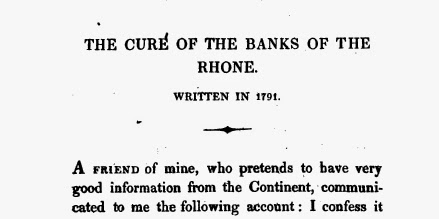
two) that makes the attribution certain. It was compiled by Barbauld's niece Lucy Aikin who had access to a great deal of private material about her aunt. The letter appears in volume two, pages 260-7, under yet another title,
The Curé of the Banks of the Rhone, with the notation that it was written in 1791. The text matches that of the letter to the
Morning Chronicle.
With the appearance of the letter in her niece's collection of Barbauld's works, I accept the attribution and am left with the need to explain the advertisement consisting of Withy's gaming books along with Barbauld's letter.
The explanation is, I'm afraid, rather prosaic. Let us return to
The Religion of Nature, the work causing all the confusion. Pictured below are the title page and introduction for the copy at the University of London Goldsmiths' Library. What I am not showing is a handwritten annotation on the front fly leaf "by Anna Letitia Barbauld", another attribution without evidence.
 |
| Religion, title page |
 |
| Religion, Introduction |
The title page indicates that the "short discourse" was delivered by "Mons. le Curé of ———" and it is "the short address to the jurymen of Great Britain", that is the introduction, that is by "Bob Short". The former is Barbauld and the latter must be Withy. Note the annotation "Withy" next to the name Bob Short on the title page. I am not the first to reach this conclusion, although I hope mine is better documented.
 |
Quadrille, introduction
Levy [1757] |
The introduction is signed Bob Short at Baker's Coffee-house, December 22, 1793. This is just as he signed the introduction to
Quadrille, pictured at right: Baker's Coffee-house, January 1, 1793. I wish I could see a physical copy of
The Religion of Nature. From the reproduction, it appears quite similar to the contemporary copies of
Whist and
Quadrille
I have seen. All have an oblong format and the type and layout appear
similar.
Indeed, Withy carried on his trade at the coffee house:
...Robert Withy...transacts as usual, all the branches of this business, and attends at Baker's Coffee-house, Change-alley, every day from one to three. (Morning Herald, October 23, 1799)
The conclusion is that Withy wrote the introduction to Religion as "Bob Short" while Barbauld wrote the text. My strong suspicion is that Withy, a former seller of books and
prints, published all three pamphlets, explaining the advertisement linking all three books. We can say with certainty that Robert Withy and not Anna Letitia Barbauld was the author of
Whist and
Quadrille.
Establishing that fact was my primary goal although I greatly enjoyed
the detour provided by Barbauld. She was a remarkable woman—dissident,
poet, educator and more.
Professor McCarthy left me with some interesting questions about Withy and
The Religion of Nature:
Did Barbauld know Robert Withy? Why did he reprint this piece from the [Morning Chronicle]? Did he know who wrote it, or did he reprint it because he agreed with it? Or did he reprint it because he cared about the plight of the Spitalfields silk-weavers?
I cannot answer these questions, but perhaps some readers can help?
If you're still not convinced about Withy's authorship of
Whist and
Quadrille, stay tuned for a brief part 3 coming shortly!




 Posts